King's College Chapel, Cambridge
King's College Chapel, Cambridge
Jake Davies

The chapel at King's College in Cambridge is a stupendous architectural marvel and is often used as an icon of the ancient university town.
For any visitor to Cambridge it is the one sight that should not be missed.


History
King's College was established by Henry VI (1421-1471) in 1441, and he personally laid the foundation stone for the chapel in 1446 as well as specifying the dimensions of the structure.
The architect is believed to have been Reginald of Ely. However, construction was halted due to the Wars of the Roses (1455-1487), or rather because of the diversion of funds to fight the wars.
Construction did continue under Richard III (1452-1485), but it was Henry VII (1457-1509) who funded the completion though the building was not finished until 1544 during Henry VIII's reign.
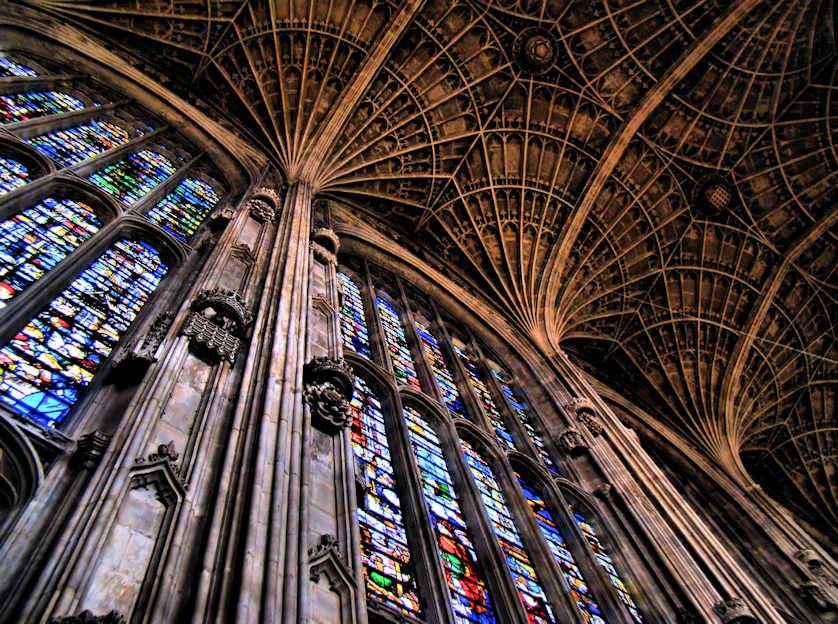
Interior
The chapel is constructed in Perpendicular Gothic style, a form of architecture that was unique to England and that would be revived in the 18th century.
As the name suggests, height is accentuated, and a phrase commonly used to describe King's College Chapel is "gravity defying".
A perfect example of this is the ceiling that soars 80 feet above the floor and the visitor. It is a fan vault type ceiling, unique to England, and the one in King's College Chapel is the largest in the world. Amazingly it was built in just three years by master mason John Wastell.

The interior of the chapel is also surprisingly light due to the large amount of stained glass windows.
On each side of the chapel in the 12 bays are stained glass windows extending to the ceiling, and both the east end and the west end of the chapel has much wider "Great Windows".
Most of the stained glass was done by Flemish artisans and was completed in the early 16th century. All the stained glass was removed during World War II and stored safely. The Great West Window is a more recent addition being installed in 1879.
Much of the intricately carved woodwork was funded by Henry VIII, and the magnificent screen between the ante-chapel and the choir features his initials entwined around those of Anne Boleyn. It was made by Peter the Carver, as were the choir stalls.
The altarpiece is a modern addition. "Adoration of the Magi," painted by the Flemish Baroque painter Peter Paul Rubens in 1633 to 1634, was originally created as an altarpiece for a convent in what is now Belgium.
In the late 18th century it was sold and after passing through the hands of several British owners was donated to King's College and put on display as an altarpiece in 1968.
It is believed the chapel originally had two small organs, but in 1605 Thomas Dallam was given the order to construct a new organ and he closed his factory in London and brought all his workers to Cambridge for this important project.
Decades later the pipes were moved to their current position above the screen. The organ has been rebuilt and even expanded numerous times since then. The acoustics of the chapel are considered especially fine and the organ and choir regular perform for audiences and recordings.

Information
King's Parade
Cambridge CB2 1ST
Tel: 01223 331212
www: kings.cam.ac.uk/chapel
The chapel is a 30-minute walk from Cambridge Station. Alternatively, take a 1citi or 3citi bus up Regent Street from stop 6 at the station.
Great St. Mary's University Church, another beautiful church, is virtually next door.

Accommodation
If you wish to stay in Cambridge there are several recommended options. These include the three-star Holiday Inn Express Cambridge, the three-star ibis Cambridge Central Station and the four-star Ramada Cambridge, a 20-minute drive from the centre.
See here for a listing of hotels and guesthouses in Cambridge.

Cambridge Access - Getting To Cambridge
Cambridge Station is over a mile south east of the city centre off Hills Road. The number #3 bus runs into town to Emmanuel Street. Long distance buses leave from nearby Drummer Street bus station.
Cambridge Station has rail services to Liverpool Street Station in London via Tottenham Hale and Hackney Downs. The "Cambridge Cruiser" travels non-stop between London King's Cross and Cambridge with slower trains stopping at Finsbury Park Station (which has connections to the Piccadilly & Victoria tube lines), Stevenage, Hitchin, Letchworth Garden City and Baldock.
Other local lines from Cambridge run to King's Lynn, Ipswich and Norwich.

CrossCountry connects Cambridge to Birmingham New Street Station in Birmingham and to Stansted Airport via Leicester and Peterborough.
By car Cambridge can be reached by the M11 motorway or A14.
It's definitely worth renting a car if you want to get to some of the more off-the-beaten track places in East Anglia and out to the Wash and Hunstanton, a quaint Victorian resort on the coast.
Cycling is a good way to get around Cambridge and there are cycle hire outlets all over town. Do take care to lock your bike securely.
Cambridge Related
Cambridge Map

Hotels in Cambridge
Cambridge Accommodation - Booking.com
Book Hotels in England - Booking.com