Exeter Guide
Exeter is the county town of Devon and its largest urban area with a population of around 120,000. Exeter is particularly famous for its impressive cathedral and well-regarded university.


Exeter History
Exeter as a city dates back to Roman times and the building of a Roman fortress in AD 55. The Norman castle dates to 1068 and Exeter Cathedral to 1108.
During the Medieval period of English history, the town's relative wealth was based on the wool and cloth trade.
The town remained a prosperous market town into the Georgian period. Unfortunately, Exeter was badly damaged in World War II, losing several of its historic buildings. Nowadays, Exeter has an easy-going, small town feel and is considered one of the best small towns to live in the United Kingdom.

Exeter Attractions
Exeter's main attractions include its beautiful St Peter's Cathedral and the surrounding Cathedral Close and lawns, the Guildhall, the Quayside and Exeter Canal.
Exeter Cathedral
Set between the lovely streets of Cathedral Close and Cathedral Place and fronted by a grassy square, the Cathedral Church of St. Peter was begun in 1114 by the Normans and the sturdy, rather squat cathedral towers date from Norman times.
The cathedral was remodelled in a decorative Gothic style over a century beginning in 1270 by Bishop Walter Bronescombe. Influenced by the architecture of nearby Salisbury Cathedral in Salisbury, the church was built using local stone, including Purbeck Marble.
The interior of the cathedral features the magnificent Bishop's Throne which is 18 meters tall. The cathedral in Exeter is equally well known for its ceiling or "vault" which was designed as a vision of heaven. This vault extends for 96 meters and is the longest of its kind anywhere in the world. This style of vaulting is called "tierceron".

The Quay
Exeter Custom House on The Quay dates from 1681, and is reputed to be the country's oldest custom house in existence. The building was still used by HM Customs and Excise until 1989.
The historic area of red stone warehouses, pubs, antique shops, teahouses and cafes has been transformed into one of the city's liveliest districts.
Other places to see are St Nicholas Priory, a 900 year old priory, the Rougemont Castle and Gardens and the Royal Albert Memorial Museum.
Rougement Castle was built by William the Conqueror after a rebellion in Exeter in 1068 AD. The castle's place in history is scarred by its association with witchcraft trials and the last four witchcraft-related executions in the history of England.
The Royal Albert Memorial Museum (RAMM) has a diverse collection including antiquities, coins, decorative and fine art, costuumes and fabrics as well as natural sciences.
St Nicholas Priory is the city's oldest building. It began as a Medieval Benedictine priory becoming a Tudor home after the Dissolution of the Monasteries.
Another historical sight in Exeter are the Underground Passages. They date from the 14th century and were originally built to bring clean drinking water through lead pipes to the city from natural springs outside the walls.
Visitors can enjoy guided tours of these fascinating passages which are the only remaining examples of their kind in the country. The tours begin with interactive exhibits in the interpretation centre on Paris Street in Princesshay. (2 Paris Street, Exeter EX1 1GA; Tel: 01392 665887).

Guildhall
Exeter Guildhall on the High Street is said to be the "oldest municipal building in England still in use." It dates from the late 15th century with a portico added in the late-16th century. It was under this beautiful granite and Beer stone portico that Exeter's stocks used to be. Here too Judge Jeffreys held one of his infamous Bloody Assizes in 1685. The Victorian interior is lavish with wooden panelling, large classical paintings and chandeliers. A Grade I Listed building, the Guildhall is still in use as a civic office for meetings and official receptions.

Picturesque Villages
The city makes for an excellent base to explore nearby Dartmoor National Park. There are also several picturesque villages on the Exe Estuary such as Exmouth, Teignmouth, Topsham, and Dawlish which can be visited by bus or train from Exeter. Also nearby are Ottery St. Mary, birthplace of the poet Coleridge and to the east the beaches at Beer, Seaton and Lyme Regis.
Historical Homes
Within easy reach of the city by car are several historical homes. These include Killerton House, Powderham Castle and Castle Drogo.
Killerton in Broadclyst was built in 1778-9 as a home for the Acland family, one of Devon's oldest families. In 1944, Sir Richard Acland "gave away" Killerton to the National Trust and used the proceeds to further his political beliefs. Sir Richard Acland was a devoted socialist and one of the founders of the British Commonwealth Party.
Castle Drogo near Chagford and Drewsteignton in Dartmoor, was the last castle to be built in England.
Designed by Sir Edwin Lutyens, who built much of British New Delhi in India, and the Cenotaph in London, Castle Drogo was constructed, mostly in granite, between 1911-1931.
Now a Grade 1 listed building administered by the National Trust, Lutyens designed the granite castle as a country home for millionaire Julius Drewe, who had made his fortune from his empire of general food stores.
Powderham Castle, located in the Exe Estuary south of Exeter, is one of the south west's finest castles.
Powderham dates originally from 1391. Built by Sir Philip Courtenay, today it belongs to the 18th Earl of Devon so the house has been in the hands of the Courtenay family since the start.
Powderham Castle offers one-hour guided tours, a gallery, gift shop, tea room and a deer park. The castle rooms may also be hired for wedding receptions and as a film location.
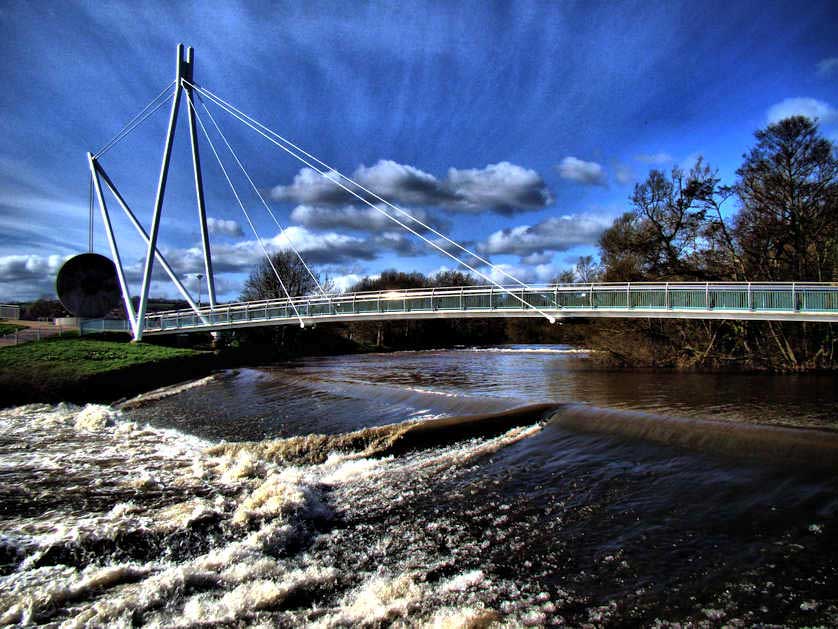
A short walk from Exeter St David's Station or the cathedral is Miller's Crossing Bridge near the Mill on the Exe pub on Bonhay Road. The most interesting feature of its design is the anchor to which the cables attach. This is in the shape of two large, circular millstones, a reference to the many mills that formerly operated along this stretch of the river.


Exeter Shopping
Exeter's main shopping street is High Street with the usual department stores and shops found on high streets throughout the country.
The Princesshay and Guildhall shopping centres are new retail developments.
Stroll Gandy Street for more independent shops selling furniture and fashion. On Fore Street Mansons Guitar Shop and The House of Hope and Mercy in the Jungle are two recommended independent stores.
The Exeter Farmers' Market takes place on Fore Street every Thursday from 9 am - 2 pm.

Exeter University
The university in Exeter is set on a pleasant, hilly campus north of Exeter St. David's Station. A Sculpture Walk contains pieces by Henry Moore and Barbara Hepworth. The town's largest theatre, the Northcott, is also here. Past alumni include Harry Potter author J.K. Rowling and musician Thom Yorke.
The Bill Douglas Cinema Museum on the Streatham Campus is also definitely worth a visit for film buffs. The museum's diverse collection has exhibits from the seventeenth century to the present, including Peep Shows, kaleidoscopes, cinema programmes, lobby cards, movie posters and books.

Exeter Hotels
Exeter's hotels are mostly congregated around Exeter Cathedral and Cathedral Close.
Choose from a range of hotels and guest houses in Exeter including the four star Mercure Exeter Southgate Hotel, the four star Southernhay House Hotel, and Jurys Inn Exeter, also a four star hotel.
See here for a complete list of accommodation in Exeter.
Exeter Access - Getting To Exeter
Exeter is located at the end of the M5 motorway coming south from Bristol.
Exeter's main railway station is Exeter St David's Station with rail links to Bristol, Birmingham and London Paddington Station as well as on to Plymouth. Local trains run south from Exeter St David's to the Victorian seaside resort of Exmouth.
Exeter International Airport, just 5 miles to the east of Exeter city near Clyst Honiton off the A30 has regular domestic flights to Aberdeen, Belfast, Edinburgh, Guernsey/Jersey, the Isles of Scilly, Leeds Bradford, Manchester and Newcastle. International destinations include Alicante, Amsterdam, Dubrovnik, Dublin, Faro, Funchal, Geneva, Hannover, Larnaca, Nice, Palma, Paris, Malaga and Salzburg.
Local Buses
There are bus services from the new bus station at St Sidwell's Point leisure centre to Monkerton and Duryard Hall at Exeter University, Sowton (H1), Exeter High Street (H2) and (M), Barnstaple (155) & (315), Bude (6) & (6A), Chulmleigh (5), Clyst Honiton (4), Crediton (5), Great Torrington (51), Cowleymoor (55 & 55A), Tiverton (155), (55B) & (55C), Exmouth and Exeter Airport (56) & (56A), Colaton Raleigh (57C), Morchard Bishop (369), Salcombe (X64), Witheridge (678), Wonford (X38).
The 510 Western bus runs from Exeter Bus Station and Exeter St David's Station via Okehampton, Wadebridge, and Camelford to Launceston and Newquay in Cornwall in about 3 hours and 15 minutes, a distance of around 83 miles (134 km).
Exeter Map

Hotels in the South West of England & Wales
Book Hotels in Bath - Agoda.com
Find Hotels in Bradford on Avon - Booking.com
Search Hotels in Cardiff - Booking.com
Recommended Hotels in Exeter - Agoda.com
Book Hotels in Salisbury - Agoda.com
Hotels in London - Booking.com
Hotels in England - Booking.com
Bath Hop-On Hop-Off Sightseeing Bus (Open Top)
The Hidden Cotswolds and The Making of England Day Tour from Bath