Books on Wales
Read a series of book reviews of books on Wales. Find books on Welsh culture, history, food, people and politics.
Welsh Legends & Myths

By Graham Watkins
Lulu Press Inc, 2018
ISBN 10-1291985271
284 pp, paperback
After scouring hundreds of Welsh legends and myths, author Graham Watkins has come up with 80 of what he considers the best and most interesting. The 80 legends come from different locales in Wales. The cast of characters includes a lot of kings and king wannabes, a lot of kings' daughters looking for love, a lot of paupers looking for kings' beautiful daughters (hint: they'll need a lot of money), with some barons, travelers, ghosts, mermaids and ordinary folks mixed in.
Although the chapters are all short, this is not exactly a book for children, like an Aesops Fables would be. There are plenty of head choppings, vengeful ghosts, rapes, adultery, and dismembered bodies to go around. There is a lot of hardship in the book, which reflects the hard lives and violent past of the people of Wales.
If you are expecting morals to the story, you can forget about those, too. One story was little more than "quintuplets boys were born, they went on a journey and all of them died."
The first thing to get used to is Welsh names and words. Chapter titles include Tylwyth Teg, Y Bugail Unig, The Ogre of Abergavenny, and The Gwiber of Penmachno.
A lot of entertaining Welsh history can be learned from this book, although it is at times difficult for the reader to differentiate between actual myth and actual history. A reader might think a story is complete myth, then find that the castle, for example, mentioned in the story is an actual castle that is still standing, and the protagonist was an actual historical figure.
One of the more thought-provoking stories is about Prince Madoc, a Welsh explorer, who is believed by some to have landed on Americas East Coast in the year 1170. Then, in 1608, an explorer named Peter Wynne is said to have discovered an Indian tribe in Virginia calling themselves Monacan Indians, a tribe which Wynne claims spoke "Welch."
Further research shows that in an 1804 letter, then U.S. President Thomas Jefferson wrote of searching for Welsh Indians, "said to be up the Missouri (River)."
Interestingly, in the introduction, the author mentions his "licence to embroider." He writes, "I admit that I had a lot of fun adding my own interpretation to some of the tales." In other words, he has changed some of the stories from more original versions.
This book was previously published in five volumes and named Legends and Myths from Wales.
If you are a "Cambrophile" and already well-versed in Wales and its history and culture, you will almost certainly enjoy this book. If you are a complete Wales neophyte, you can enjoy this book if you have an open mind.
Marshall Hughes
Buy this book from Amazon USA | UK | Japan
Wales, the Welsh and the Making of America

By Vivienne Sanders
University of Wales Press, 2021
288 pp, paperback
ISBN: 978-1-78683-790-5
Covering the history of the outsized contributions of the Welsh to the establishment and growth of America, author Vivienne Sanders starts at the beginning - with the first arrival of the Welsh to America - claimed by some to predate Christopher Columbus by almost 325 years.
There is evidence, albeit, shall we say, less than fully confirmed, that Welshman Prince Madoc came to America in the year 1170, landed in present day Alabama and started the Madoc Indian tribe - who, of course, spoke Welsh.
Some believers in this Madoc Indian theory included President Thomas Jefferson, who instructed the famous explorers Lewis and Clark to find the Madoc Indians, and a number of Indians themselves, including the Zuni Indians of Arizona and the chief of the Cherokee, Oconostota, who both claimed Welsh ancestry.
From there, the book moves on to sections on how critical the Welsh were in the colonization of North America, the American Revolutionary War, the Civil War, the spread of America to western lands and the industrialization of America.
Sanders also discusses some of the most influential Welshmen in American history, including five of the first six presidents (plus other, later presidents), William Penn, the aforementioned Meriwether Lewis of Lewis and Clark fame, Benjamin Franklin, Frank Lloyd Wright and the under-appreciated Richard Price among others.
Ivy League schools Yale, Brown and Princeton were all started or greatly advanced by Welshmen, often in the name of Christianity. Those that know what is the current state of Yale is will find it is hard to fathom Yale having Christian roots, yet that is the history.
It should be noted that Sanders is not an apologist for the Welsh. Some low lights are covered, too. Many ethnic groups tend to overestimate their contribution to America's founding, but since there were so many Welsh to come early in the country's history, that is probably not the case here.
Almost as interesting as the stories of famous Welsh and their contributions to America are the short sidebars which are often quite interesting. Some examples of these include:
- President James Garfield, whose Welsh ancestors included a knight at Caerphilly Castle, died more from the incompetence of his doctors, one of whose given name was "Doctor," than from his official cause of death which was a gunshot wound to the stomach.
- William Penn, after whom the state of Pennsylvania is named, didn't want a state named after him - he wanted it named New Wales - but agreed to the name Pennsylvania since the word "penn" means "high" or "chief" and the word "sylvania" means "woods" in Welsh.
- The mean net worth of Welsh immigrants in Jefferson County, Ohio, in 1870, was more than five times the average American, seven times the average German immigrant and 26 times the average Irish immigrant.
Before her list of conclusions, Sanders discusses the reasons why the Welsh influence in America has greatly decreased. Basically, it is because of their assimilation into the rest of America.
Overall, readers who are Welsh or have Welsh roots should enjoy this work. They might even enjoy that, unsurprisingly, the English come in for a bit of a kicking every so often. That certainly isn't unforeseeable when you consider that many of the early Welsh came to America because of their ill treatment by the English.
Marshall Hughes
Buy this book from Amazon USA | UK | Japan
The Customs and Traditions of Wales: A Pocket Guide
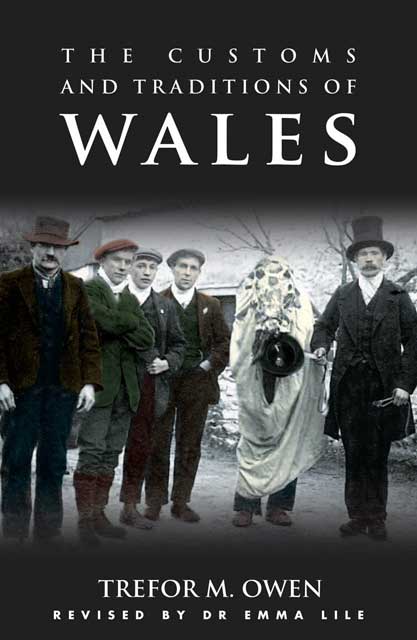
By Trefor M. Owen
University of Wales Press, 1991
188 pp, paperback
ISBN: 978 0708 3111 89
Taking a deep dive into Welsh customs and traditions of the 18th to late 19th centuries, author Trevor Owen covers the interesting and mundane.
This book often reads like a college text, and the author expects that the reader already has a basic knowledge about Wales. He also expects the reader to have a good vocabulary as words such as quintain, nosegay, gainsaid, scrofulous, and antiquarianism appear. Of course, there are also Welsh words which the reader must remember from chapter to chapter.
Here is a sample sentence from page 2: "The system of migration or transhumance associated with the permanent settlement of the low-lying hendre and the hafod (pl. hafodydd) or upland summer pasture, with its seasonally occupied dwelling or hafoty (pl. hafotai), was an important feature of Welsh rural life."
Owen starts off with the basics, writing of the historical importance of the land and its connection to the people of Wales.
The second chapter, the longest chapter at 60 pages, talks of the all-important hearth and of the home, fire, cooking, heating, storytelling and home life.
Later chapters touch on folk customs and wedding and funeral practices. Also, numerous festivals are described which include various uses for horse heads! Community traditions often included lots and lots of drinking, which tapered off after the Methodist revivals. Some annual festivals were little more than organized, drunken fist fights, with women jumping in if their husbands or brothers were not faring particularly well.
There is mention of a four-day festival which concluded with the election of a "mayor" of the festival. A major qualification for election to this "office" was that "the candidate must have spent the whole of the time from Sunday morning until Wednesday night in the public houses in a state of drunkenness without once visiting his family."
Interestingly, even during its darkest, more drunken times, the Welsh always had a safety value to somewhat take care of the poor.
Readers will find out about old-time laws such as (keep in mind, this was a law, not a custom): "when it is proved that a man has been beaten by his wife, he shall be carried about the town in a chair fixed to two poles, on the shoulders of four men, and exposed to all the ridicule of both sexes."
Sports covered include football (soccer), cnapan (cq), bando and handball. The football games in some places were played with the goals being several miles apart, with each goal being near a church. Rules were only occasionally used in these games.
The later part of the book touches on the great influence of industrialization, especially the coming of the railroads. New education systems led to uniformity in education and the spread of English, to the detriment of the native Welsh language and a lot of long-established traditions.
Pictures are few and far between, as you might expect about a book focused on centuries past, but the pictures provided are interesting and provide context.
As amazing as the 1904-95 Great Revival was, it is barely mentioned, although that is probably due to the focus of the book being on earlier days. What the book calls the Methodist Revival is mentioned numerous times. Wales was quite a religious country, as shown by the fact that at the close of the 1800s Sunday school teachers outnumbered day school teachers by seven to one.
One stumbling block to the reader’s enjoyment is the occasional impossibly long paragraphs, which sometimes run for more than a page and a half. Sentences can be long and complex, reaching over 80 words at times.
Complete neophytes to Wales might struggle a bit with the book, but those with even a little curiosity of 18th and 19th Europe can learn a lot.
Marshall Hughes
Buy this book from Amazon USA | UK | Japan
Shop at Amazon
Buy books on Britain, souvenirs and other Britain related goods from Amazon US, Amazon UK and Amazon Japan.
Britain-Visitor & Britain All Over are participants in the Amazon Services LLC Associates Program, an affiliate advertising program designed to provide a means for sites to earn advertising fees by advertising and linking to amazon.com and affiliated sites.