Books on Scotland
Read a series of book reviews of books on Scotland. Find books on Scottish culture, history, food, whisky and politics.
Bizarre Scotland
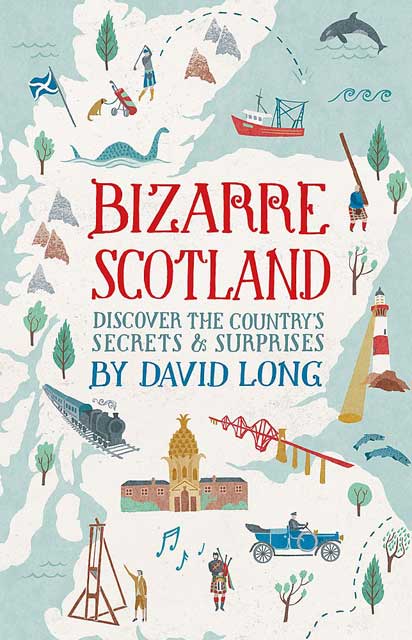
By David Long
Constable Publishing, 2014
218 pp, hardback
ISBN: 978-1-4721-1746-5
The Scottish people have contributed to the world to a far greater extent than might be expected of such a small nation. Winston Churchill, in fact, said, "Of all the small nations of this earth, perhaps only the ancient Greeks surpass the Scots in their contribution to mankind."
Shining a spot light on the good, the bad, the ugly, the informative, the bizarre and the head scratching, author David Long delivers an interesting look at Scotland and its culture, history and people.
If you are not familiar with British culture in general and Scottish culture in specific, you might have to give your dictionary a good work out while making your way through this book. While words like kirk, yob, haggis and gaol might be familiar to some people, only a person with experience with Scotland or Great Britain probably knows words like rozzer, drintling, crofter and gaberlunzie that are sprinkled throughout the book.
Most of these words can be figured out from context.
Chapter subjects range from the serious to the silly, and from the informative to the ghastly and gruesome. There are 19 chapters and if you don't like one, you can skip to another. It's not a book that needs to be read in order, front cover to cover.
The author has no interest in showing only the good parts of Scotland. The tone is light and breezy, some might call it flippant or cheeky.
Be careful not to apply anachronistic thinking while reading. People and cultures change. There is a story of Scotland's oldest surviving music hall where concert goes used to fill their pockets with horse manure and heave it at the acts who failed to live up to expectations. I don't believe the Scots are a feces-slinging people these days, although perhaps I am just misinformed.
Readers will also learn of some of the aforementioned contributions Scots have made to the world, including forensic fingerprinting, ultrasound scanners, the first gas-lit house, the first reflecting telescope, the first permanent color photograph, the first practical general anesthetic, the first ATM and the first flushing toilet, although it was invented by Alexander Cumming(s) and not Thomas Crapper as many believe or maybe want to believe.
Not contributions, but other informational tidbits the reader will learn about include the world's shortest commercial flight (1.5 miles), the sculpture dedicated to the world's ugliest woman, the fact that in 1914 the country had more than 50 car manufacturers and the fact that some Scots claim that Pontius Pilate played under a now perhaps 5,000-year-old tree in Fortingall as a youth.
By the way, and trust me on this, you didn't want to be an accused witch in Scotland.
Scotland lovers will enjoy the book for sure, and even people with just a passing interest in the country should be amused and entertained.
Marshall Hughes
Buy this book from Amazon USA | UK | Japan
Scottish History (Strange but True)
By John and Noreen Hamilton
The History Press, 2018
191 pp, paperback
ISBN: 978-0-7509-8788-2
The first thing to know about this book on Scottish history is that, well, it's not really a true history book.
"The book is designed as entertainment: a short romp through the characters, places and events of Scotland's past. We are certainly not academic historians," write the authors.
At least they are honest up front. At times, the book feels like it was written by your clever friend, and, as stated, not academic historians.
Numerous times the authors refer to Scottish people as "we," so you always know where they are coming from. Authors who admit their own biases are always appreciated.
The authors start Scottish history from way back, from the five ice ages that the land has gone through. They move through continent drift, explain where the Scots actually came from, and before you know it, they have reached the 1800s. From there, the pace of the book slows down a bit and the reader can relate better to what is happening.
Throughout the book, you are given thought-provoking snippets of interesting facts mixed with actual history.
Written loosely in chronological order, there are many times where seeming anachronisms are tied together.
A small sample of topics covered include:
- Why Al Capone's car is to this day held in Scotland.
- The first "dunce" was John Duns Scotus, and far from being a dunce, he was a noted philosopher and theologian.
- How the growth of Scotch was greatly enhanced by America's prohibition.
- While you might want to try your hand at glory, you definitely don't want to have a "hand of glory."
- Why so-called "mort safes" became necessary in the 1820s. A mort safe is a metal cage locked over a grave long enough to ensure that bodies in the graves have decayed enough to not be targets of body snatchers.
- The fascinating life of John Logie Baird, arguably the inventor of both black and white and color television.
Although entertaining and educational, the book does have a few minor flaws. The paper that the book is printed on is not of high quality, so some of the illustrations bleed through to other pages. Also, the font used for the page numbers is so small and "scripty" that it is basically unreadable.
Still, if you have an interest in Scotland, want some laughs and don't want to read a long, detailed history filled with little more than dates and names, this is worth a pick up.
Marshall Hughes
Buy this book from Amazon USA | UK | Japan
The Flying Scotsman: The Eric Liddell Story

By Sally Magnusson
The History Press, 2012
192 pp, paperback
ISBN: 978-0-7524-4352-2
As the world's fastest sprinter, Scotland's Eric Liddel was favored to win track and field's most celebrated event, the 100-meter dash, at the 1924 Paris Olympics. Although winning the 100 would not set him up financially for life, as it would today, a win would have assured a very bright future.
There was one problem, however. The preliminary heats for the 100 were to be held on a Sunday, and Liddel considered Sundays to be The Lord's Day. Much to the dismay and criticism of some of his countrymen, he decided not to run, thereby forfeiting likely glory. The British press called him a traitor. He also passed on two relay races, which had heats on a Sunday.
Instead, he ran in the 200, where he finished third, and the 400, an event in which he had very little experience. Running in the outside (worst) lane, he broke the world's 400 record in a stunning gold-medal performance.
Much of this in known because of the 1981 Academy Award winning film, "Chariots of Fire." It is the lesser-known parts of Liddel's life which make up the gist of this book.
Barely a quarter of the way through the book, Liddel has won his medal and the book moves on to its main focus, what he did after his 1925 return to China, the place of his 1902 birth to missionary parents. He worked there as a teacher and missionary, until he, along with hundreds of others, was put in an internment camp by the Japanese during World War ll. Unable to get treatment for a brain tumor, he died there in 1945, just a few months before the war's conclusion.
The book is filled with interesting historical details of the times from before his Olympic glory days in the 1920s through his dying days. The reader will come away with a better understanding of history, and not just sports history.
Interestingly, since Liddel was born in China, the Chinese consider him to be the country's first Olympic gold medalist. For all that he did for the Chinese people, he is fondly remembered there. In 1991, a stone memorial to Liddel was built in Weifang, at the site of the internment camp.
Of course, the Chinese would not let any mention of his Christian beliefs be on the monument, but on the back is written a well-known Bible verse, "They shall mount up with wings as eagles, they shall run and not be weary."
The book offers interesting speculation as to whether Liddel could be a star in modern times. His life was never focused exclusively on his track career. He was a student and was very active in various Christian endeavors. He wasn't fully focused on becoming the world's fastest human.
At three or four points in the book the author describes details that the movie knowingly and purposely got wrong in their attempt to "improve" the story. The movie was British, showing that it is not only the American media which play fast and loose with facts if they think a few more bucks can be made.
Not only did Liddel lose his life because of his decision to return to China, he lost much more, too. For one thing, he never did get to see his third daughter, Maureen, because his pregnant wife and first two daughters left China in early 1941 when things started to get too dangerous.
Many pages are dedicated to the hope that Liddel gave those interred. His life went from working with the Chinese to encouraging the imprisoned foreigners. Many firsthand tributes are recorded in the book.
The only negative of the book is the exceptionally small type size used in this edition. If you have good eyes and read in a well-lit place, you might be OK.
All in all, this is a very worthwhile book.
Marshall Hughes
The Wicked Wit of Scotland

By Rod Green
Michael O'Mara Books Limited, 2018
159 pp, hardback
ISBN: 978-1-78929-022-6
What do the telephone, penicillin, bicycles, steam engines, hypnotism, Encyclopedia Britannica and the video game series Grand Theft Auto have in common? If author Rod Green is to be believed, they all came from brainstorms of the Scottish.
Mixing history, weather, politics, food and, of course, humor, Green educates his readers on his beloved Scotland.
This book differs a bit from the Wicked Wit of England and The Wicked Wit of Ireland books. There is a bit less emphasis on humor and a bit more emphasis of culture. For example, there are sections on Scottish food (more than just haggis), Scottish drink (more than just whisky, "the water of life"), on the aforementioned Scottish inventions, on the world's worst poet (he was pretty bad) and on vocabulary specific to Scotland.
Unsurprisingly, much of the humor revolves around the Scots' entrenched reputation, deserved or not, for excessive drinking, fighting and tightfistedness. However, the Scots are not to be looked down upon by any means. None other than Winston Churchill said of them, "Of all the small nations of this earth, perhaps only the ancient Greeks surpass the Scots in their contribution to mankind."
Some of the humor involves some good snark about the British. One passage tells of when God was creating Scotland. The angel Gabriel told God that he was being too generous to Scotland, with all of its beautiful landscapes, abundant wildlife and other wonders of nature.
God replies, "Don't worry. Wait till you see who they are getting as neighbors."
Many of the other bits of humor are, shall we say, self-effacing. Green says that the Scots can laugh about their stereotypes "because we know that none of them are true." What stereotypes? Stereotypes that talk about "...mean Scots, drunken Scots, aggressive Scots, unintelligible Scots, ginger-bearded, kilt-wearing, bagpipe-playing, bar-brawling, haggis eating, caber-tossing, whisky-sozzled Scots."
As for violence and fighting, the reader will find out that there are not many drive-by shootings, but there are drive-by headbutts - with head bands being used as silencers.
As for their being cheap, one Scottish comedian says that America's Grand Canyon "was started by a Scotsman who lost a dime in a ditch."
The ninth (of 10) chapters is filled with Scottish slang, which can be somewhat different from that of their English neighbors to the south. You will enjoy it.
After reading this book, you'll be able to warn your friends, "Don't be a doolally eejit, take yer manky tattie outta yer oxter, ye bampot."
Marshall Hughes
Buy this book from Amazon USA | UK | Japan
The Wicked Wit of Ireland
By Myles Byrne
Michael O'Mara Books Limited, 2019
160 pp, hardback
ISBN: 978-1-78929-023-3
The newest of the "Wicked Wit of" trilogies, the Ireland version doesn't disappoint.
The six-page introduction, which explains the importance of and possible cultural explanations for the Irish sense of humor, is a good set up for what is to come.
The Irish often use self-depreciating humor, and this is apparent throughout the book. One example is of a local writer saying of his countrymen, "If it was raining soup, the Irish would go out with forks." And there is this: "Irish ignore anything they can't drink or punch."
Drunkenness is a big theme of the book. A "traditional" joke still making the rounds asks what the difference is between an Irish wedding and an Irish funeral. The answer: "One less drunk."
Not all jokes are so ham-fisted. There is a certain subtlety in some of the humor, although much of the humor lacks, shall we say, nuance.
The Irish are well aware of their unsophisticated, rough-and-tumble reputation around the world, and are waiting for the world's perception of reality to catch up to modern times. They are tired of the worn-out stereotypes of them.
Over the years, Irishmen have not been treated well in a number of countries, including England, where landlords looking for tenants used to hang signs on their open apartments which read, "No Irish, No Blacks, No Dogs."
Of course, with the history of Ireland being what it is, there are jokes about the influence of the Catholic church, too. The jokes are often less than charitable towards the Catholics.
One area covered in several places is the Irish contempt for its media, specifically journalism, which seems to be in a worse state than even America's. Famed Irish writer George Bernard Shaw is quoted as saying, "Newspapers are unable, seemingly, to differentiate between a bicycle accident and the collapse of civilization."
Said Patrick Campbell, "Journalism, the only job that requires no specialized knowledge of any kind." Included in the review of media are humorous headline gaffs from Irish newspapers such as, "Deaf Mute Gets New Hearing at Court," and "Drunk Gets Nine Months in Violin Case."
Irish cuisine, not exactly known as the world's best, is defended to some extent. The book says the Irish are eating much more healthy foods now and have moved away from their famous "three food groups of Ireland," namely beer, whiskey and potatoes.
The book ends with a humorous discussion of...death.
Marshall Hughes
Buy this book from Amazon USA | UK | Japan
Pocket Scottish History

By Dr. James Mackay
Lomond Books Limited, 2019
352 pp, paperback
ISBN: 978-1-84204-711-8
Covering literally 10,000 years of Scottish history, including the mundane, exciting, confusing and intriguing parts, James Mackay tells you everything you need to know about Scottish history...and more.
There are 162 left-and-right-facing pages, each of which is a self-contained chronicle of Scottish history.
The left-facing pages all have one-paragraph introductions of the short chapters, printed on an occasionally hard-to-read background. The rest of the left-facing pages are details on the topics introduced, with the explanations sometimes spilling over to the right-facing pages. The right-facing pages are full of pictures, drawings or maps along with the occasional written spillover from the preceding page. These pictures etc., are interesting and of high quality. The book is printed on glossy, high-quality paper which helps bring out fine details.
Early History
A lot of the early history of Scotland seems little more than who killed who and who married who in order to build up his fiefdom. As in the rest of the world, there weren't a lot of good times to be had by anybody but the elite of the elite. There sure was a lot of double-crossing back in those days, too. Parts of the book read like a whodunnit. Revenge is a constant theme.
The book is a complete history of Scotland, but neophytes to Scotland's past, or at least British history, might struggle as the author assumes the reader knows quite a bit about the subject already.
For example, words such as bishopric, regicide, gibbets, dragoons, press gang, run rig, gutta-percha and surplice, among many others, appear quite frequently and are rarely explained fully. If you already know what these words mean, then you will surely enjoy the book to its fullest.
There is a four-page glossary at the end, but it explains merely 28 words, which only helps a little.
Although Scotland certainly has had some rough times in its history – what country hasn't? - there are a number of things written about that the Scots can be proud of.
Sources of Scottish Pride
- During Scotland's Age of Enlightenment (18th- and early 19th century) its universities in St. Andrews, Aberdeen, Glasgow, and Edinburgh were clearly better than their counterparts in Oxford and Cambridge.
- Scotland was the world leader in shipbuilding in the 19th and early 20th centuries, and it was they who later built the Queen Mary and Queen Elizabeth, the largest ships afloat at the time of construction.
- Both the Stone of Scone (1945) and the Stone of Destiny (1996) have been returned to their rightful places in Scotland. If you know what these are, then you are already a true Scotland scholar, and you will assuredly enjoy this book.
Readers will learn other interesting things, including tartans and bagpipes were once outlawed under the threat of heavy penalties, that the Scots went on a one-week strike against a new tax on beer (but could manage to hold out one week), and that Elizabeth I of England, who hoped to get (her cousin) Mary Queen of Scots married off, suggested she wed Robert Dudley, a British nobleman who happened to be Elizabeth's long-time lover.
Overall, the book is interesting but not for rank beginners.
Marshall Hughes
Buy this book from Amazon USA | UK | Japan
The Outrun - a memoir
Amy Liptrot's memoir, The Outrun, offers a deeply personal exploration of recovery, self-discovery, and the human connection to nature. Published in 2016, the book narrates Liptrot's journey from the chaotic nightlife of London, marred by alcohol addiction, to the remote Orkney Islands, where she embarks on a path of healing and renewal. Through her evocative prose, Liptrot intertwines her personal struggles with the natural beauty and isolation of the Orkneys, creating a narrative that resonates with themes of escape, rebirth, and the restorative power of nature.
The Outrun is structured around Liptrot's journey to sobriety, moving back and forth between her past in London and her present on Orkney. This non-linear narrative reflects the disorientation and fragmented sense of self that often accompanies addiction. Liptrot's writing is lyrical and vivid, rich with descriptions of the Orkney landscape, yet grounded in the raw honesty of her struggles. Her style combines memoir with nature writing, offering readers not only an account of her personal battles but also a deep appreciation for the natural world.
Liptrot's prose is striking in its simplicity and elegance. She uses the rugged beauty of Orkney as a metaphor for her own internal landscape, drawing parallels between the wild, untamed environment and her own tumultuous emotions. The contrasts between the city and the countryside, addiction and sobriety, chaos and calm, are skillfully woven throughout the narrative, creating a sense of balance and tension that drives the book forward.
By intertwining her personal story with the history and ecology of the Orkneys, Liptrot crafts a memoir that is as much about place as it is about self, making The Outrun a compelling read for anyone interested in the intersections of mental health, nature, and cultural identity.
Review by Alan Irvine
Buy this book from Amazon USA | UK | Japan
Shop at Amazon
Buy books on Britain, souvenirs and other Britain related goods from Amazon US, Amazon UK and Amazon Japan.
Britain-Visitor & Britain All Over are participants in the Amazon Services LLC Associates Program, an affiliate advertising program designed to provide a means for sites to earn advertising fees by advertising and linking to amazon.com and affiliated sites.