Westminster Cathedral, London
Jake Davies
There are no shortage of magnificent cathedrals and churches for tourists to visit in London, St. Paul's Cathedral and Westminster Abbey immediately spring to mind, but one of the more interesting ones that is often overlooked by tourists, Westminster Cathedral, is quite surprising and yet lacks the high priced entrance fee of the others.
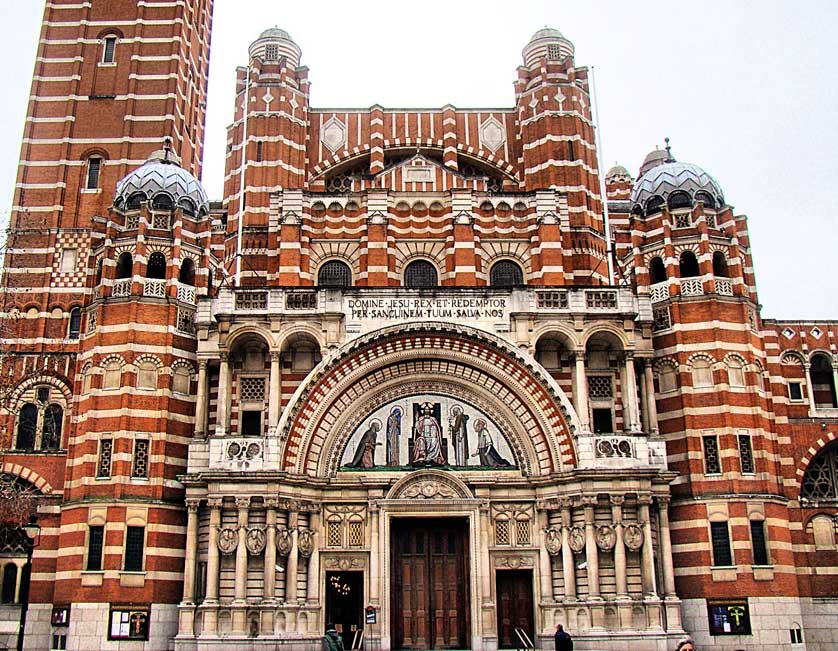
It's full name is The Cathedral Church of Westminster, and it is both the head of all Catholic churches in England & Wales, and the largest Catholic church in England & Wales.
Architecture
The outside of the building is unusual and striking, not being built in the traditional Gothic style. With its striped layers of alternating red brick and white Portland stone, the design is based on very early churches in the Byzantine style and has sometimes been confused with a mosque.
It is no mere copy of a Byzantine building, but places like the Hagia Sophia in Istanbul and St. Marks in Venice, served as inspiration for its design. Construction of Westminster Cathedral began in 1895 and it opened 8 years later.
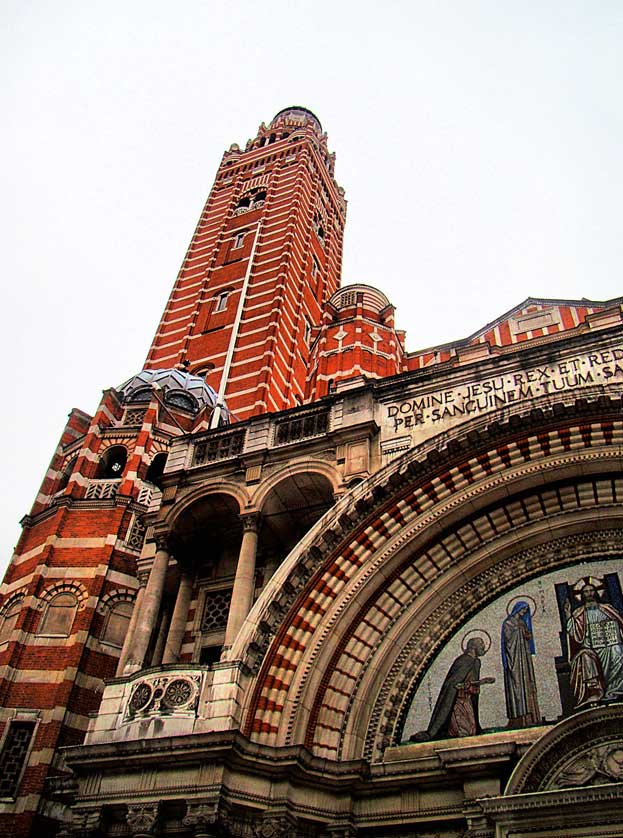
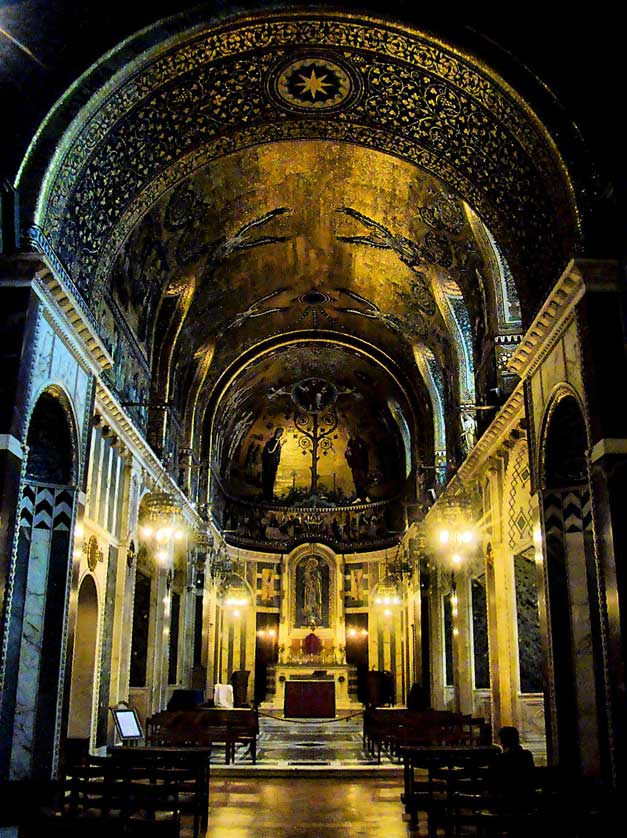
The architect was John Francis Bentley. The interior is perhaps even more interesting than the exterior, lacking as it does the stained glass windows commonly associated with such a grand church.
Visitors are often surprised that is feels larger on the inside than the exterior would suggest. There is much to see, though three things stand out.
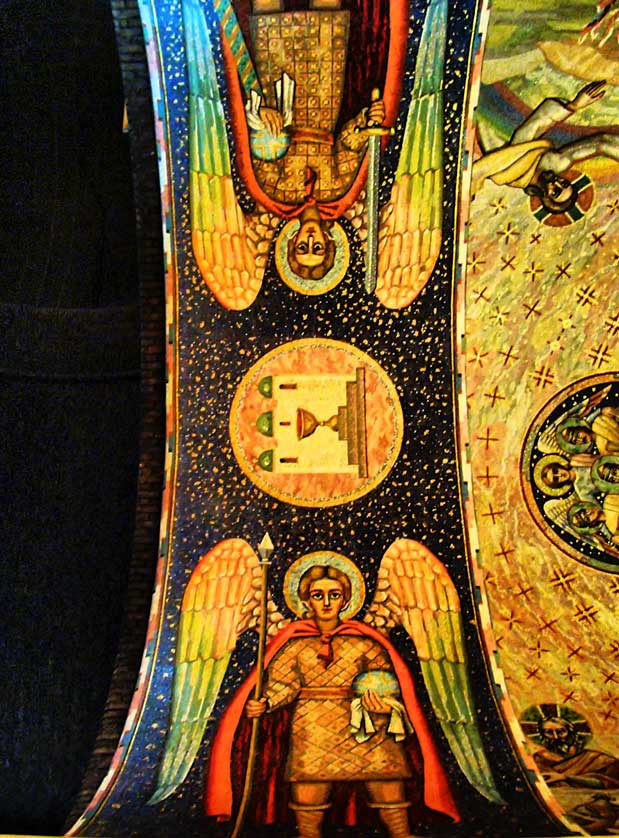
First are the mosaics. The domed and arched ceilings are covered in them. The architect died before the cathedral was finished and very little of the mosaics had been completed. He left very little information on his plans for them, so in the ensuing decades many different people have worked on them and they therefore display many different styles and techniques.
Eric Gill
New mosaics were still being installed in the early years of the 21st century. Possibly the most famous artworks in the cathedral are the Stations Of The Cross by Eric Gill (1882-1940). These 14 carved reliefs in stone were executed by Gill when he was just starting out as a young sculptor and consequently charged quite little for them.
Gill later went on to make a name for himself as a sculptor, mason, and designer, though revelations about his various sexual activities has made him somewhat controversial.
Another feature of the cathedral that marks it as quite unique is the extensive use of marble, which in itself is perhaps not noteworthy until you realise the number of different types of marble.
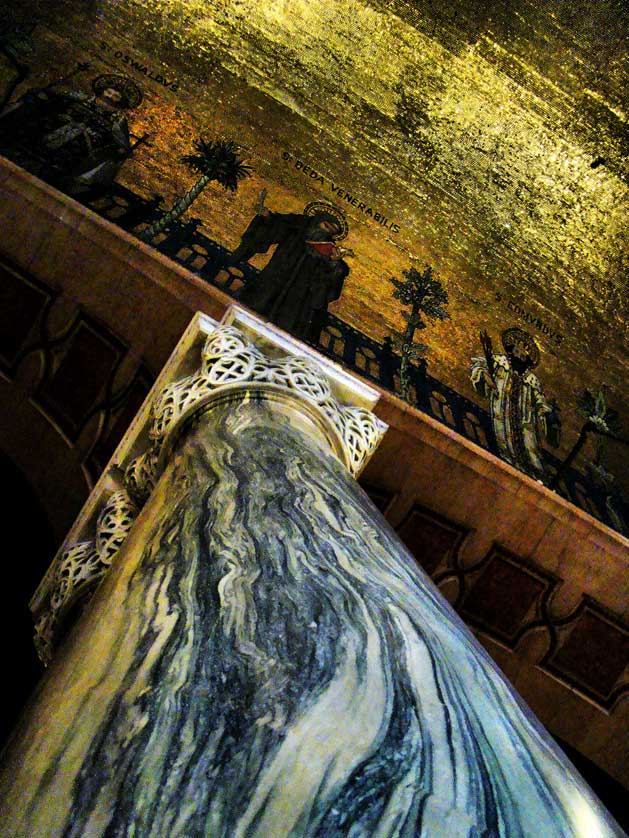
At last count over 120 different marbles have been used, sourced from 24 different countries across five continents. This staggering number is due primarily to one man, William Brindley, who sought out, and in some cases, reopened the ancient quarries that had supplied marble to the builders of Greece and Rome.
The tower has a public elevator that takes visitors up to a viewing gallery 210 feet above street level from where great views over London can be had. Due to repair work the tower is currently closed to the public.
There is gallery containing many of the cathedral's treasures as well as a remarkable model of the cathedral and displays on its history and construction.
The gallery at Westminster Cathedral is open 9.30 am to 5 pm weekdays, 9.30 am to 6 pm weekends. Admission 5 Pounds.
Entrance to the cathedral itself is free.
Access - Getting There
Westminster Cathedral (westminstercathedral.org.uk)
42 Francis Street
London SW1P 1QW
Tel: 020 7798 9090
The closest Tube station to Westminster Cathedral is Victoria on the Victoria Line and Circle & District Lines. St James's Park Station on the Circle & District Lines is also a short walk away.
London buses 11, 24, 148, 507 and 211 bus lines stop in front of the Cathedral Piazza.
Cathedrals in Britain
Hotels in London
Book Hotels in London - Booking.com
Find Luxury Hotels in London - Booking.com
Budget Hotels in London - Booking.com
Find Hotels in England - Booking.com