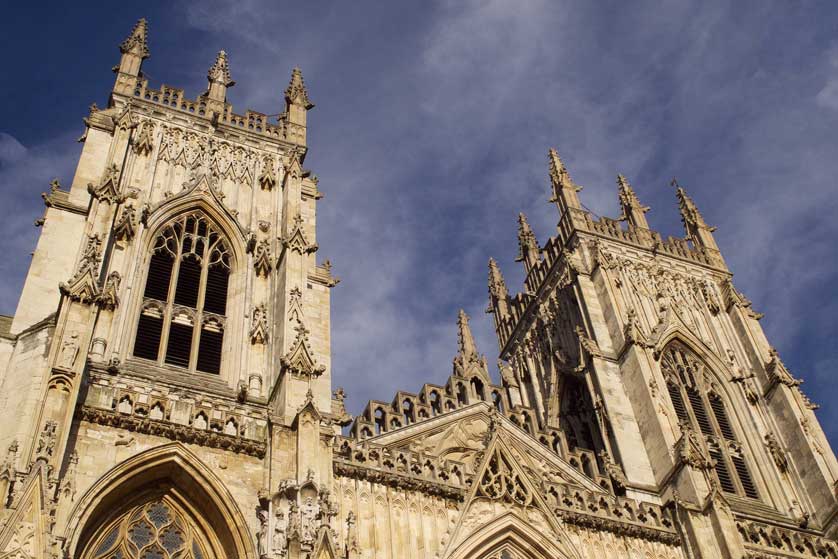
York Minster, York
York Minster
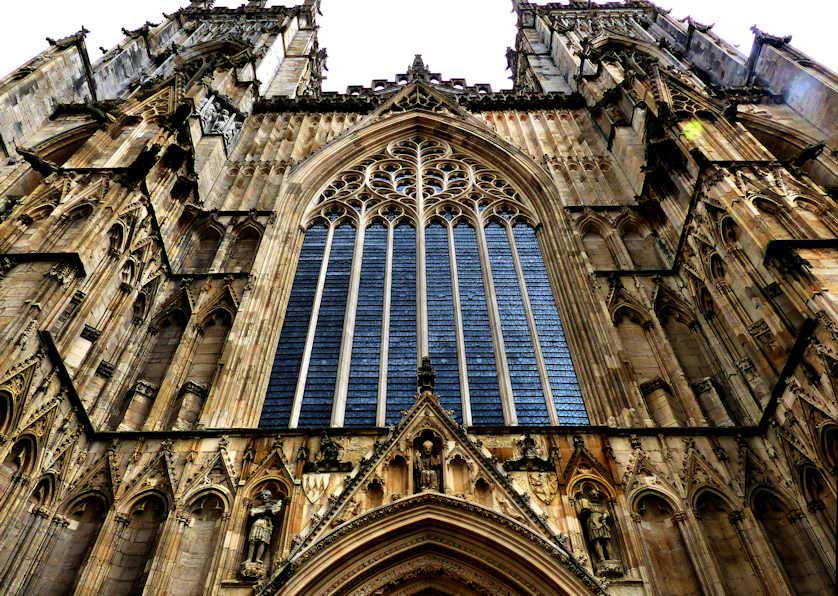
York Minster is one of Britain's finest cathedrals. Constructed over 200 years from the 1220's to 1470, York Minster is a must-see on any visit to the historic city of York in northern England.
The Cathedral and Metropolitical Church of Saint Peter in York is most commonly known as York Minster. Minster was an old English term that applied to certain kinds of religious communities, and there was certainly a minster at York. Nowadays however minster is an honorific title given to important churches.

History
The first wooden church near the site was built for the baptism of the Anglo Saxon King, Edwin of Northumbria in 627. Later a stone Norman church was begun nearby, remains of which can be seen in the Undercroft.
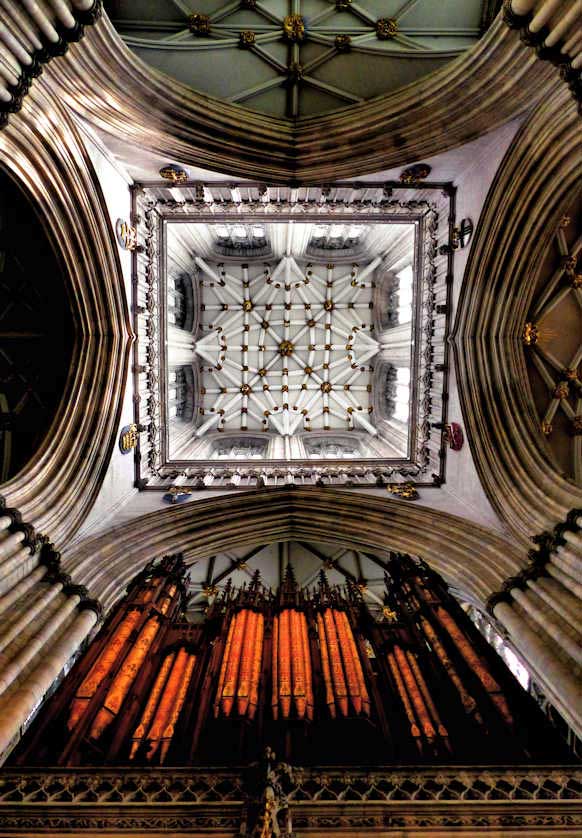
York Minster's Central Tower also called the Lantern Tower, was constructed between 1407 and 1433 and at one point was topped with a wooden spire. Rising more than 230 feet and the highest point in York, visitors can climb 275 steps to get fantastic views down on the city and out across the countryside.
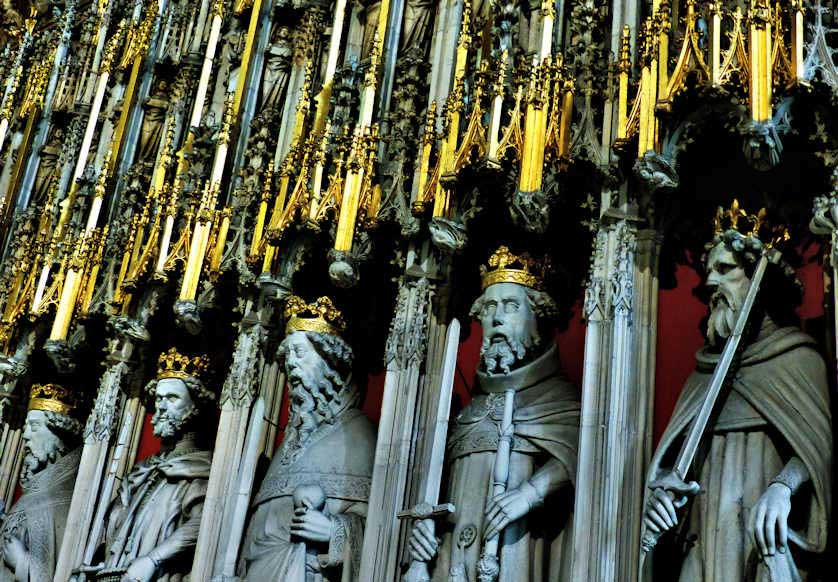
The Choir Screen at York Minster is known as the King's Screen. Separating the nave from the choir stalls and altar, the dominant feature of the screen is 15 stone sculptures of the kings of England from William the Conqueror to Henry VI.
Carved by William Hindley of Norwich, it was a project of Henry V and work began in 1420. Henry V died before work was completed, so the new king, Henry VI, was added to make 8 on the right and 7 on the left. In the photo (below) is Henry I, followed by Stephen, then Henry II, Richard I, and John Lackland.
In the undercroft below York Minster is the crypt of the patron saint of York, Saint William. The Roman coffin containing his remains is on display as is a small shrine with a modern mosaic. He died in 1154 shortly after being made Archbishop of York for a second time. He was canonized by Pope Honorius III in 1226. His sarcophagus was rediscovered in the 1960's.
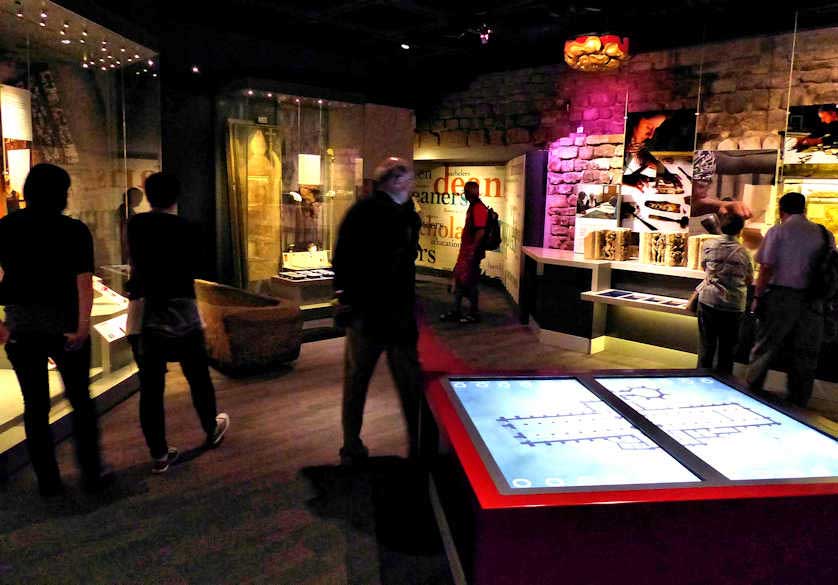
The Undercroft of York Minster houses a museum displaying artifacts from the Roman and Norman times before the construction of the present cathedral. It is believed that this was the site where Constantine the Great was proclaimed Emperor of Rome following the death of his father Constantius in 306.
Architecture
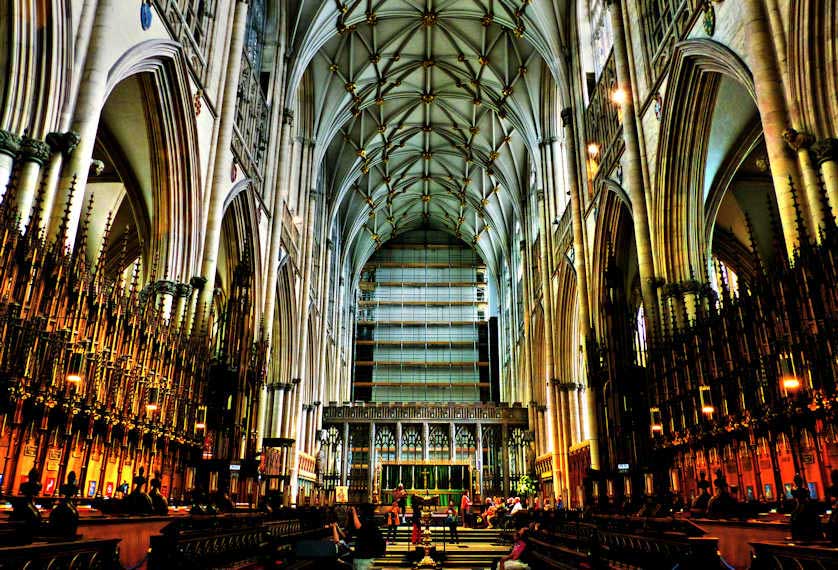
From 1220 this Norman church was gradually enlarged to become the Minster we see today, one of the largest Gothic cathedrals in northern Europe after Cologne Cathedral in Germany.
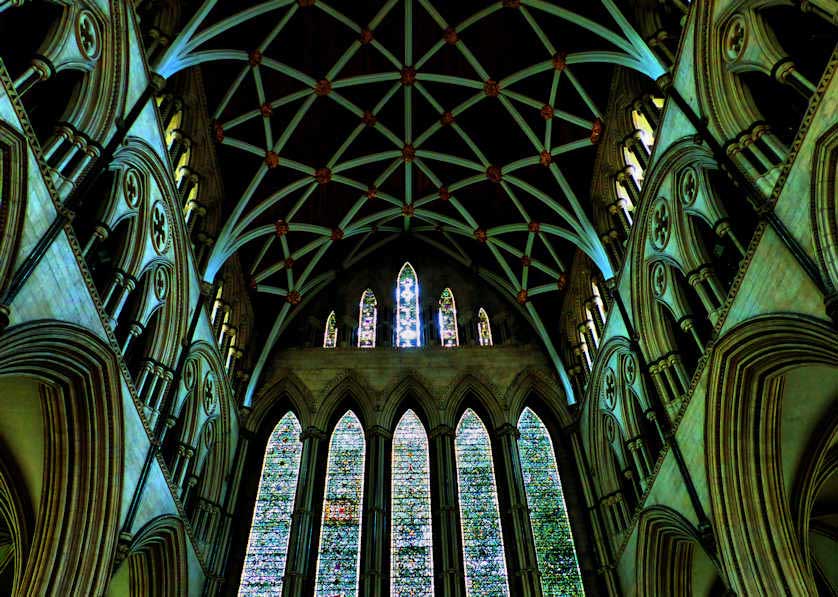
York Minster, often described as the largest Gothic Cathedral in northern Europe has truly staggering dimensions, 525 feet (160 meters) in length, 249 feet (76 meters) in width. The vaulted ceiling is 88.6 feet (27 meters ) above the floor, and the two west towers are 184 feet (56 meters ).
The earlier Roman influence on York can also be appreciated from the remains of Emperor Constantine's palace that are located under the central tower.
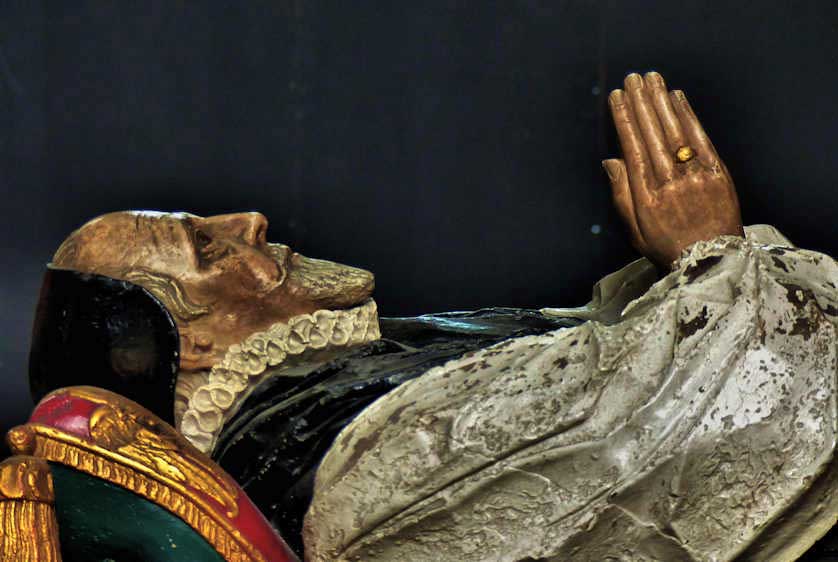
There are dozens of tombs within York Minster, mostly archbishops, and some dating back to the 8th century. Many of the tombs have effigies such as on the tomb of Tobias Matthew (1546-1628) who was Archbishop of York from 1602. Prior to that he was Vice-Chancellor of Oxford University and Dean of Durham.
In the undercroft below York Minster is the crypt of the patron saint of York, Saint William. The Roman coffin containing his remains is on display as is a small shrine with a modern mosaic. He died in 1154 shortly after being made Archbishop of York for a second time. He was canonized by Pope Honorius III in 1226. His sarcophagus was rediscovered in the 1960's.
Windows
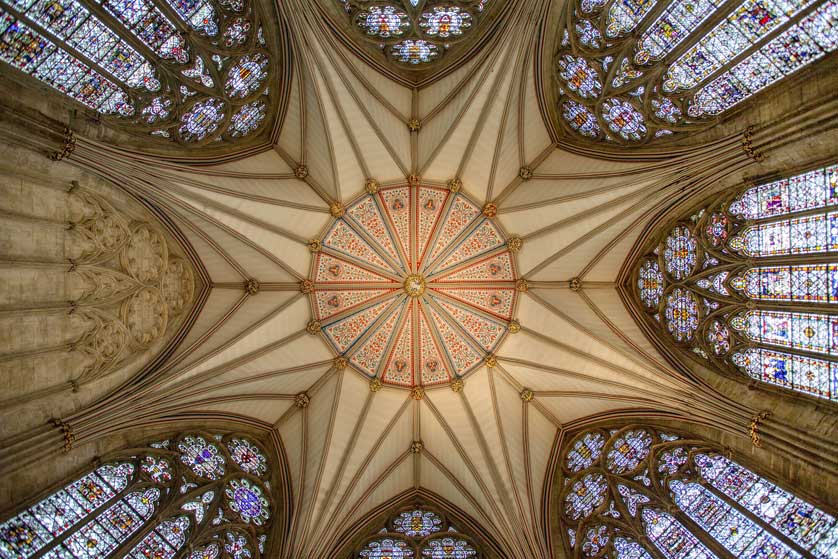
York Minister is known for its famous Rose Window and the Great East Window, (completed in 1408), the largest area of medieval stained glass in the world.
This shows scenes from Genesis and Revelation - the beginning and end of the world.
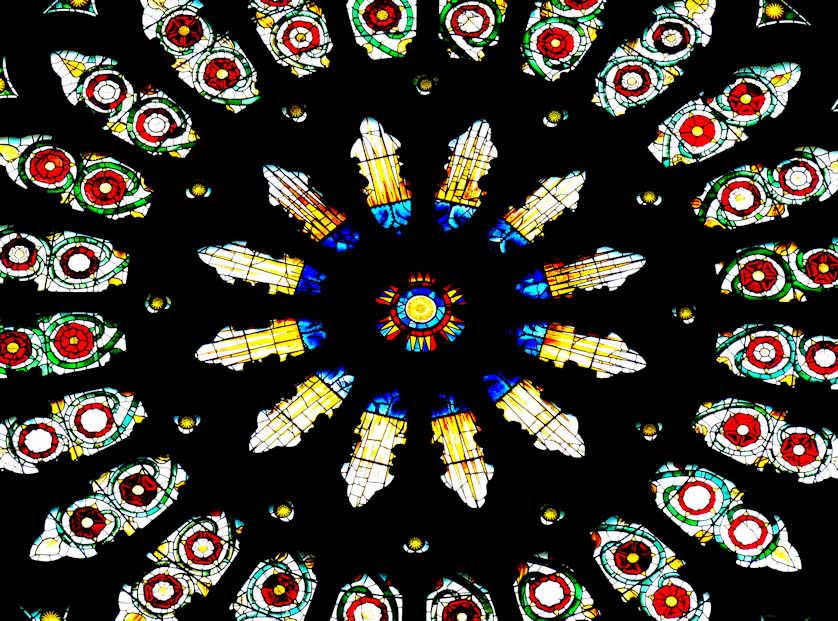
The Rose Window of York Minster dates to about 1500 and is located in the South Transept. Rose windows are a type of stained glass window with a circular design around a centre point, but in this case it also describes the main motif in the design, red roses and white roses, representing the two sides of the War of the Roses of the latter half of the 15th century which came to an end when Henry VII married Elizabeth of York. The window was damaged by a fire that ensued after a lightning strike on the wooden roof in the 1980s, but it has been painstakingly restored.
The Five Sisters Window, located at the North Transept of York Minster was created in the mid 13th century. Each of the 5 slender windows reach a height of 17 meters, making it the largest of its type in the world. During World War I the glass was removed for safe-keeping under the threat of Zeppelin attack. When it was reinstalled the window was dedicated to all the women who lost their lives in service to the country during the war.
The Minster has been damaged by fire and other calamities (there was extensive damage, for example, done in the English Reformation). Thereafter the church has been repaired over time including as recently as 1984, when a roof was destroyed in a blaze.
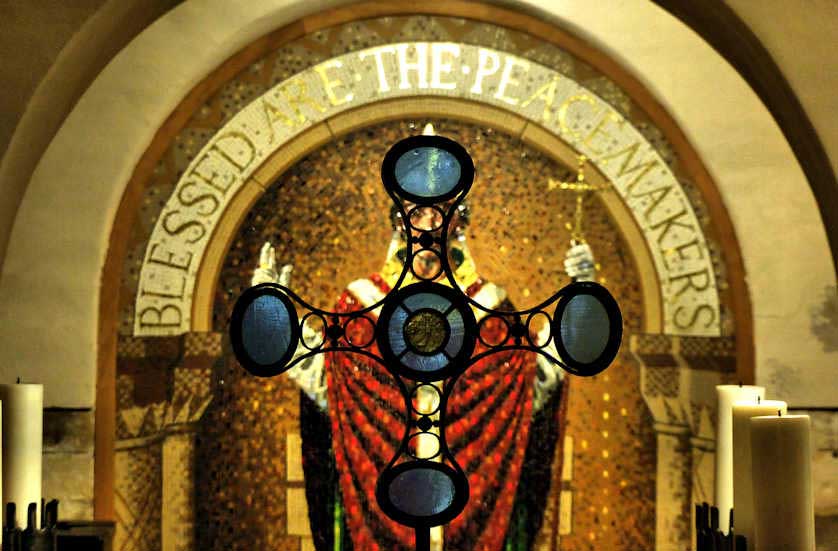
Archbishop of York
York Minster is the seat of the Archbishop of York, after the Archbishop of Canterbury, with his seat in Canterbury Cathedral, the second-highest office of the Church of England.
The church plays host to various musical concerts, which can be booked online. There is also a shop within the church selling CD's of music from York Minster, books and carvings.
Information & Hours
York Minster (www.yorkminster.org)
Administration offices
10-14 Ogleforth, York
YO1 7JN
Tel: 0844 939 0011
Admission
Admission 11 GBP for adults; 9 GBP for seniors and students
Hours: Monday - Saturday: open 9 am (9.30 am November- March); last entry 5.30 pm
Sunday: 12.00 noon - 3.45 pm
There is no sightseeing on Good Friday and Easter Sunday or on Sundays before 12.00 noon
York Minster is a pleasant 700-meter walk from York Station. There are train services to York from both Manchester Piccadilly and Manchester International Airport as well as London Euston.
Access - Getting to York
York Station, just outside the city walls, is York's main station with trains to Manchester Piccadilly, London King's Cross, Edinburgh, Glasgow, Durham, Inverness and Newcastle.
There are CrossCountry trains to Darlington, Durham, Newcastle Central, Berwick-on-Tweed, Edinburgh Waverley, Glasgow Central, Dundee and Aberdeen.
Services south on CrossCountry include trains to Leeds, Wakefield Westgate, Doncaster, Sheffield, Derby, Birmingham New Street, Bristol Temple Meads, Exeter St Davids, Plymouth, Penzance, Reading and Southampton.
First TransPennine Express has services to Leeds, Huddersfield, Manchester Piccadilly, Manchester Airport and Liverpool Lime Street as well as Scarborough, Middlesbrough, Darlington, Durham and Newcastle Central.
Northern Rail has rail connections to Knaresborough, Harrogate and Leeds, Bradford Interchange, Halifax, Blackburn, Preston, Blackpool North Selby and Hull Paragon as well as infrequent trains to Sheffield.
Long distance National Express buses run nationwide from the bus station in Rougier Street, a short walk north of York Station.
York Related
Other places of interest in York include the Yorkshire Museum in Museum Gardens, the nearby York Art Gallery, and Guy Fawkes birthplace (now the Guy Fawkes Inn).
Also popular with visitors are The Shambles, Monk's Bar, the National Railway Museum, the city walls, Jorvik Viking Centre and Cliffords Tower.
Standing outside York Minster is a Roman column, believed to be part of the building where Constantine was proclaimed Emperor of Rome in 306 AD.

Hotels in the North East of England
Book Hotels in Durham - Booking.com
Find Hotels in Newcastle - Booking.com
Scarborough Hotels - Booking.com
Search Hotels in Whitby - Booking.com
Hotels in London - Booking.com
Hotels in England - Booking.com