Bridges in the UK
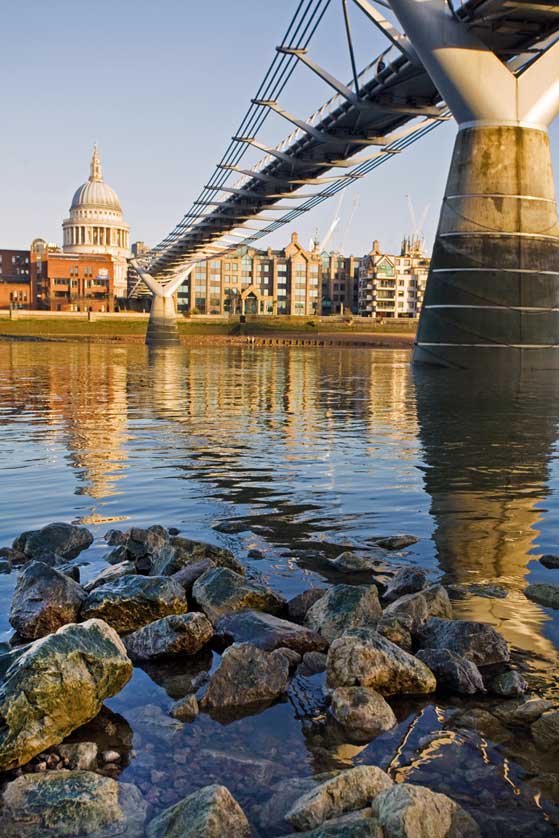
Britain is a country of many rivers. From early times rivers were a means of communication and many towns in the country are located on rivers especially where they could be easily forded or later bridged.
The Romans reached what is now London by sailing down the Thames. They also founded York, the second city in Roman Britain, at the confluence of the rivers Ouse and Foss.
Later the Vikings were to penetrate deep into the country by sailing down navigable rivers. They took York, which became their capital via the rivers Humber and Ouse.
First London Bridge
The Romans built the first bridge in London about 60 meters east of the present London Bridge. Wooden bridges followed in London during Saxon times until the first stone bridge erected by the Normans in 1176 with houses and even a chapel.
Other Roman bridges crossed the River Tees and the River North Tyne near Hadrian's Wall.

Iron Bridges
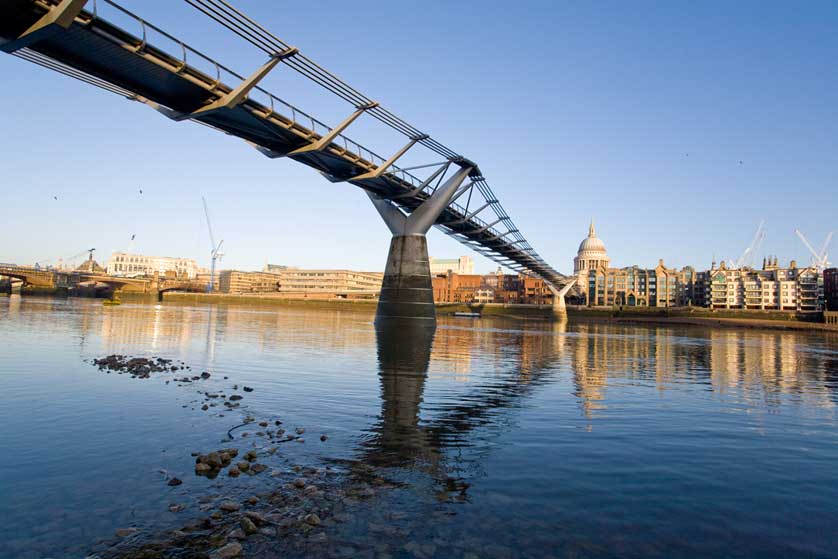
With the coming of the Industrial Age more modern bridges of iron and steel were built. The Iron Bridge that crosses the River Severn in Shropshire was the first cast-iron bridge in the world. It dates from 1781 and is a symbol of the Industrial Revolution.
Important ports in the UK grew up at the mouth of navigable rivers including Liverpool (The River Mersey), Bristol (The River Severn), Newcastle (The River Tyne) and Glasgow (The River Clyde).
All four cities are known for their numerous and often beautiful bridges.
Oxbridge
The rivers Cherwell and Thames in Oxford and the River Cam in Cambridge are crossed by more ornamental bridges. These include Folly Bridge over the Thames in Oxford and the Bridge of Sighs in Cambridge, named after the famous bridge in Venice. It dates from 1831 with Folly Bridge completed in 1827.
The word "Bridge" also appears in several British place names such as Cambridge, Bridgend (Pen-y-bont) in Wales, Hebden Bridge in Yorkshire, Whalley Bridge in Derbyshire and Bamber Bridge in Lancashire. "Pont" from the Latin meaning "bridge" appears in the Welsh town names of Pontypridd and Pontypool.
See a listing of some major and historic bridges in Britain.
Bridges in England

Tower Bridge, London
Tower Bridge is a combined draw bridge and suspension bridge in London over the River Thames.
The draw bridge is operated about 1000 times a year.
Tower Bridge gets its name from the nearby Tower of London. Construction of Tower Bridge began in 1886 and the bridge opened in 1894. The bridge consists of two bridge towers (65 metres tall) connected at the upper level by two horizontal walkways. The towers are 61 metres apart with the bridge 240 metres long in total.
The towers are clad in Cornish granite and Portland stone.
Tower Bridge has become an iconic symbol of London. It is painted blue and white, its original colors. The bridge is illuminated at night.

Albert Bridge, London
Albert Bridge traverses the River Thames in London between Chelsea on the north bank and Battersea on the south bank.
The now iconic bridge dates from the late 19th century and has an interesting history.
Originally designed and constructed by Rowland Mason Ordish in 1873, Albert Bridge was originally a toll bridge. Unfortunately it was neither a commercial success, nor structurally sound.
As a result the bridge was purchased by the government of the day in 1879 and had to be strengthened with steel chains by Sir Joseph Bazalgette, the Board of Works' Chief Engineer and the man responsible for creating the sewer system in central London.
The structure had already acquired the nickname, "The Trembling Lady" as it tended to shake. Signs are still visible warning troops from the former Chelsea Barracks to break step as they crossed the bridge.
Later in the 1970's the bridge was strengthened again by the Greater London Council (GLC). The GLC also imposed weight limits for vehicles.
The bridge is 220 metres long and 12 metres wide. Its distinctive paintwork in various pastel shades is meant to make the bridge more visible to river traffic in bad weather. At night the bridge is illuminated by 4,000 low voltage LED lights which makes for a pleasing sight.
Tower Bridge and Albert Bridge are the only Thames road bridges not to have been replaced since they were first constructed.
Millennium Bridge, London
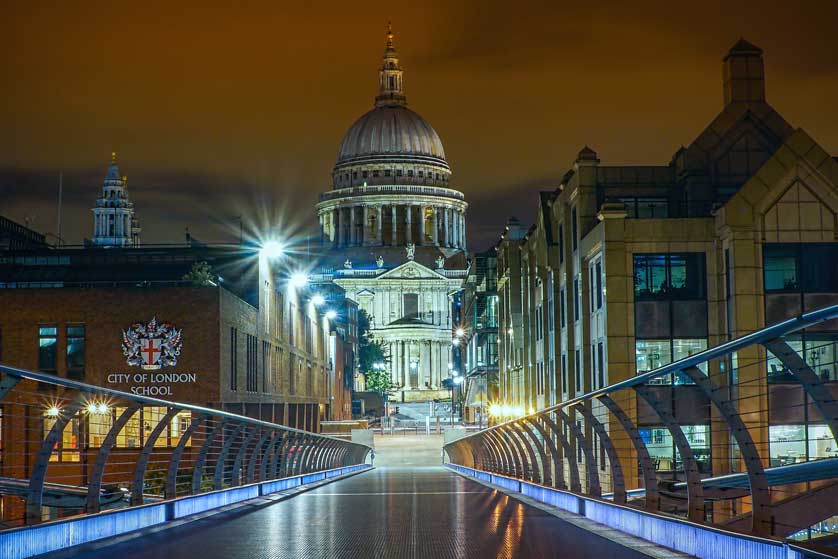
The Millennium Bridge (London Millennium Footbridge) is one of the capital's most recent bridges along with the Golden Jubilee Bridges which flank Hungerford Bridge. It crosses the river from Bankside on the south bank to St. Paul's Cathedral in the City. A steel suspension bridge for pedestrians only it opened in June 2000, only to close two days later for around two years to correct its swaying motion. The motion earned the bridge the nickname "Wobbly Bridge."
The bridge took two years to build. The competition to construct the bridge was won by the Arup Group working with Sir Norman Foster and sculptor Sir Anthony Caro. The work came in over budget at £18.2 million and two months late. It opened on 10 June 2000. However, just two days later the bridge was forced to close due to lateral vibration caused by people walking across the bridge.
Millennium Bridge stands midway between Blackfriars Railway Bridge and Southwark Bridge on the River Thames. The entrance to the bridge on the South Bank is close to Shakespeare's Globe and the Tate Modern. The Golden Hinde and Southwark Cathedral are a short walk east of Southwark Bridge. London Bridge Underground Station is the nearest tube station on the south side. On the north side of the river, the bridge is close to the City of London School and affords spectacular views of St. Paul's Cathedral.

Pulteney Bridge, Bath
Pulteney Bridge in Bath, which spans the River Avon in the eastern part of the city is another Georgian masterpiece up there with The Circus and The Royal Crescent as highlights of any visit to this wonderful city.
A Grade I Listed Building, Pulteney Bridge was designed by the Scottish architect Robert Adam (1728-1792) and is one of the few bridges in the world with commercial buildings on both of its sides.
The bridge has undergone a number of vicissitudes since it was completed in 1773 and indeed the appearance of the three-span bridge is much different from its original form of the late 18th century.
Barton Bridge, Bradford-on-Avon
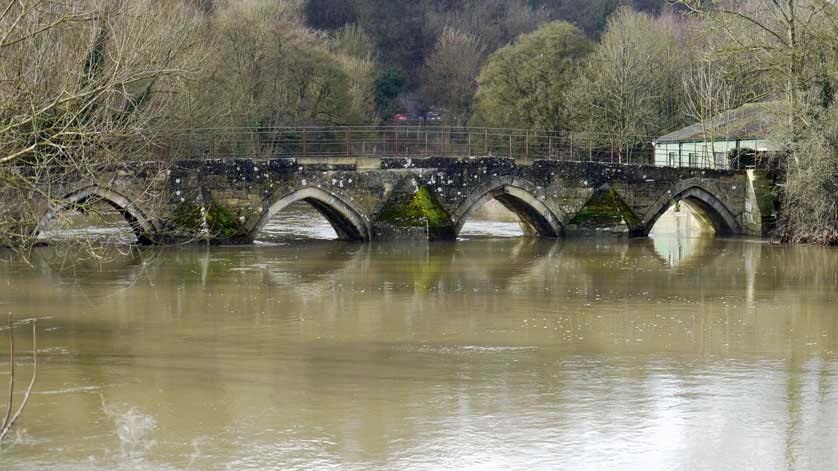
Barton Bridge in Bradford-on-Avon is a medieval stone pack horse bridge that crosses the River Avon around 500 meters downstream from the better-known Town Bridge.
Barton Bridge forms part of a group of remarkable medieval buildings, including the 14th century tithe barn, all within Barton Farm Country Park. Access to the park is free to the public.
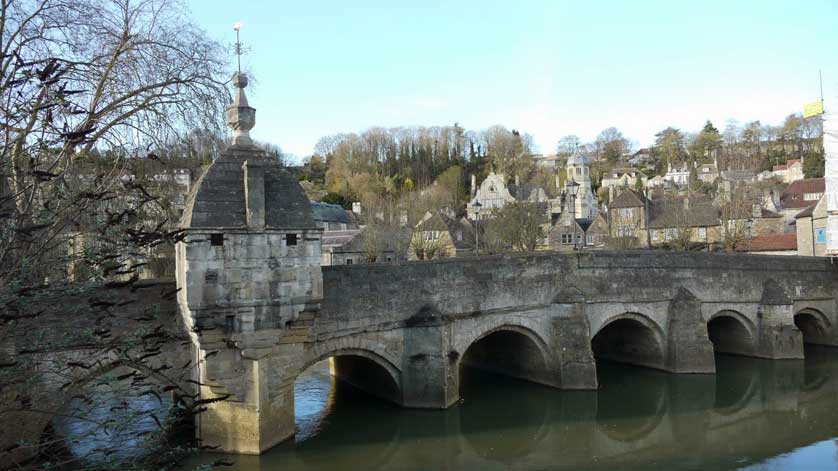
Town Bridge, Bradford-on-Avon
The centre of Bradford-on-Avon developed around the ford across the river Avon, thus the origin of the town’s name 'Broad-Ford'.
In Norman times, the stone bridge known today as Town Bridge was added. The Norman side of the bridge the visitor sees today is upstream and has pointed arches; the newer side has curved arches. Town Bridge is a grade I listed building.
On 2 July 1643, during the English Civil War, Royalists seized control of the bridge on their way to the Battle of Lansdowne. Another event from the 17th century to affect Town Bridge was the addition of a small building on the bridge. It was originally a chapel but later used as a gaol.

Clifton Suspension Bridge, Bristol
The Clifton Suspension Bridge spans the Avon Gorge and is the symbol of the city of Bristol. For over 150 years, this Grade I listed structure has drawn visitors from around the world.
Clifton Suspension Bridge was designed by the then 24-year-old Isambard Kingdom Brunel who had been declared the winner of a design contest for the bridge and was appointed project engineer - his first major commission in a glittering career.
Work on the bridge began in 1831 but was interrupted for financial reasons, and the bridge wasn't completed until 1864, after Brunel's own death in 1859.
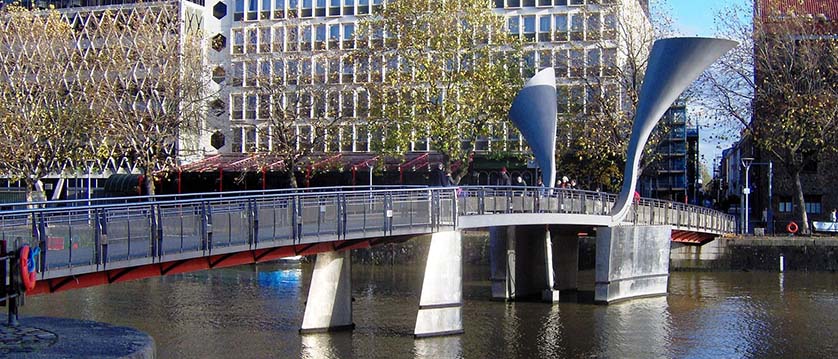
Pero's Bridge, Bristol
Linking Queen Square and Millennium Square on Bristol's waterfront, Pero's Bridge is a pedestrian, bascule (moveable) bridge at St Augustine's Reach in Bristol Harbour.
The bridge, which was designed by Irish artist Eilis O’Connell and built by Ove Arup & Partners in 1999 is named after "Pero" the black African slave of local merchant John Pinney (1740-1818).
Bristol's wealth as a port was built up on the back of slavery and the slave trade and the naming of the bridge after a former slave is recognition of this.
John Pinney's former 18th century residence is now a museum - The Georgian House - at 7, Great George Street, just off Park Street. Pinney’s elegant, six-storey, townhouse was built between 1788 and 1791.

Clare Bridge, Cambridge
Clare Bridge is a delightful and picturesque stone bridge across the River Cam in Cambridge in the area known as the Backs, in the University of Cambridge. Clare College Bridge, to give it its full name, was built between 1639 and 1640, making it the oldest bridge in Cambridge. It connects the Old Court of Clare College on the east bank with the college gardens and new campus on the west. Constructed mostly out of limestone, it is one of the earliest bridges in England built in the new Classical style. It is 75 feet long with three 21 feet arches. It is 14 feet wide between the balustrades, on top of which are perched large stone balls, one of which is missing a segment. Two stories, neither of which are proven, account for this anomaly.

Bridge of Sighs, Cambridge
The Bridge of Sighs is a covered, pedestrianized bridge over the River Cam at St. John's College in Cambridge. It is probably the best known and most photographed bridge in Cambridge. The bridge opened in 1831 in St. John's College and links Third Court and New Court.
The structure is the design of Henry Hutchinson (1800-1831), who died shortly after its opening. Done in the Gothic Revival style, it is said to have been a favourite of Queen Victoria. Originally called just "New Bridge," the name "Bridge of Sighs" stuck due to a supposed similarity to the famous enclosed bridge that links the prison to the Ducal Palace in Venice.
Mathematical Bridge
The Mathematical Bridge is a wooden footbridge over the River Cam in Cambridge that connects two parts of Queen's College. The bridge is 50 feet, 8 inches (15.44 metres) long and a marvel of 18th century engineering. The bridge opened in 1749 and was designed by William Etheridge (1708-1776). The construction was by the locally-born builder and architect James Essex (1722-1784), who worked on several Cambridge colleges as well as nearby Ely Cathedral. Originally called "Wooden Bridge," it is the only one of several wooden bridges around the country designed by Etheridge that still stands today. His most famous wooden bridge of a similar design was the Old Walton Bridge over the River Thames that was twice painted by Canaletto. The Grade II Listed building is not the original, however, as it has been replaced twice in 1866 and in 1905, retaining the basic design.
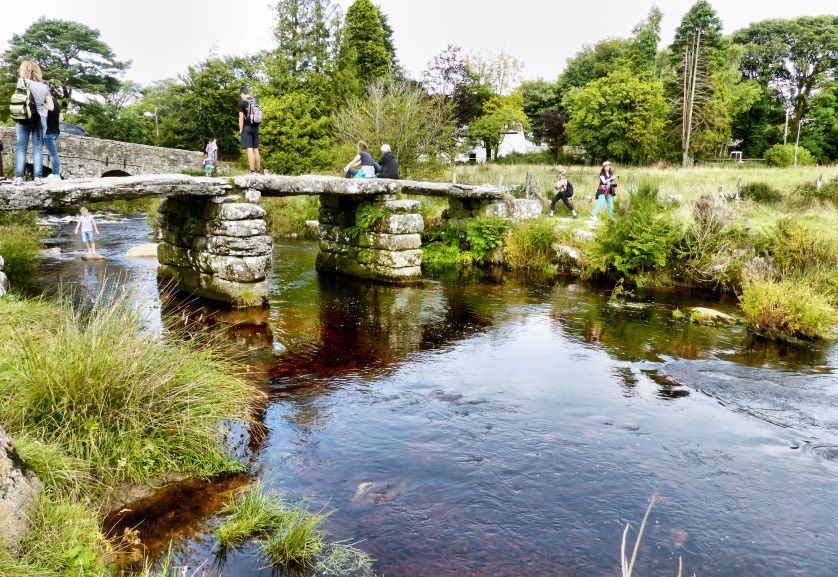
Postbridge Clapper Bridge, Dartmoor
Postbridge is a tiny settlement on Dartmoor in Devon, southwest England. The East Dart River passes through it and the B3212 passes over the stream on a picturesque stone bridge constructed in the late 18th century.
About 20 yards downstream from the road bridge however is a much, much older bridge of a type known as Clapper Bridge.
A series of long, natural rock slabs are laid across small piers made of stones. These clapper bridges are found across Dartmoor, Exmoor, and other highland areas of the UK and are believed to be derived from the Saxon word cleaca which means "bridging the stepping stones". Often thought to date back to prehistory, the one at Postbridge is believed to have been built in the 13th century, however.
Its slabs are more than 4 meters in length, 2 meters wide, and weigh more than 8 tons.
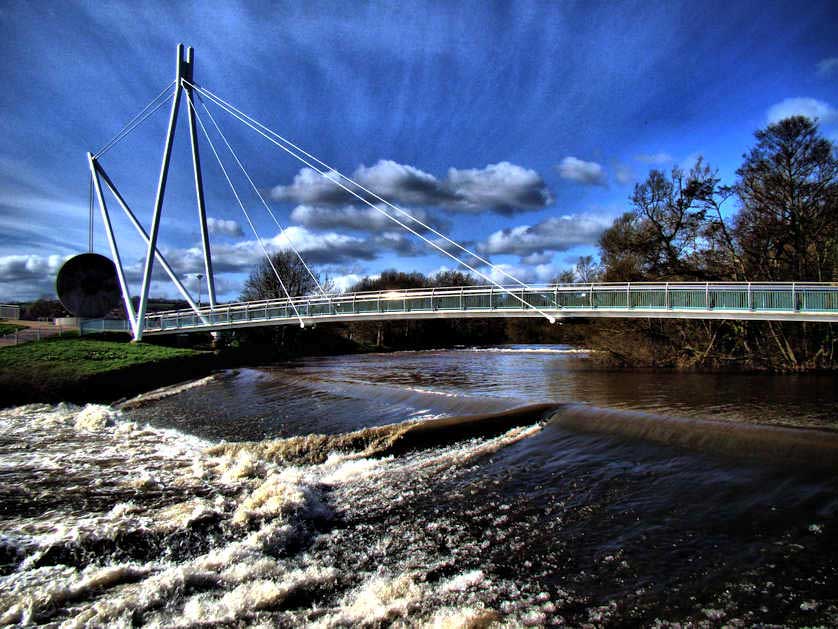
Miller's Crossing Bridge Exeter
Miller's Crossing Bridge across the the River Exe in Exeter, Devon, is a new pedestrian and cyclist bridge with a striking design.
The most interesting feature of its design is the anchor to which the cables are attached. This is in the shape of two large, circular millstones, a reference to the many mills that formerly operated along this stretch of the river.

Gateshead Millennium Bridge
Gateshead Millennium Bridge is a pedestrian and cyclist bridge over the River Tyne connecting Gateshead on the south bank and Newcastle on the north bank. It is part of the Gateshead Quays development along with Sage Gateshead (The Glasshouse International Centre for Music) and the BALTIC Centre for Contemporary Art. The bridge has won several awards for architecture and has appeared on the one pound coin. It was the world's first tilting bridge.

Iron Bridge, Shropshire
Ironbridge Gorge is a scenic gorge on the River Severn in Shropshire. Named after the first bridge made of iron, it is an area registered as a UNESCO World Heritage Site for its role in the beginnings of the Industrial Revolution.
The Iron Bridge was designed by Thomas Farnolis Pritchard, a local architect who mostly worked on interiors. His design is based on the structure of a timber bridge and construction began in 1777. He died before the bridge was completed in 1779.
Consisting of a single span of just over 100 feet, the bridge opened to traffic in 1781. The construction and the casting of the parts was undertaken by Abraham Darby III, the third generation of a local iron-making family. In 1934 the bridge was closed to vehicular traffic, but tolls were still charged to pedestrians crossing the bridge until 1950. The bridge has been recently renovated and is now painted a dark red.
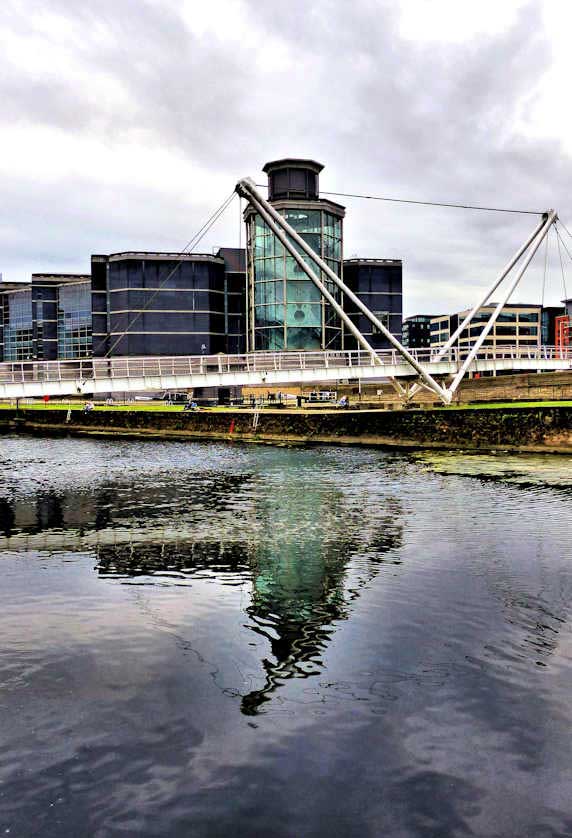
Knights Way Bridge
Knights Way Bridge in the Leeds Dock (formerly Clarence Dock) area of Leeds in Yorkshire is an 80-meter long, crane-type, cable-stayed pedestrian bridge with two spans over the River Aire. It was designed by Buro Happold, one of the designers of the nearby Royal Armouries Museum building, and opened in 2007. Other bridges in the UK with a similar design are Lune Millennium Bridge in Lancaster and Newport City footbridge in Wales.
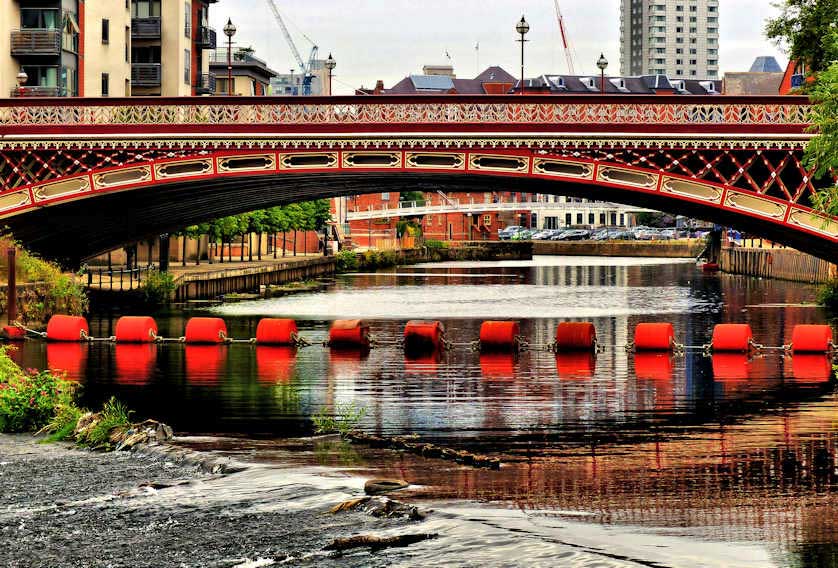
Crown Point Bridge
Crown Point Bridge also in Leeds is a classic Victorian cast-iron arch bridge, that though strengthened and widened in the late 20th century still retains its original grace and decorative ornamentation. It provides vehicular access to the Leeds Dock district. It was built in 1842 and is Grade II Listed structure. The bridge is the work of George Leather and his son, John Wignall Leather, who were responsible for several bridges in the city.

Severn Bridge (Pont Hafren)
The Severn Bridge (Pont Hafren in Welsh) crosses the River Severn and River Wye and links England to Wales.
A steel suspension bridge, it first carried the M4 motorway and now the M48 and opened in 1966.
Downstream the Second Severn Crossing (aka the Prince of Wales Bridge), which opened in 1996, now carries the M4.
Altogether the Severn Bridge is made up of four structures - the Aust Viaduct, Severn Bridge, Beachley Viaduct and Wye Bridge.

Tyne Bridge, Newcastle & Gateshead
The Tyne Bridge connecting Gateshead and Newcastle opened in 1928 and has a span of 162 metres. The road is 26 metres above the level of the river. The towers at either end of the bridge are made of Cornish granite (as is Tower Bridge in London) and were originally designed as warehouses.
Other bridges over the Tyne between Gateshead and Newcastle nearby include the Swing Bridge and the High Level Bridge.
The historic road and railway High Level Bridge was designed by Robert Stephenson, the son of George Stephenson and constructed between 1847 and 1849.
The Swing Bridge was the largest swing bridge ever built when it opened in 1876. Now the bridge can be turned by electric power rather than the original hydraulics. The swing bridge is said to stand on the site of the Roman Pons Aelius, the first bridge to span the Tyne.
Altogether seven bridges span the River Tyne.
Bridges in Wales
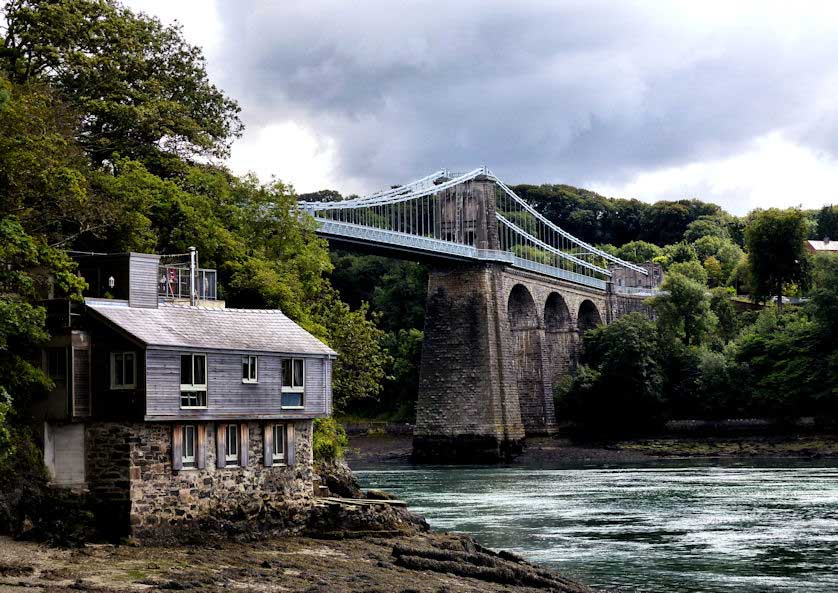
Menai Bridge
Menai Bridge was designed by the Scottish engineer Thomas Telford (1757-1834). It was decided to make it a suspension bridge so that ships could continue to easily pass through the strait.
The total length of the bridge is 417 meters and the central span is 176 meters and connects to 5 stone piers with 7 arches. The suspension was provided by huge iron chain cables. Originally with a wooden deck, it was replaced with steel in 1893.
To increase the weight limit of traffic over the bridge the iron chains were replaced with steel in 1938. The A5 now crosses the bridge.
Monnow Bridge
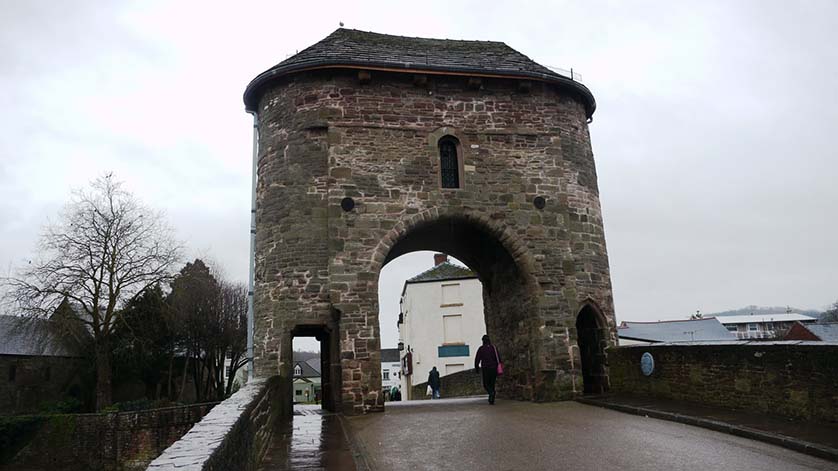
Monnow Bridge was built around 1270 AD as part of the defences of the castle town of Monmouth.
Monmouth was a Norman settlement in the strategic Welsh Marches and was one of system of fortifications to project Norman power into Wales.
Nowadays, Monnow Bridge remains the only surviving medieval bridge in Britain with a gate tower standing on the bridge. The gate tower has historically served as toll house, gaol, guard room and dwelling house.
Monnow Bridge crosses the River Monnow (Afon Mynwy) just above where it flows into the River Wye.
Bridges in Scotland

Forth Bridge
The Forth Bridge spans the estuary of the Forth River outside Edinburgh in Scotland and is the world's longest multi-span cantilever bridge. It is now the second longest single cantilever bridge after Quebec Bridge in Canada. The Forth Bridge opened in 1890 and carries railway passengers and freight. It was designed by English engineers Sir Benjamin Baker and Sir John Fowler and carries the Edinburgh to Aberdeen railway line across the Forth. Altogether the bridge is 8,094 feet (2,467 meters) in length. The engineering marvel of its time is classified as a UNESCO World Heritage Site. It was the first of several bridges that now span the the Forth River.

Forth Road Bridge
The Forth Road Bridge opened in 1964 and at the time was the longest steel suspension bridge in Europe. It resembles both the Golden Gate Bridge in San Francisco and the Ponte 25 Abril in Lisbon. After the opening of the Queensferry Crossing, the Forth Road Bridge closed for repairs. It reopened in 2018 with priority given to public transport, cyclists and pedestrians.

Queensferry Crossing
The Queensferry Crossing is a road bridge that carries the M90 motorway across the Forth. It is adjacent to the previous Forth Road Bridge which had exceeded capacity and was found to have structural problems in 2004. It is the third bridge across the Firth at Queensferry after the Forth Bridge and Forth Road Bridge. Queen Elizabeth II officially opened the bridge in 2017 as she had done the Forth Road Bridge in 1964. Cable-stayed the structure has three concrete towers each 207 metres (679 feet) high. This makes them the tallest bridge towers in the UK. The three Forth Bridges span three centuries of British engineering.
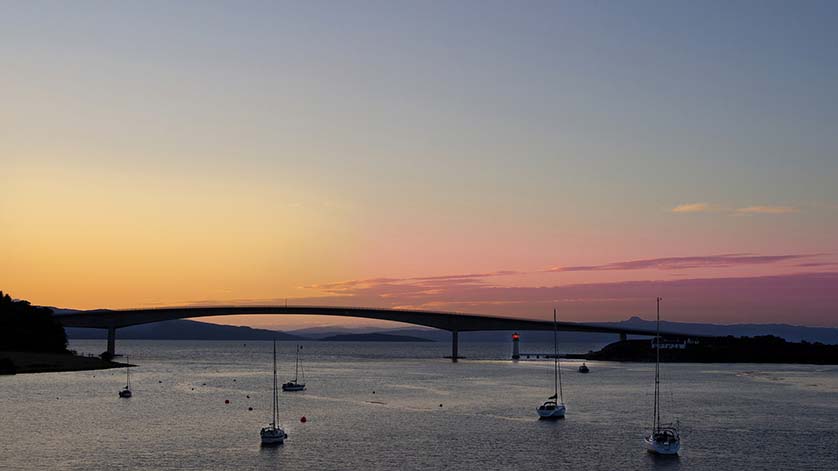
Skye Bridge, Scotland
The Skye Bridge was opened to traffic in 1995 and connects the Isle of Skye with the mainland of Scotland at Kyle of Lochalsh where the channel between the two is only a few hundred meters.
The bridge is a concrete box girder type with a total length of 500 meters and a central span of 250 meters. The center of the bridge has a clearance above the water of 35 meters. The bridge makes use of the island of Eilean Bàn as a stepping stone.
The bridge carries the A87 with intercity buses connecting Portree on Skye with Inverness and Fort William. These buses also stop at the iconic Eilean Donan Castle nearby.
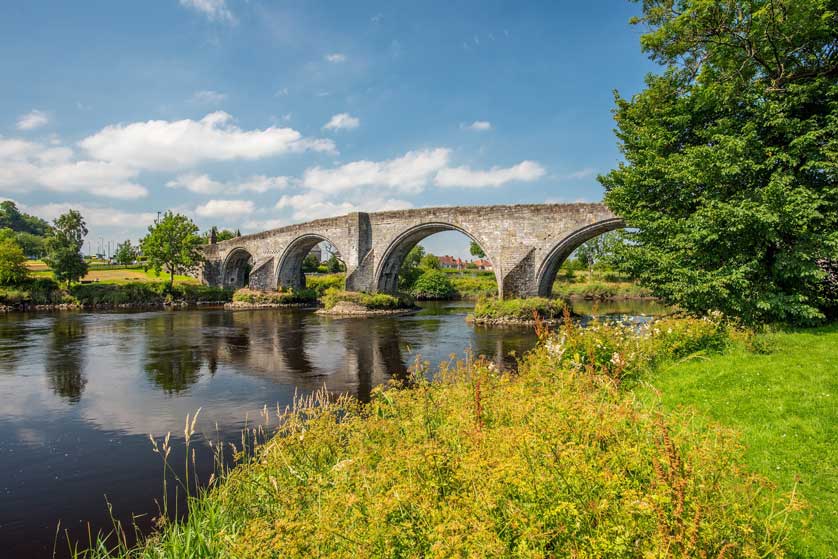
Stirling Old Bridge
Stirling Old Bridge in Stirling not far from Stirling Castle is the site of the Battle of Stirling Bridge in 1297 where William Wallace defeated the English. This wooden structure was replaced by the present stone bridge in the early 16th century. In 1745, one of the arches was destroyed by the English to hinder the advance of the Jacobite army. It was replaced in 1749.
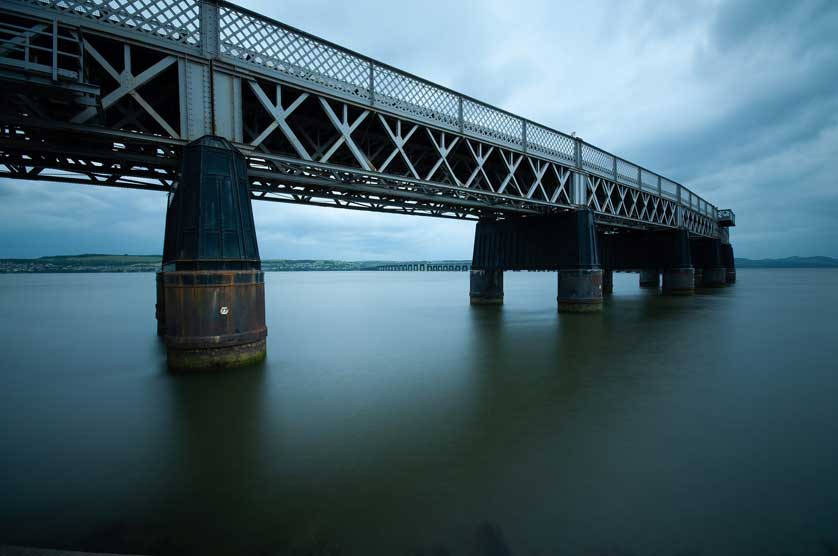
Tay Bridges
The Tay Bridge carries the railway 4.43 km across the Firth of Tay from Dundee to Wormit in Fife. It replaced the original Tay Bridge which collapsed in a storm in December 1879, just a year after it opened. A train carrying 75 passengers and crew fell into the Tay killing everyone onboard in one of the UK's worst rail disasters. The present bridge opened in 1887 and was strengthened in 2003. It is a pier-and-lattice, iron and steel, girder bridge with 85 spans, located 18 metres upstream of the original bridge.
The Tay Road Bridge dates from 1966 and opened after 3 and a half years of construction. The steel and concrete structure is 2,250 meters in length and replaced the Tay ferry service. The bridge carries the A92 across the Firth of Tay from Newport-on-Tay in Fife to Dundee. It is one of the longest road bridges in Europe.
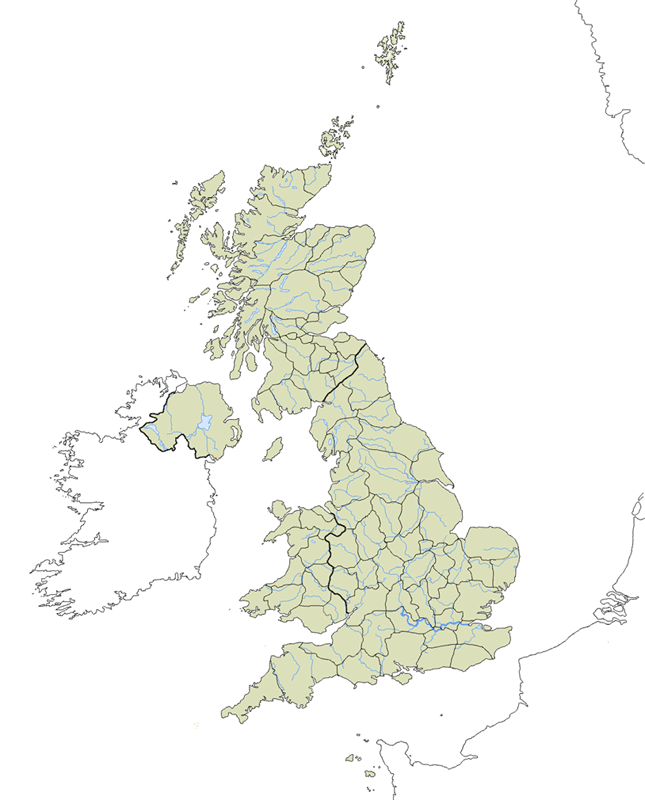
Map of the Major Rivers in Britain
Bridges Related
Hotels in London
Book Hotels in London - Booking.com
Find Luxury Hotels in London - Booking.com
Budget Hotels in London - Booking.com
Find Hotels in England - Booking.com