A-Z Listing of British Authors & Their Associated Places

See a listing of British authors and places in the UK associated with their life and works.
Britain is world famous for its authors and their literature. Each writer is often linked with a particular place or region. Shakespeare, for example, is most connected with Stratford-upon-Avon, where he was born and died and London, where he wrote his plays and poems and established his theatre - The Globe. To find out more about famous British writers the British Library is a good place to start.

A B C D E F G H I J K L M N O P Q R S T U V W X Y Z
A = Jane Austen (1775-1817) - was born in Steventon in Hampshire. As an adult, she also lived in Bath and Southampton. She moved to Winchester to seek treatment for the disease which was to kill her. She is buried in Winchester Cathedral in Winchester, where she died in 1817. Fans of Jane Austen should visit the Jane Austen Centre in Bath, the Assembly Rooms, also in Bath and her house in Winchester where she spent the last six weeks of her life.
B = Brontë Sisters (Charlotte, Emily, Anne) - the isolated moors surrounding the village of Haworth provided the backdrop for novels like Wuthering Heights and Jane Eyre. The family parsonage is now the Brontë Parsonage Museum.
Anthony Burgess (1917-1993) was born in Manchester in northwest England and attended university there. He spent much of his life outside the UK. Most remembered for his dystopian novel, A Clockwork Orange, the author is celebrated at the International Anthony Burgess Foundation in his birthplace. An independent charity, the foundation was founded in 2003 by Burgess' second wife, the Italian translator and literary agent, Liana Burgess (1929-2007). It contains a library, archive and study centre for Burgess's books, music and papers.
Robert Burns (1759-1796) - aka Rabbie Burns is considered the national poet of Scotland. Born in Alloway, Ayrshire, on the west coast of Scotland, he lived in both Edinburgh and Dumfriesshire during his short life and is buried in St. Michael's Churchyard in Dumfries. The 25th January is traditionally Burns Night when lovers of the poetry of Scottish bard celebrate his birthday with Burns' Suppers, which include dining on haggis, drinking Scotch whisky, donning tartan and reciting Burns's poetry especially his classic Auld Lang Syne.
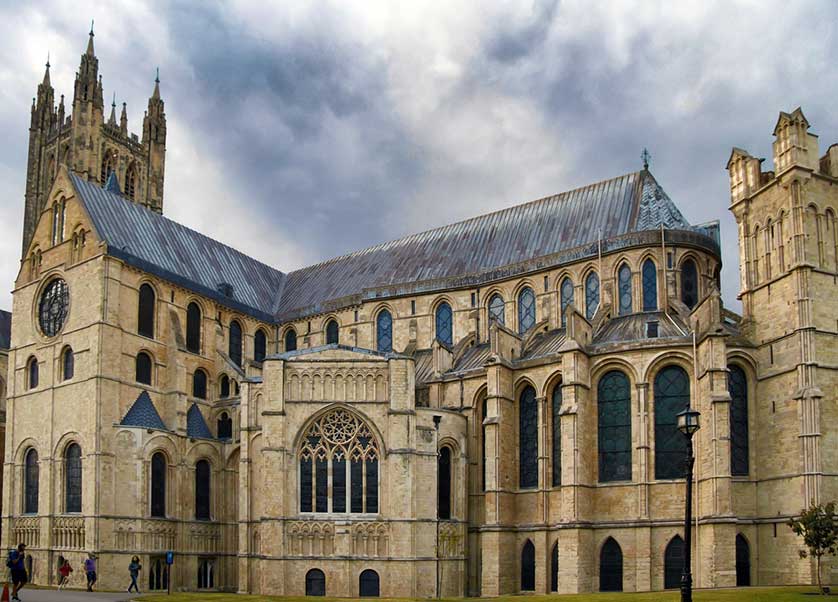
C = Geoffrey Chaucer (c. 1343-1400) - is most associated with the city of Canterbury in Kent the inspiration for The Canterbury Tales. Visitors should head for the Canterbury Tales Experience when it reopens. Chaucer was born in London and is buried in Westminster Abbey.
Agatha Christie (1890-1976) - Christie was born in Torquay and used Greenway House, her holiday home in Devon, as a setting in novels like Dead Man's Folly.
Samuel Taylor Coleridge (1772-1834) - was born in Ottery St Mary in Devon, where his father was vicar at The Church of St Mary of Ottery. Fans of the poet should visit Coleridge Cottage in Nether Stowey, Somerset. It was the home Coleridge for nearly three years from 1797. Within a year of moving to the cottage, Coleridge had written some of his most famous works including, The Rime of the Ancient Mariner, Frost at Midnight, and Kubla Khan. Coleridge died in London and is now buried in St Michael's Church, Highgate.
Other literary connections to Ottery St Mary include William Makepiece Thackeray, who occasionally stayed in the village and set his novel Pendennis here. In addition, the 19th-century Japan scholar, translator and statesman Sir Ernest Satow (1843-1929) is buried in the northeast corner of the churchyard.
Joseph Conrad (1857-1924) - though born in Poland, Conrad spent much of his life in England, mostly in London, and lived the last six years of his life in Bishopsbourne near Canterbury, Kent.
D = Charles Dickens (1812-1870) - born in Portsmouth (his birthplace is a museum), Dickens is most associated with London and Rochester, Kent. His home at 48 Doughty Street near Russell Square and the British Museum in London is now the Charles Dickens Museum. The Charles Dickens Coffee House in London's Covent Garden district was on the ground floor of the building that was the office of All The Year Round, a magazine Dickens founded to publish his stories. At the peak of Dickens' popularity, crowds would gather outside to wait for the latest episode. A Blue Plaque now commemorates the spot.
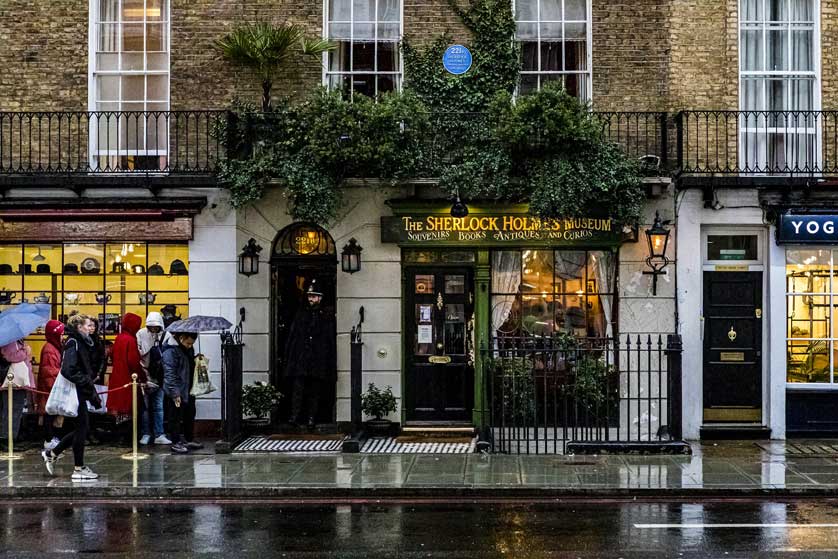
Arthur Conan Doyle (1859-1930) - the famous detective Sherlock Holmes's fictional address was 221B Baker Street in London, which is now the Sherlock Holmes Museum near Baker Street tube station.
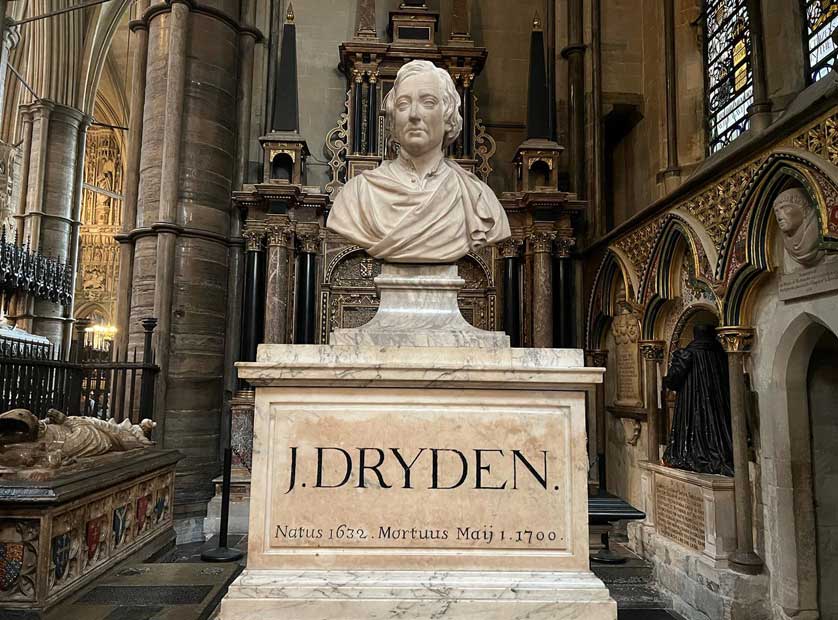
John Dryden (1631-1700) - the poet, playwright and translator is buried in Westminster Abbey where he has an elaborate monument dedicated to him. John Dryden became England's first Poet Laureate. As a young man he attended the nearby Westminster School as a King's Scholar before going on to Cambridge.
E = George Eliot (Mary Ann Evans) (1819-1880) - born in Warwickshire, Mary Ann Evans was the daughter of a farm manager at Arbury Hall. She moved to London aged 30 working as an editor of The Westminster Review, after living in Coventry during her 20's. It was her move to the capital and her controversial (for the time) relationship with the married George Henry Lewes that was the stimulus for the publication of her greatest works. A blue plaque marks her house in Cheyne Walk, Chelsea.
T.S. Eliot (1888-1965) - though American by birth, Eliot spent most of his adult life in England working for the publishing company Faber & Faber in Russell Square. Eliot is buried near Yeovil in the village of East Coker, a title of one of the poet's Four Quartets.
F = Ian Fleming (1908-1964) - the creator of James Bond, Fleming lived in London and had a holiday home in St Margaret's Bay, Kent, a location used in Moonraker.
Ken Follett (1949-) - Ken Follett's novel The Pillars of the Earth is one of his most popular and leads readers to Kingsbridge Cathedral. Follett's epic 1000+ page yarn tells the story of the building of a 12th century English cathedral, supposedly based on Salisbury Cathedral and Wells Cathedral. The book details the lives, loves, and fears of those involved, set against the political intrigue and violent skullduggery of those times. This is a period in English history known as "the Anarchy".
G = William Golding (1911-1993) - born in Newquay in Cornwall, the author of The Lord of the Flies, studied at Oxford before becoming a school teacher in Maidstone and later Salisbury. After active service in the Royal Navy in World War II he returned to Salisbury. He died in Truro and is buried in the parish churchyard of Bowerchalke in Wiltshire.
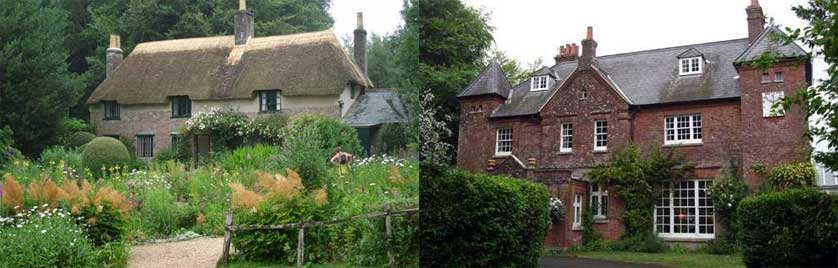
H = Thomas Hardy (1840-1926) - is most associated with Dorset (Wessex in his novels). Visitors to the area can visit his birthplace Hardy's Cottage in Higher Bockhampton, Dorchester (or Casterbridge as the town is known in the writer's novels) where he worked as an architect and the house he built for himself in later life, Max Gate. The Dorset County Museum on High West Street in Dorchester holds the largest collection of original Hardy manuscripts in the world. Hardy's heart is buried at Stinsford Churchyard, north of Dorchester along with his first wife (Emma nee Gifford) and second wife (Florence Emily nee Dugdale). Hardy's ashes are placed at Poet's Corner in Westminster Abbey in London.
Anne Hathaway (1556-1623) - the wife of William Shakespeare - Anne Hathaway's Cottage was the family home of Anne Hathaway's father, Richard. The large farmhouse and gardens are located in the village of Shottery about a mile from the centre of Stratford-upon-Avon. The house remained within the Hathaway family and its descendants until 1892 when it was purchased by The Shakespeare Birthplace Trust.
I = Kazuo Ishiguro (1954-) - born in Nagasaki, Japan, Ishiguro moved to Guildford in the UK aged 5. The author of A Pale View of Hills, An Artist of the Floating World and The Remains of the Day has made his home first in Guildford (he attended school in Woking), then Canterbury as a student and now lives in Golders Green, north London.
J = Samuel Johnson (1709-1784) - was born in Lichfield, Staffordshire, studied at Pembroke College in Oxford and lived much of his life in London. For an interesting insight to the great man of English letters head to Doctor Johnson's House near near St Paul's Cathedral and his nearby local pub, Ye Olde Cheshire Cheese.
K = John Keats (1795-1821) - Keats was born in London and worked at Guy's Hospital in the city. He died at a young age of tuberculosis in Rome, Italy. His former home is now the Keats House Museum near Hampstead Heath.
Rudyard Kipling (1865-1936) - Kipling's home, Bateman's, in East Sussex. provided inspiration for many of the author's works set in the Sussex countryside.

L = D. H. Lawrence (1885-1930) - born in Eastwood near Nottingham, Lawrence spent much of his adult life on the move. He lived in Croyden, and spent time in Germany, Italy, Zennor in Cornwall, where the author lived with his wife Frieda for 18 months from 1915, London again, Australia, Italy, Sri Lanka, the United States, Mexico and the south of France, where he died in the small town of Vence from complications of tuberculosis in 1930.
M = John Milton (1608-1674) - Milton is most associated with Cambridge, where he studied and London and the Home Counties, where he spent most of his adult life. One of his former homes still exists in the village of Chalfont St Giles in Buckinghamshire.
William Morris (1834-1896) - though most remembered as an artist and social activist, Morris was also an author of such works as The Earthly Paradise and News from Nowhere. His former home in Walthamstow, east London is now the William Morris Gallery.
N = V. S. Naipaul (1932-2018) - was born in Trinidad but studied at Oxford, before living at various addresses in London including Kilburn and Streatham Hill. He was cremated at Kensal Green Cemetery.
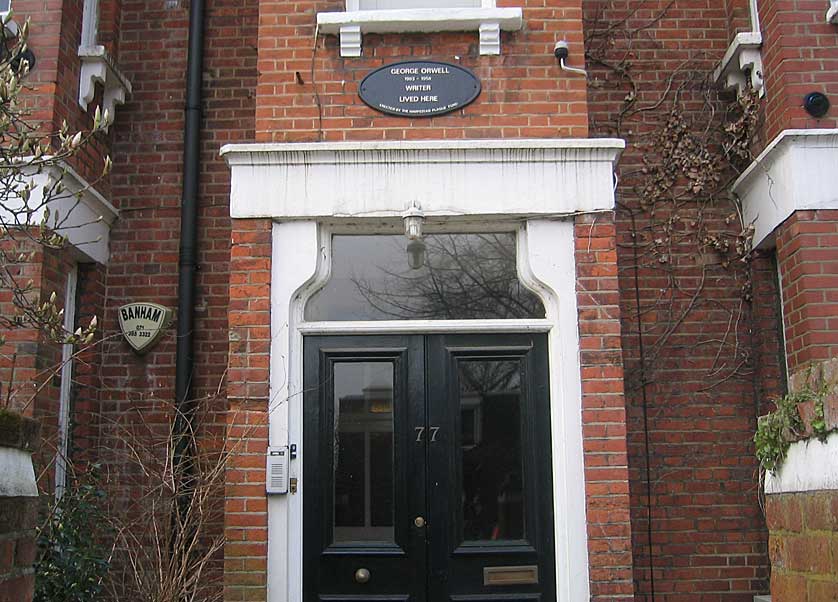
O = George Orwell (1903-1950) - the author of Animal Farm and Nineteen Eighty-Four was born in British India, attended Eton College and lived in various places in the UK including his parents' house in Southwold after his return from Burma, where he worked in the police. A stay in Paris inspired Down and Out in Paris and London. Orwell worked for a period as a teacher in Uxbridge, west London and later lived in Kentish Town, Hampstead and Greenwich. Nineteen Eighty-Four was written on the Isle of Jura in Scotland. His grave is in All Saints' churchyard, Sutton Courtenay, Oxfordshire. A statue of George Orwell stands outside Broadcasting House, the headquarters of the BBC in London.
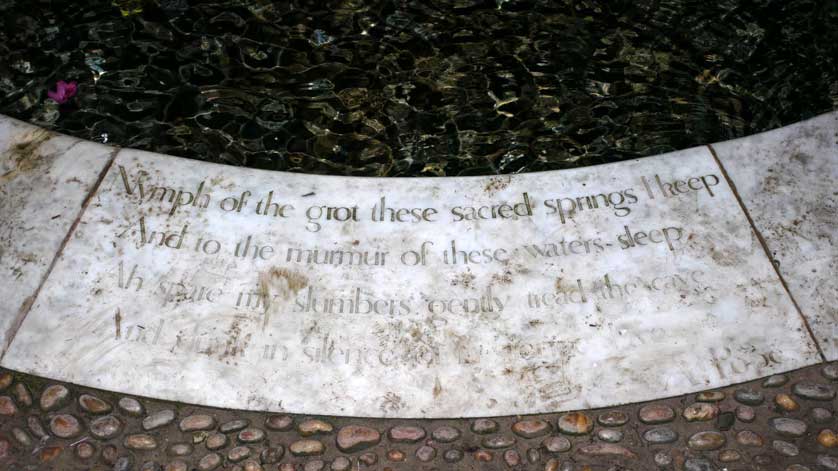
P = Alexander Pope (1688-1744) - born in London, the poet spent much of his life in and around the capital namely in Chiswick and Twickenham, where he is buried in St Mary's Church. At Stourhead in Wiltshire is a poem by Pope preserved in stone in one of the garden's grottoes.
Beatrix Potter (1866-1943) - The Lake District and her home, Hill Top, inspired many of her Peter Rabbit stories and characters. She bought the property with the royalties from her first book.
John Cowper Powys (1872-1963) - though born in Derbyshire, like Hardy many of Powys' novels are set in the West Country (Wessex). These include A Glastonbury Romance (1932), in Glastonbury, Somerset, Weymouth Sands (1934), and Maiden Castle (1936) set around Maiden Castle in Dorset, the UK's largest Iron Age fort,.
Q = Thomas De Quincey (1785-1859) - was born in Manchester and best known for his Confessions of an English Opium-Eater (1821), publication of which caused a sensation at the time. He lived at Fox Ghyll, near Rydal in Cumbria from 1820 to 1825 but later moved to Scotland, living in both Glasgow and Edinburgh. His grave is in St. Cuthbert's Kirkyard, Edinburgh.
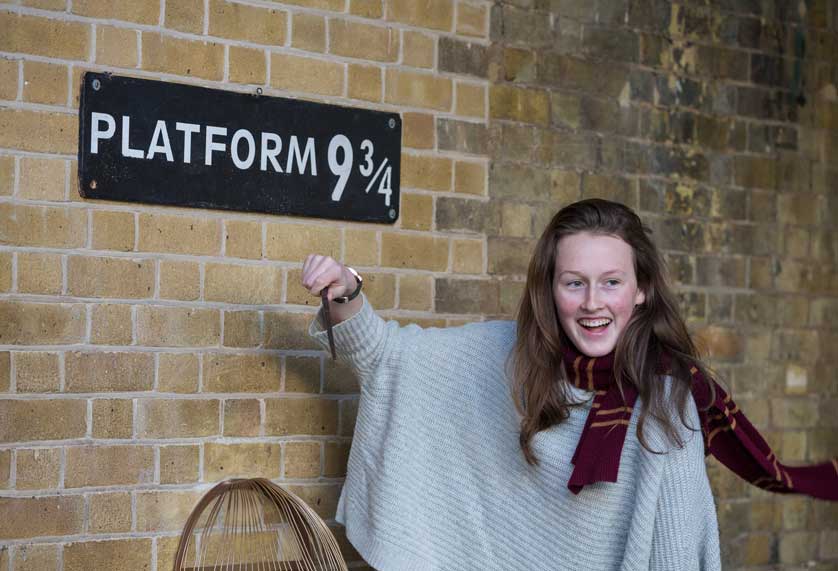
R = J. K. Rowling (born 1965) - the author of the Harry Potter series was born in Gloucestershire but now lives in Edinburgh in Scotland. Platform 9¾ at King's Cross Station draws a daily deluge of Harry Potter fans.

S = William Shakespeare (1564-1616) - His birthplace is a museum, and visitors can also see Anne Hathaway's Cottage and the Royal Shakespeare Theatre in his hometown. In London, the recreation of Shakespeare's Globe Theatre is a major landmark. William Shakespeare and his wife Anne are interred at the Holy Trinity Church in Stratford-upon-Avon.
Walter Scott (1771-1832) - Scott was born in Edinburgh and lived for most of his life there and in the Scottish Borders. The Fair Maid's House in Perth is a setting for Scott's 1828 novel The Fair Maid of Perth.

T = Alfred Tennyson (1809-1892) - was Poet Laureate for much of Queen Victoria's reign. Born in Somersby, Lincolnshire, he studied at Cambridge and lived in his later years on the Isle of Wight. At the top of Tennyson Down at 147 meters above sea level on the island, stands a huge granite cross, the Tennyson Memorial, commemorating his life. He is buried in Poets' Corner at Westminster Abbey in London, near other literary giants such as Robert Browning and Geoffrey Chaucer.
Dylan Thomas (1914-1953) - The boathouse where Thomas lived and worked in Laugharne, Wales is a key location associated with his life.
J. R. R. Tolkien (1892-1973) - Tolkien lived in Oxford and often visited the Cotswolds, which are said to have provided inspiration for the tranquil setting of The Shire in The Lord of the Rings.
U =
V =
W = H. G. Wells (1866-1946) - Wells only lived in Woking for a year from 1895-1896 but it was here that he wrote many of his famous works including War of the Worlds and The Time Machine.
Virginia Woolf (1882-1941) - Woolf and her husband lived at Monk's House in Rodmell from 1919. Her writing lodge in the garden overlooks the South Downs. Her childhood holidays in Cornwall are said to have inspired the setting for To the Lighthouse.
William Wordsworth (1779-1850) - the Romantic poet is most associated with the Lake District and his home there at Dove Cottage, where he wrote his classic I wandered Lonely as a Cloud. This quaint whitewashed house near Grasmere was Wordsworth's first home in the Lake District, where he stayed between 1799 and 1808. His poem, Lines composed a few miles above Tintern Abbey, written in 1798, celebrates Tintern Abbey near Chepstow.
X =
Y =
Z =
Iconic Book Locations in Britain
Hotels in the UK
Book Hotels in England - Booking.com
Find Accommodation in London - Booking.com
Search Hotels in Scotland - Booking.com
Hotels in Northern Ireland - Booking.com