HMS Victory, Portsmouth
HMS Victory
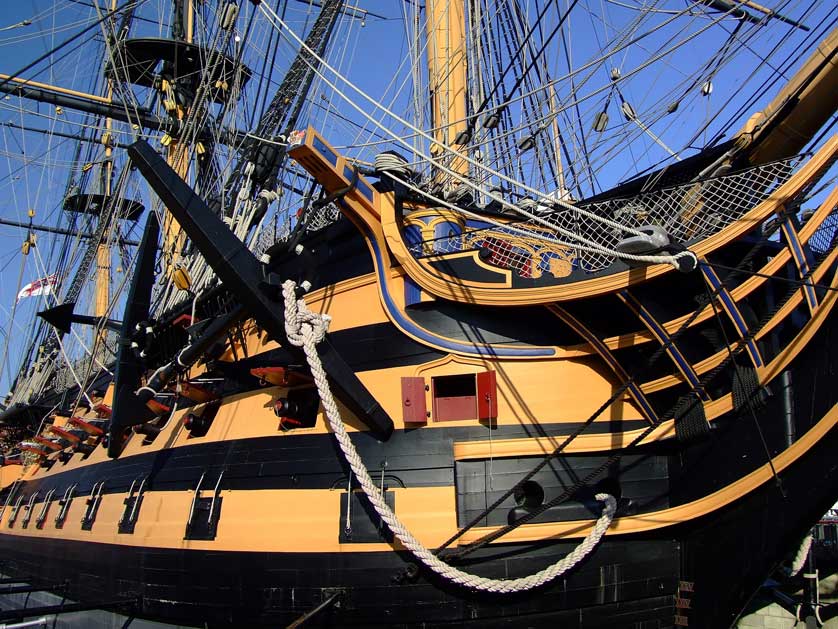
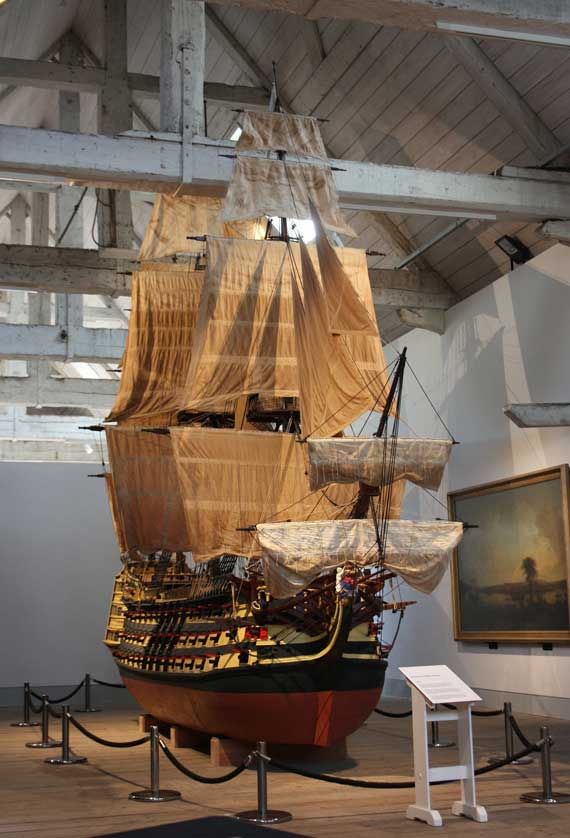
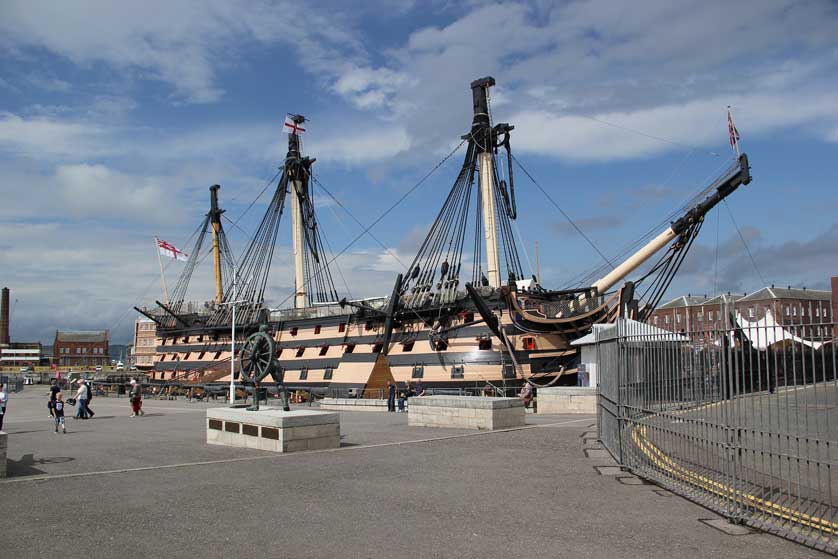
HMS Victory is Britain's most famous battleship. She was launched in 1765 and was Lord Nelson's flagship at the Battle of Trafalgar in 1805. Victory is the world's oldest naval ship still in commission.
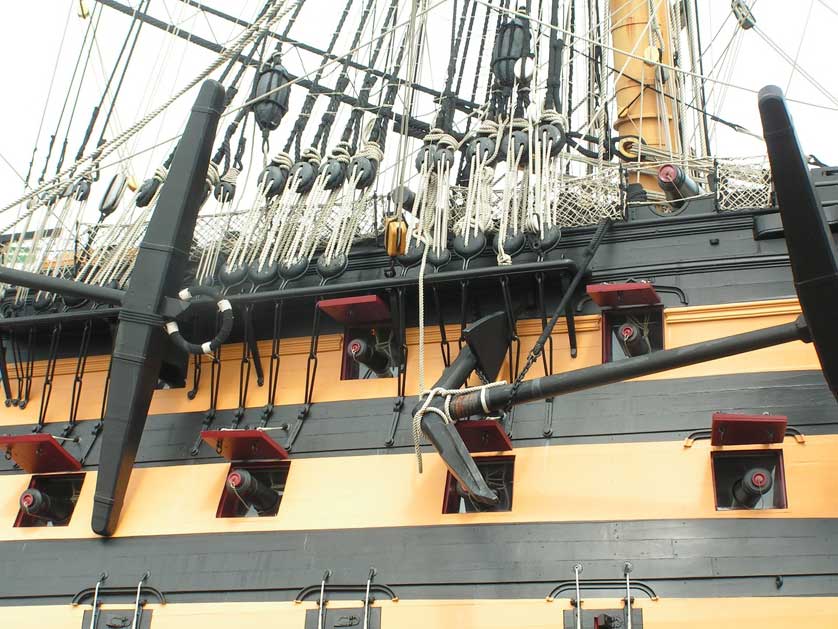
The ship carried 104 guns and had a displacement of 3,500 tons. She was in active service until 1824.
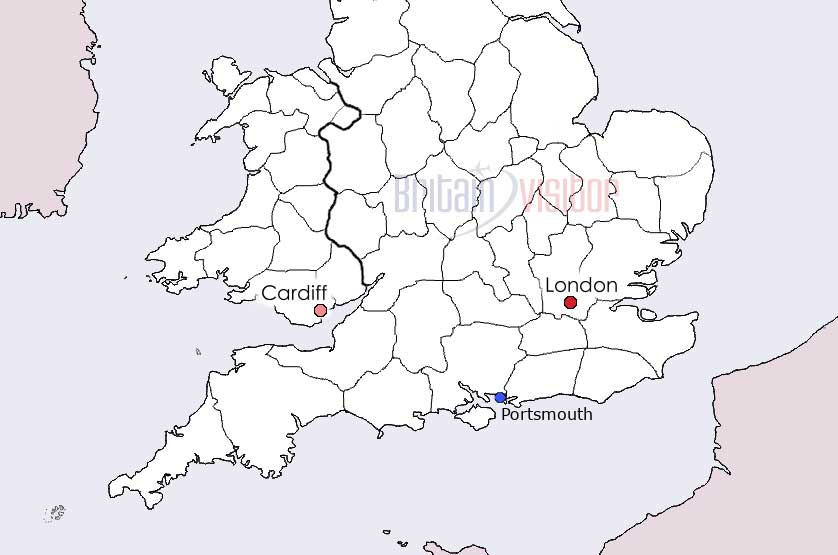
The vessel is now in dry dock at Portsmouth Harbour in Portsmouth, Hampshire and is part of The National Museum of the Royal Navy.
History
Launched from Chatham Dock in Kent, southeast of London in 1765, HMS Victory served in various conflicts. During a turbulent period in Britain's history, the ship saw action during the American War of Independence and the Napoleonic Wars.
Altogether the ship fought in five naval battles including Trafalgar and the Battle of Cape St Vincent in 1797, when she was Admiral Sir John Jervis' flagship.
After Trafalgar the vessel again led the fleet in the Baltic before going into semi-retirement in harbour service as a residence for crews.
In 1922 she was placed in dry dock in Portsmouth and preserved for posterity. Recently the original steel supports from the 1920s were removed as the ship's timbers were beginning to sag. They were replaced by 134, new, locally-manufactured hydraulic supports which were placed in position using laser guidance. The conservation and preservation of the vessel is an ongoing process involving a team of experts.
The Crew
Victory had a crew of 821 men at the Battle of Trafalgar. These included the Captain and nine commissioned officers, 146 Royal Marines, and over 500 seamen. Mostly these men were young with the majority less than 24 years old and the youngest just 12. At Trafalgar the oldest crew member was the ship's purser aged 67. 10% were from outside the UK. 289 were volunteers, and 217 had been pressed into service.
The Ship
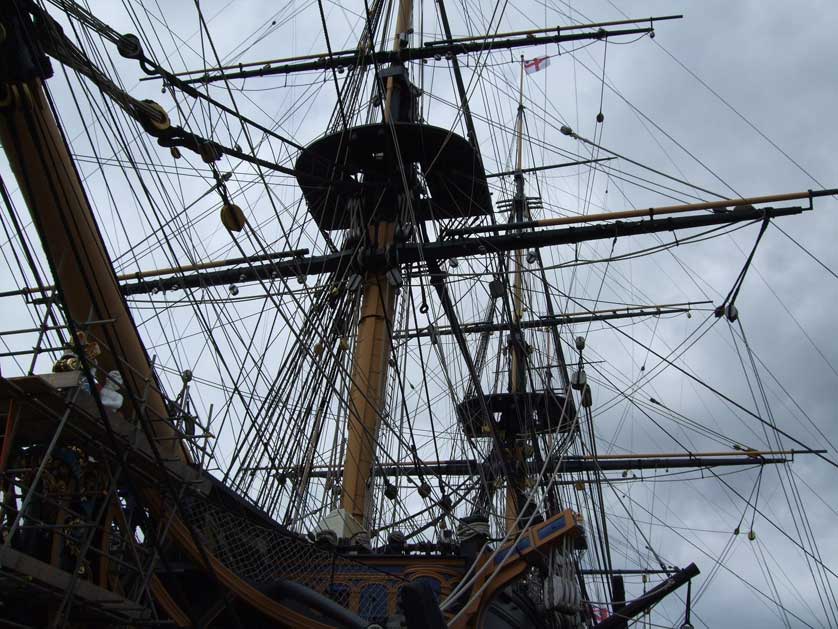
6,000 trees were used in the construction of the ship, about 90% of them oak along with small quantities of elm, fir, pine and teak. Altogether the ship is nearly 70 meters in length, carried 104 guns and had a displacement of 3,500 tons when at sea. At full speed she could sail at around 20 km per hour.
Although a large battleship, HMS Victory was not the largest ship that took part at the Battle of Trafalgar. Both the French and Spanish navies had larger vessels.
Tour of the Ship
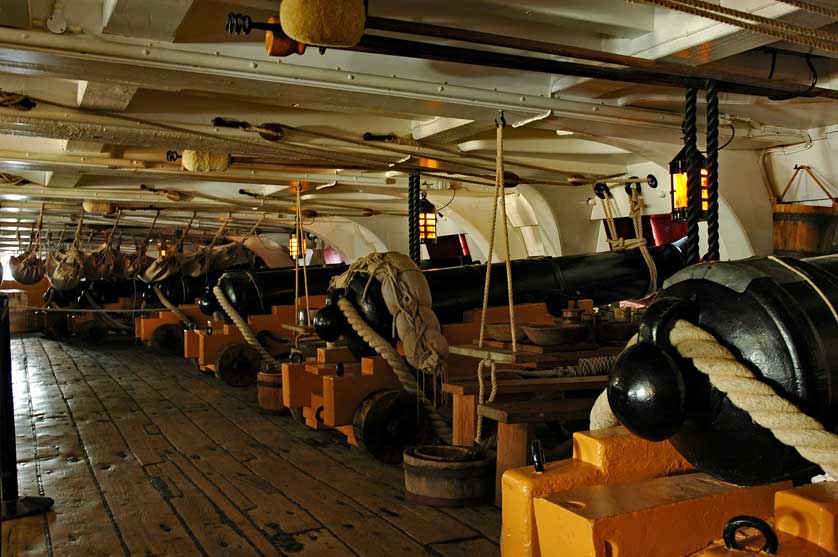
Any visit to HMS Victory allows access to the Poop Deck, where you can gaze out over the other ships in the harbour, the Galley, wherein a single small stove had to cater to over 800 men, and the tight confines of the Lower Gun Deck with its 32-pound guns weighing more than 4 tons. Here more than 600 men would eat their meals and 460 slept in hammocks.
Nearly all of the guns on board now are lighter, mainly fiber glass, replicas but an original gun can still be seen on the middle gun deck.
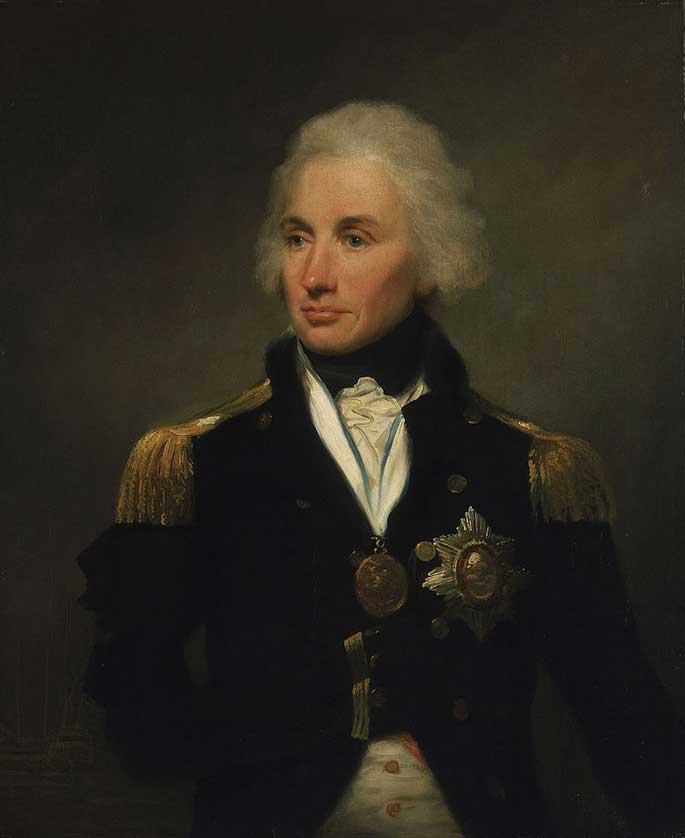
A plain brass plaque on the Quarterdeck marks the spot where Nelson was fatally shot with a musket ball from the rigging of the French warship La Redoutable. His face covered with a handkerchief, so not to lower the morale of his men, he was carried to the Orlop Deck where he died three hours later, knowing victory was assured. He was later buried with great pomp in St. Paul's Cathedral in 1806.

Great Cabin
A highlight of a visit to the ship is the Great Cabin, where Nelson would have spent his time and discussed his battle plans with the other captains. As a flagship, and therefore the home of an Admiral, the Great Cabin was about as luxurious as it got on battleships at the time. It includes a Day Cabin, basically the Admiral's office and the Dining Cabin, where Nelson entertained his officers. The other two rooms in the suite were an ante-room for staff and Nelson's bed chamber.
Hardy's Cabin
Hardy's Cabin is a simpler version of the Great Cabin and was the home at sea for the ship's captain at the time of Trafalgar, Sir Thomas Masterman Hardy.
Dry Dock
Visitors can get an idea of the size of the ship from her dry dock and also see the recent restoration efforts including the 134 hydraulic supports that hold her as if she was at sea.
National Museum of the Royal Navy
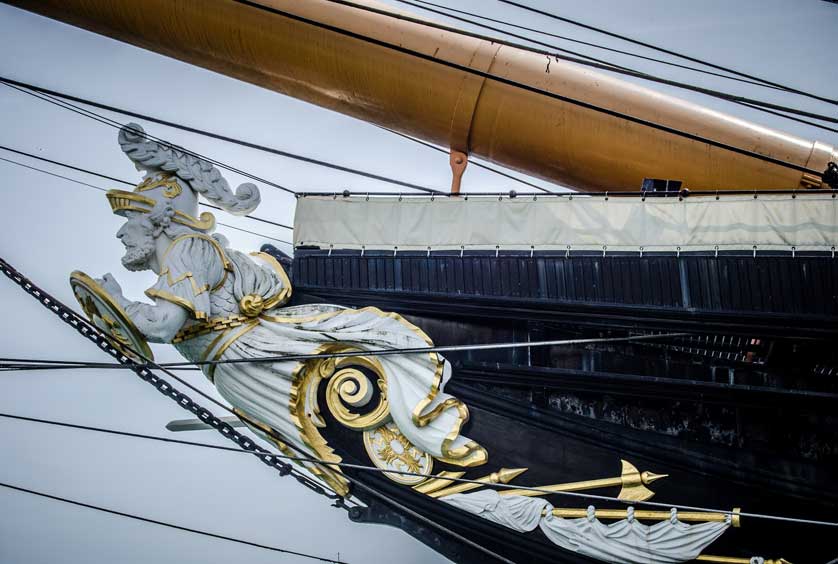
The Mary Rose and HMS Warrior are two of several ships also on display in Portsmouth.
The pride of Henry VIII's navy, the Mary Rose was raised from the sea in a complex and expensive operation in 1982. HMS Warrior is a steam-powered armoured frigate launched in 1860. The vessel was one of the first armour-plated, iron-hulled warships and was equipped with 40 guns.
Visitors can also go onboard HMS M33, one of three remaining British warships from First World War, built in 1915.
Harbour Tours allow visitors to see first hand Britain's modern navy while docked in Portsmouth.

Information & Access
Main Road
HM Naval Base
Portsmouth PO1 3LJ
Tel: 0239 283 9766
www: hms-victory.com
Hours: The Historic Dockyard opens at 10 am daily. From April to October: the Dockyard closes at 6 pm. From November to March it closes at 5.30 pm.
The Historic Dockyard is closed on Christmas Eve, Christmas Day and Boxing Day.
Portsmouth Harbour Train Station is the nearest railway station, a short walk from the Historic Dockyard. The adjacent Hard Interchange coach and bus station serves both long-distance and local buses. Trains from Waterloo Station in London take around 80 minutes to Portsmouth via Woking and Guildford.
Spinnaker Tower is a modern monument close to the station and part of the redevelopment of the area.

Other Historic Ships in Britain
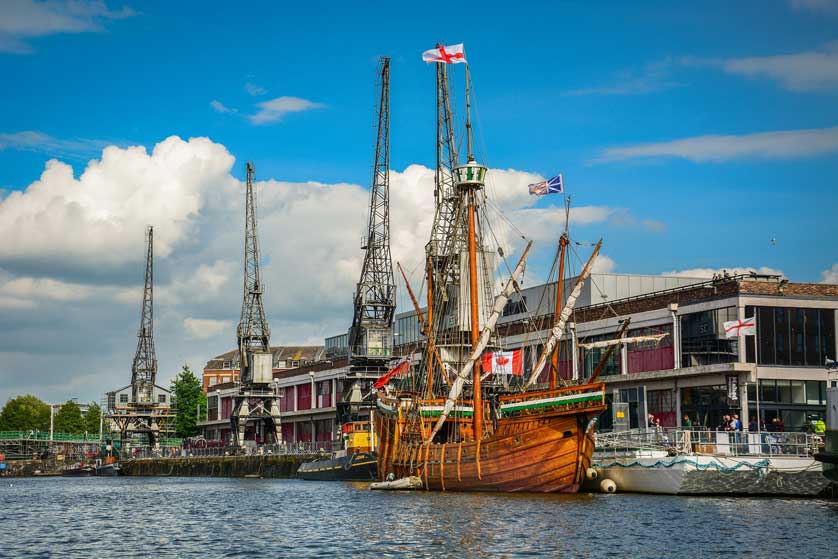
Other historic vessels that have been preserved include HMS Belfast on the River Thames in London and the Cutty Sark also on The Thames in Greenwich. The Golden Hinde, a replica of Drake's flagship is also in the capital.
The SS Great Britain and The Matthew are both in Bristol Harbour.
The PS Waverley, claimed to be the last seagoing paddle steamer in the world, is in Glasgow berthed outside the Glasgow Science Center.
Turbinia is on display at the Discovery Museum in Newcastle. It was once the fastest ship in the world at the turn of the twentieth century.
Map
Related
Hotels in London
Book Hotels in London - Booking.com
Find Luxury Hotels in London - Booking.com
Budget Hotels in London - Booking.com
Find Hotels in England - Booking.com