Portsmouth Guide
Sean O'Conor
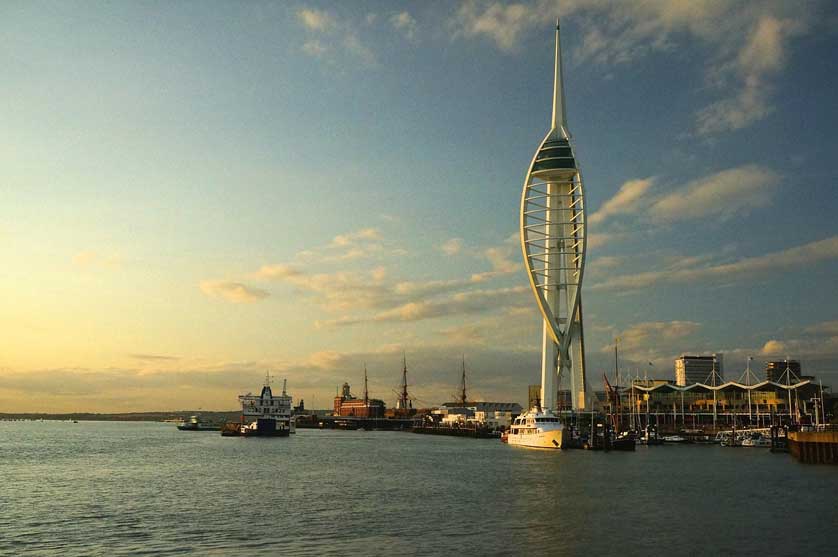
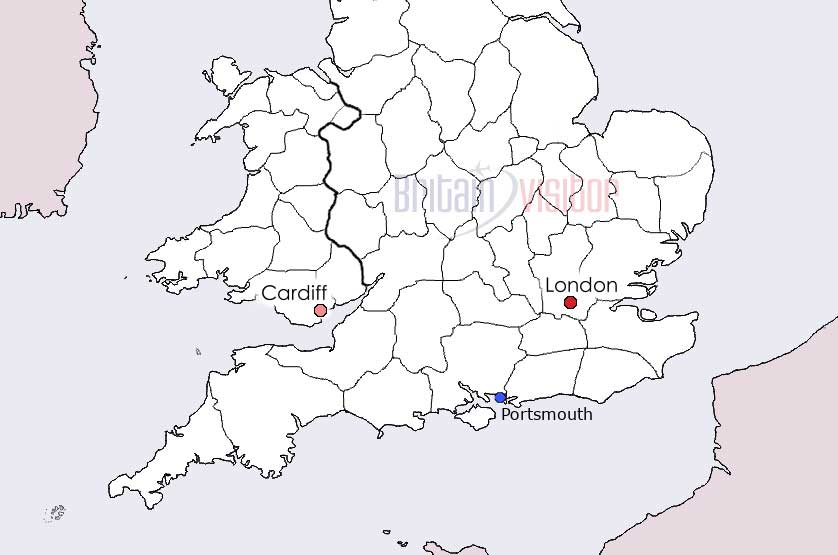
Portsmouth is a city on the south coast of England, 74 miles southwest of London, with a population of 208,000. Relatively small in area, it is Britain's most densely-populated city outside of the capital.
As a natural harbour, it is maritime-oriented and Britain's second-busiest ferryport, with frequent sailings to France, Spain and the Channel Islands. Most of the city is located on Portsea Island in the Solent, the body of water separating England from the Isle of Wight, four miles to the south, to which there are roughly 50 daily passenger sailings on ships, catamarans and hovercrafts from Portsmouth. Strictly speaking, it is the only British city not largely located on the mainland.

Portsmouth History
Much of Portsmouth's history has been military in nature, with frequent assaults by foreign powers on its strategic location. Visible from the waterfront for instance are the Solent Forts, circular artificial islands built in the 1860s to guard against a possible French invasion. In the 19th century it was the world's premier naval base and most fortified city, as a walk along the seafront today confirms.
Today the port remains home to two-thirds of the Royal Navy's surface fleet, including its two aircraft carriers, Naval Command Headquarters, Royal Marines and Army Reserves and the Special Intelligence Service (MI6)'s training centre.
Romans
Portsmouth's recorded history begins when the Romans built a fortress in the third century A.D. called Portus Adurni, now Portchester Castle, at the far end of the harbour. It was the base of the Classis Britannica, the Roman fleet whose admiral Carausius proclaimed himself emperor of northern Europe in 286 A.D. before being assassinated seven years later.
After the Romans left in the fifth century, Anglo-Saxons moved in. From the late eighth century until the Norman Conquest in 1066, the area was periodically attacked by Vikings, with notable raids occurring in 838 and 1001.
Mentioned in a 10th-century list of forts, Portsmouth is oddly not cited in the Normans' Domesday Book of 1086, and later Anglo-French chronicles state that the area of the current city was founded in 1180 by Jean de Gisors, a Norman landowner who bought the land from the local De Port family and gave it to Augustinian monks.
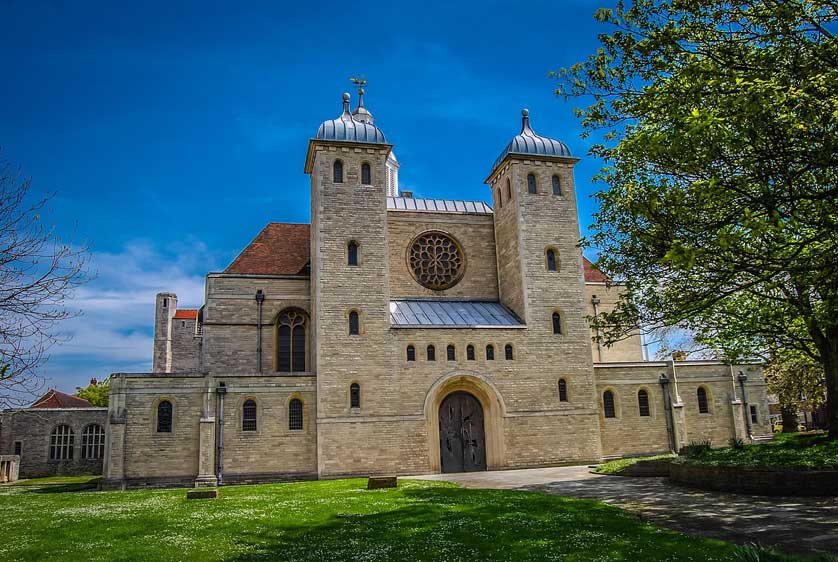
The grid-plan streets of Old Portsmouth today date from De Gisors' tenure, as does the church of St Thomas of Canterbury, which became Portsmouth Cathedral. In 1194, King Richard the Lionheart handed it a royal charter, establishing its city status. Its first docks were opened in 1212.
By the 14th century the city was growing wealthy from overseas trade, particularly in wine, but in 1338 the French laid waste to Portsmouth and pillaged it three more times over the next half century as part of the Hundred Years War between the two nations. Henry V assembled his troops here before embarking to win the Battle of Agincourt in 1415 and the city's Grade 1-listed Round Tower on the harbour walls dates from his reign.
Square Tower
Henry VII's 1494 Square Tower (another Grade 1-listed building) stands proudly on Portsmouth waterfront as a historical landmark and a year later he opened the world's first dry dock, from where his son Henry VIII watched his flagship Mary Rose sink in 1545 following a skirmish with the French navy.
The Tudor wreck was raised from the seabed in 1982 and is now a major tourist attraction. A treasure trove of 16th century artefacts were recovered along with the remains of 415 mariners. An estimated 500 drowned that day but Portsmouth's greatest tragedy came in 1782 when HMS Royal George sank in the harbour with the loss of over 800 lives.
Botany Bay
Aside from military vessels, Portsmouth ships have taken major strides in world history. In 1787, eleven set sail from the city and eight months later landed in Botany Bay to begin the British colonisation of Australia. The same year, Captain Bligh and HMS Bounty sailed out of the Solent on a fateful voyage to Tahiti and Pitcairn island. In 1834, brothers Charles and John Deane successfully demonstrated their invention of an air-supplied diving helmet to investigate the wreck of the Georgian warship the Royal George off Portsmouth.
In 1872, HMS Challenger left Portsmouth to circumnavigate the globe and lay the foundations of oceanography, analysing water, sand, ocean depths, discovering roughly 4,000 new species and photographing icebergs for the first time. The ship's name inspired that of the US Space Shuttle, which famously exploded in 1986.
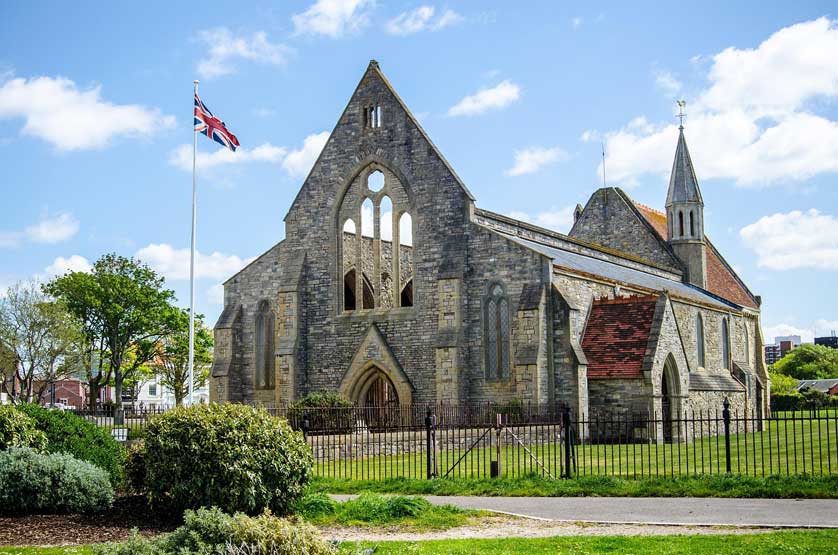
In 1662, after the English Civil War, Charles II returned from exile in France and married Catherine of Braganza in Portsmouth at the Royal Garrison Church, which still stands albeit roofless, close to the centre. It was at their wedding reception where Queen Catherine is said to have first introduced the English to tea drinking.
HMS Victory
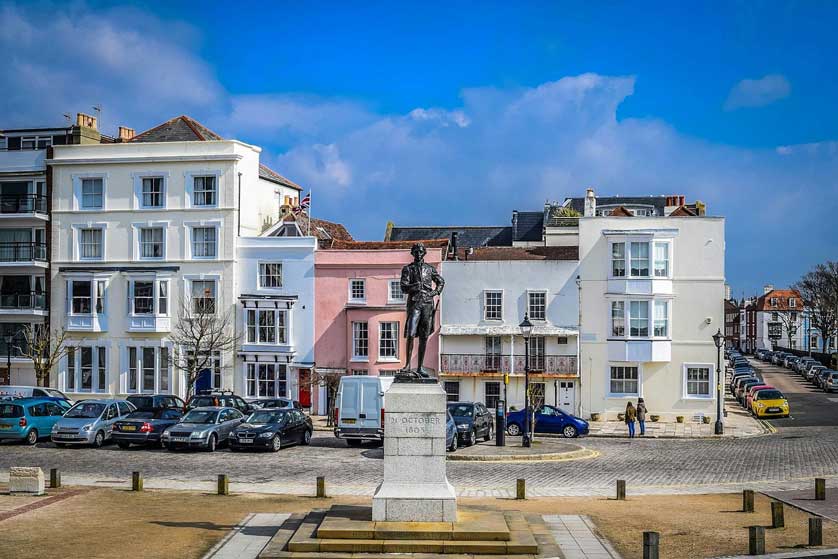
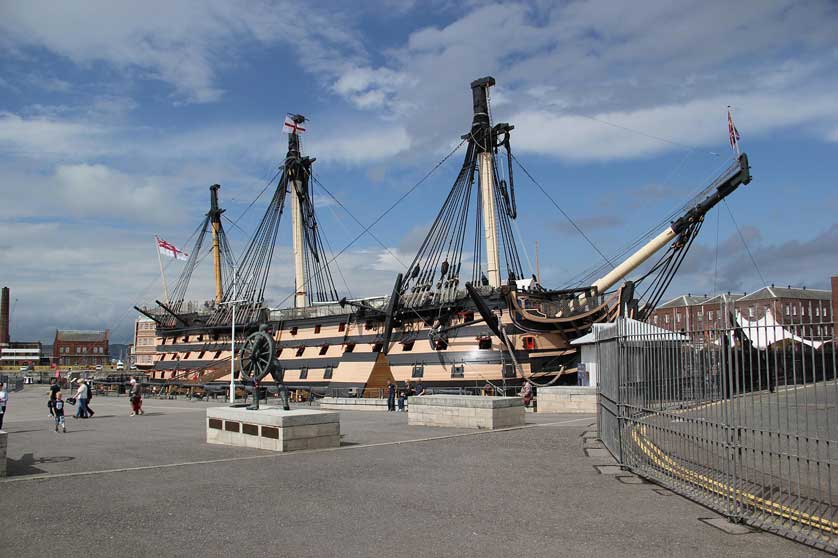
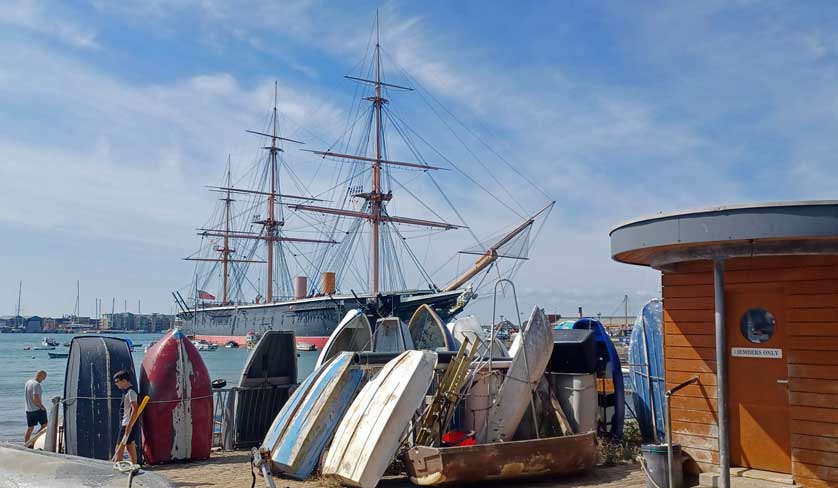
But war has largely shaped the place. In 1805, Horatio Nelson left Portsmouth on HMS Victory to die in glory at the Battle of Trafalgar, Britain's greatest naval day. The Victory is also moored in Portsmouth Naval Dockyard today alongside two other crown jewels - the Mary Rose and HMS Warrior, built in 1860 as Britain's first ironclad and the world's most formidable warship of its time. Another world-leading battleship design HMS Dreadnought, set sail from Portsmouth in 1906 and sparked another naval arms race.
Literature Connections
A year after Trafalgar, the man who would become Britain's premier engineer Isambard Kingdom Brunel, was born in Portsmouth. In 1812, the greatest novelist of London, Charles Dickens, was also born there. Other famous sons of the city are comic acting legend Peter Sellers, Prime Minister James Callaghan, 400m runner Roger Black, fantasy writer Neil Gaiman and Anglo-American journalist Christopher Hitchens. Futurist author H.G.Wells lived for three years in Portsmouth in the 1880s, while actor and governor of California Arnold Schwarzenegger also called the city home in the mid to late 1960s, training at local gyms to launch his bodybuilding career.
Aside from Conan Doyle and Wells, Portsmouth and literature collide in Jane Austen's Mansfield Park (1814), where the city is the home of the protagonist Fanny Price and the setting for the closing chapters. It also features a lot in Patrick O'Brian's Napoleonic naval novels, beginning with Master and Commander (1969). Gilbert and Sullivan also set their 1878 comic opera HMS Pinafore aboard a ship moored in Portsmouth harbour.
In 1870 the Portsmouth Polytechnic was founded. Now Portsmouth University, its alumni include astronaut Tim Peake, broadcaster Ben Fogle, poet laureate Simon Armitage and Aston Martin and McLaren supremo Martin Whitmarsh.
World War II & D-Day
The Second World War was a tough time for the city, which was bombed 67 times by the Luftwaffe, destroying or seriously damaging 13,000 properties. In one night alone in 1941, 25,000 bombs rained down. But it remained a working naval base and proved crucial in launching the Allied invasion force which took the fight to Nazi-occupied Europe on the 6th of June 1944. Future U.S. President Dwight D. Eisenhower commanded D-Day from Southwick House, five miles to the north.
Post-War
Large-scale postwar development has reversed a population decline and the waterfront aside, it largely appears a 20th century city in its architecture.
The latest great day in Portsmouth's naval history came in July 1982 when thousands thronged the waterfront to cheer home the Royal Navy's flagship HMS Hermes from the Falklands War. Then in 1997, having returned from the handover of Hong Kong to China, the Royal Yacht Britannia docked in Portsmouth for the last time before decommissioning.
Portsmouth Attractions
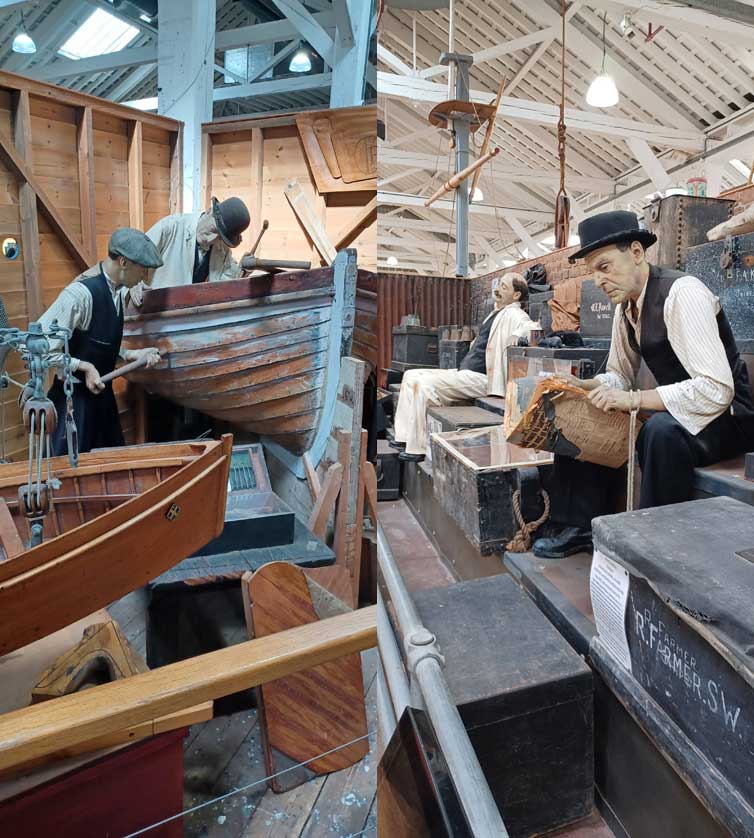
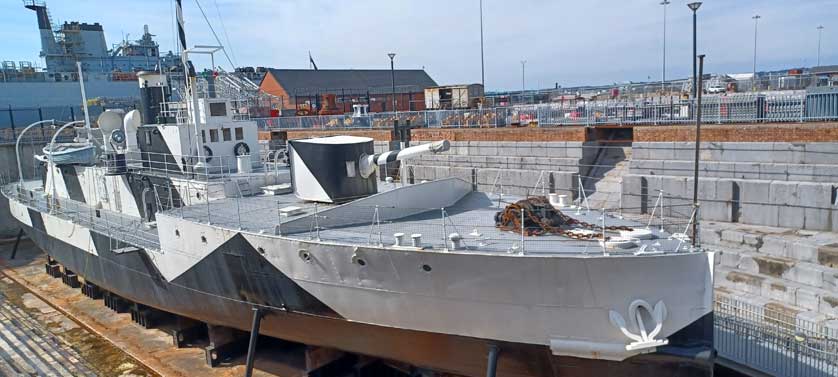
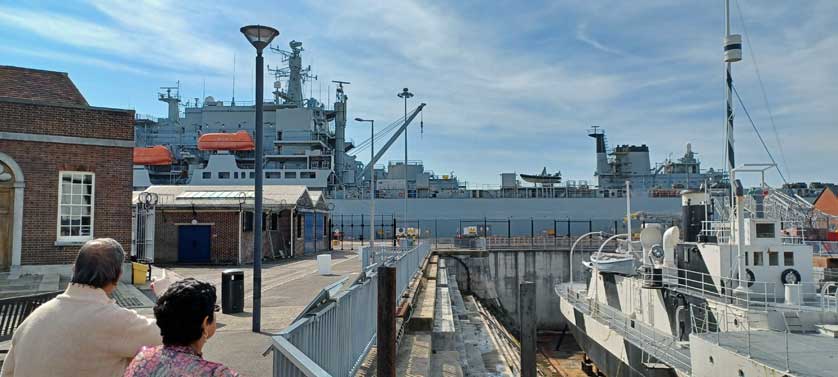
The Historic Dockyard is the city's main tourist attraction with its three great ships. The dockyard also includes the National Museum of the Royal Navy and a couple of World War I vessels. Portsmouth is in fact crammed with military and naval museums - There is also the D-Day Story, Explosion! Museum of Naval Firepower, The Royal Armouries at Fort Nelson, The Museum of Submarines, HMS Medusa, Boathouse 4 and Dockyard Apprentice, the World War I Remembrance Centre and the Royal Marines Experience.
Museums
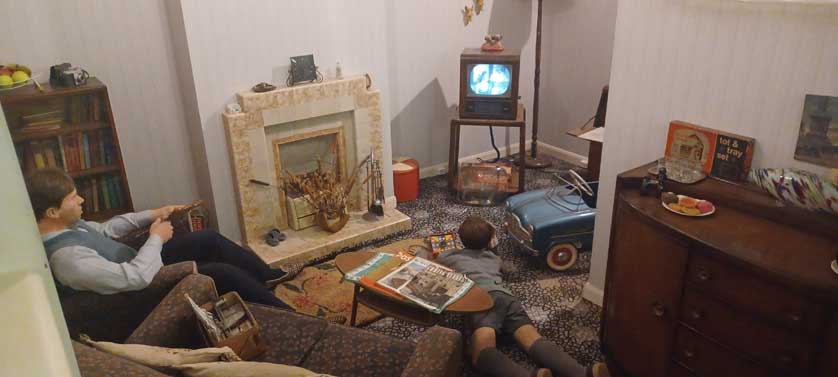
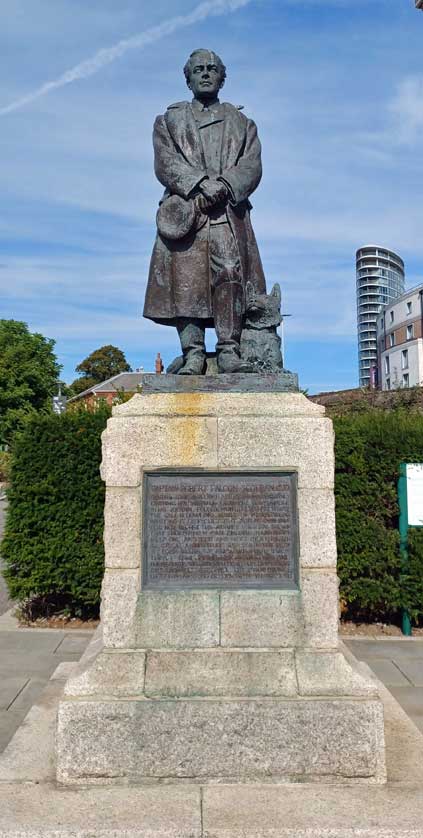
Portsmouth is not all about the armed forces though. The excellent Portsmouth Museum and Art Gallery has free entry and contains fascinating memorabilia and recreations from the city's 20th century, as well as a commemoration of Arthur Conan Doyle, who worked as a doctor in the city in the early 1880s, where he began writing Sherlock Holmes stories between seeing patients. Conan Doyle interestingly also played in goal for Portsmouth AFC, forerunner of today's Portsmouth FC.
Other places to visit include the Portsmouth Natural History Museum, with its charming butterfly house and wonderful collection of artefacts, Charles Dickens' Birthplace House and the 1950s Southsea Model Village.

Spinnaker Tower
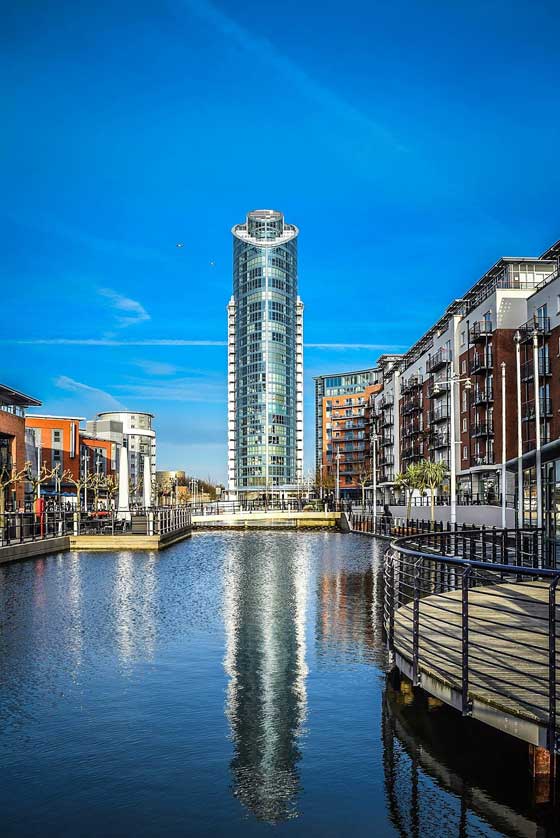
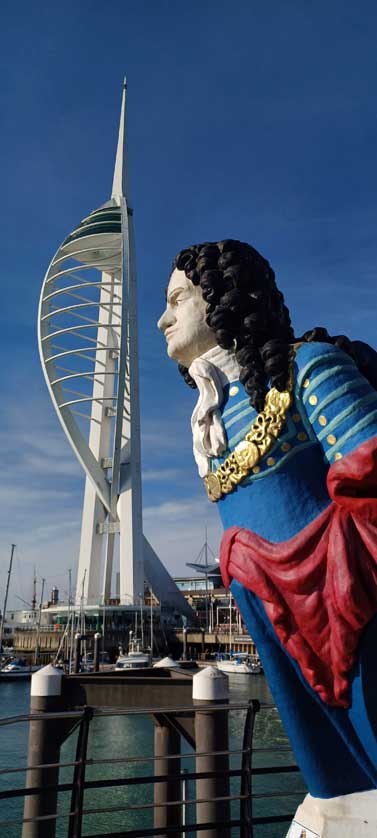
Dominating the skyline today is the 170-metre tall Spinnaker Tower, inspired by the city's sailing heritage with a hint of Dubai's Burj Al Arab. A brave move when proposed, it has become a popular success with its confident design and unrivalled views, becoming in effect the city's symbol.
Opened in 2005, the Spinnaker is now surrounded by a popular quarter of shops, bars and restaurants which has enlivened the city centre. Adjacent Gunwharf Quays is the centre's main shopping area with a wide variety of stores and is a pleasant pedestrian complex.
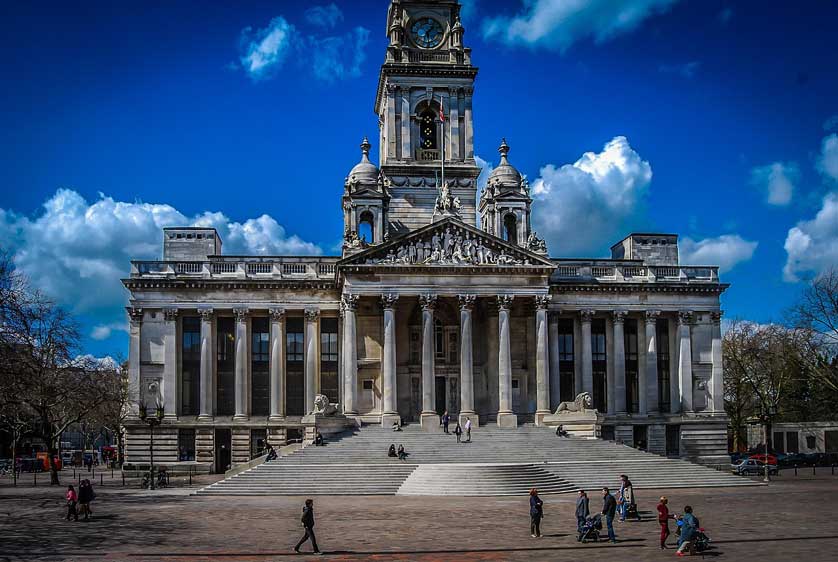
The other landmark of Portsmouth's skyline is the 1870 Guildhall, formerly the Town Hall, with its magnificent neo-classical design and imposing 54 metre tower. As a 2,500 capacity concert venue, the Guildhall has hosted all the big pop artists from the Beatles, the Rolling Stones and The Who to U2, David Bowie and Bob Dylan.
The city is also blessed with two beautiful theatres - the 1,400 seat King's Theatre built in 1907 and the 600-seat Theatre Royal, opened in 1856.
Sport
In sport, Portsmouth FC is the city's premier team, dating from 1898 and playing at 21,000-seat Fratton Park. Pompey (the city's nickname) have twice been champions of England (1949 and 1950) and twice won the F.A.Cup (1939 and 2008).
Southsea
In the Southsea area of the city is a pebble beach, a pair of Victorian piers and a large Common which hosts many outdoor events including the annual three-day music festival Victorious. Other places for natural recreation are the central Victoria Park, Alexandra Park and expansive green fields along the eastern side of Portsea Island. For more wilderness, the South Downs National Park and its rolling hills are half an hour north of Portsmouth by car or train.
Portsmouth Shopping
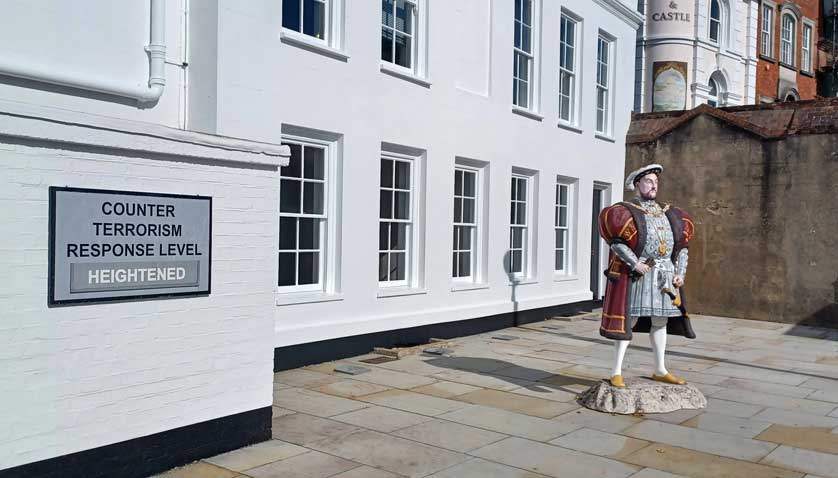
Shopping in Portsmouth offers a diverse mix of designer outlets, high-street retailers, independent boutiques and leisure destinations. Gunwharf Quays is a popular waterfront designer outlet mall featuring over 90 stores, including Nike, Ralph Lauren, Reiss, Lacoste and Crocs, as well as waterfront bars and restaurants.
In the city centre, Commercial Road and Cascades Shopping Centre offer a wide range of high-street favourites, such as Primark, H&M, Next, Sports Direct, TK Maxx and Waterstones, alongside the historic Portsmouth Market, which operates from Thursday to Saturday.
For a more independent shopping experience, Southsea, particularly Albert Road, Palmerston Road and Elm Grove, is known for its quirky vintage shops, local makers, independent cafés and regular markets, including Love Southsea.
Ocean Retail Park on Burrfields Road provides a convenient selection of major retailers selling homeware, fashion and everyday essentials, including TK Maxx.
Meanwhile, Port Solent, with its attractive waterfront Boardwalk, combines a relaxed marina atmosphere with lifestyle and footwear stores such as Cotton Traders and Pavers Shoes, alongside a variety of restaurants and an Odeon cinema, making it an ideal destination for shopping, dining and entertainment.
Portsmouth Hotels
As a busy port, the city has a huge range of accommodations including hotel brands Hilton, Marriott, The Village, Ibis and Holiday Inn as well as smaller boutique hotels, B&Bs and serviced apartments.
Some recommendations are the 4-star Portsmouth Marriott Hotel, with an onsite gym, restaurant and plentiful parking, the 3-star Holiday Inn Express Portsmouth and the Somerset House Boutique Hotel and Restaurant with 4 stars on Florence Road.
See here for a range of accommodation in Portsmouth.
Eat & Drink
Atmospheric dockside pubs are found along the old harbour walls and Old Portsmouth, such as the Still and West and The Spice Island Inn. Southsea's pubs are also popular including the Hole in the Wall, the Lawrence Arms, King Street Tavern, Staggeringly Good Brewery and Brewhouse & Kitchen.
There is a myriad of eating options from fish and chips and pub grub on the waterfront to several international cuisines. Chain restaurants are clustered around the Spinnaker Tower and Gunwharf Quays while Southsea's Clarendon Road, Osborne Road and Palmerston Road offer other options.
Portsmouth Access - Getting To Portsmouth
There are roughly five trains per hour from Portsmouth to London Victoria or Waterloo, taking between an hour and a half or two and a quarter hours. There are also two trains per hour to Gatwick Airport, taking roughly one hour and forty minutes.
Portsmouth & Southsea railway station in the Landport area near the Commercial Road shopping centre has trains to Basingstoke, Brighton, Bristol, Cardiff, Chichester, Guildford, Littlehampton, Salisbury, Southampton and Winchester.
From Birmingham change in Southampton. From Manchester or Newcastle, changing in London is the quickest.
Both main London airports Heathrow and Gatwick are approximately one hour and a quarter's drive from Portsmouth.
Maps

Hotels in the South West of England & Wales
Book Hotels in Bath - Agoda.com
Find Hotels in Bradford on Avon - Booking.com
Search Hotels in Cardiff - Booking.com
Recommended Hotels in Exeter - Agoda.com
Book Hotels in Salisbury - Agoda.com
Hotels in London - Booking.com
Hotels in England - Booking.com
Bath Hop-On Hop-Off Sightseeing Bus (Open Top)
The Hidden Cotswolds and The Making of England Day Tour from Bath