Churches in Cornwall
Cornwall is home to a cathedral in Truro and several beautiful and historic churches.
See a listing of churches in the county of Cornwall in the far south west of England.

Truro Cathedral
In 1880 construction began on a cathedral in the small town of Truro in central Cornwall. Truro Cathedral was to be the first cathedral built on a new site in England since 1220 when Salisbury Cathedral was constructed. The Diocese of Cornwall was established in 1876, and the first bishop appointed in 1877. The building was finally completed in 1910.
The architect was John Loughborough Pearson (1817-1897), who had previously worked on Lincoln Cathedral, and the two cathedrals share some features. Pearson's son continued the work after his father's death and also on St Matthew's in Auckland, New Zealand, which is a smaller version of Truro Cathedral.
The design of Truro Cathedral is primarily Gothic Revival style and incorporates some French features like Rose Windows and spires. Truro is one of only three cathedrals in the U.K. with three spires, the others being Lichfield Cathedral and St Mary's Episcopal Cathedral in Edinburgh, Scotland.
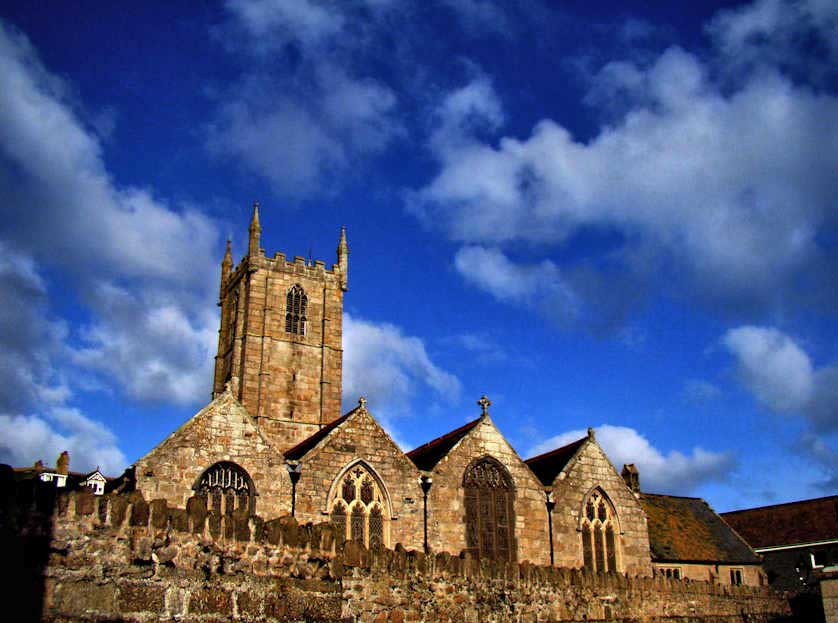
St Ia Parish Church of St. Ives
A prominent landmark of the fishing village of St. Ives in Cornwall is the tower of the local parish church dedicated to Saint Ia.
Over 80 feet high, one of the tallest in Cornwall, this harbourside church is clearly visible to returning fishing boats.
The St Ia Parish Church of St. Ives was built between 1410 and 1434 out of Cornish granite mined from nearby Zennor.
It is dedicated to Saint Ia, a 5th century Irish saint. The interior is quite beautiful with several notable features.
Although the stained glass window is modern, installed in 1907 following a major explosion at the nearby dynamite factory in Hayle that blew out many windows in St. Ives.
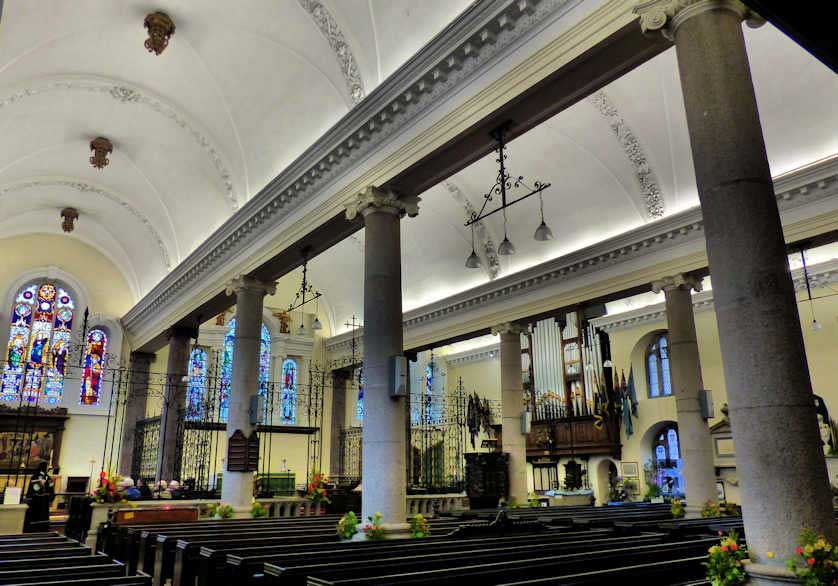
Church of King Charles the Martyr Falmouth
The Church of King Charles the Martyr is the parish church of Falmouth, Cornwall. It is located on the main waterfront street right next to the Kings Head public house.
The founding of the church was concurrent with the founding of the town of Falmouth. The church is dedicated to King Charles I who was executed in 1649 after the English Civil War.
His son and heir, later Charles II, had stopped briefly in nearby Pendennis Castle on his flight to exile. With his enthronement following the restoration of the monarchy, Charles II was petitioned by John Killigrew in 1660 to found a town and church. Killigrew, whose home, Arwenack Manor, part of which still stands in the town today, had long had the ambition to found a town here.
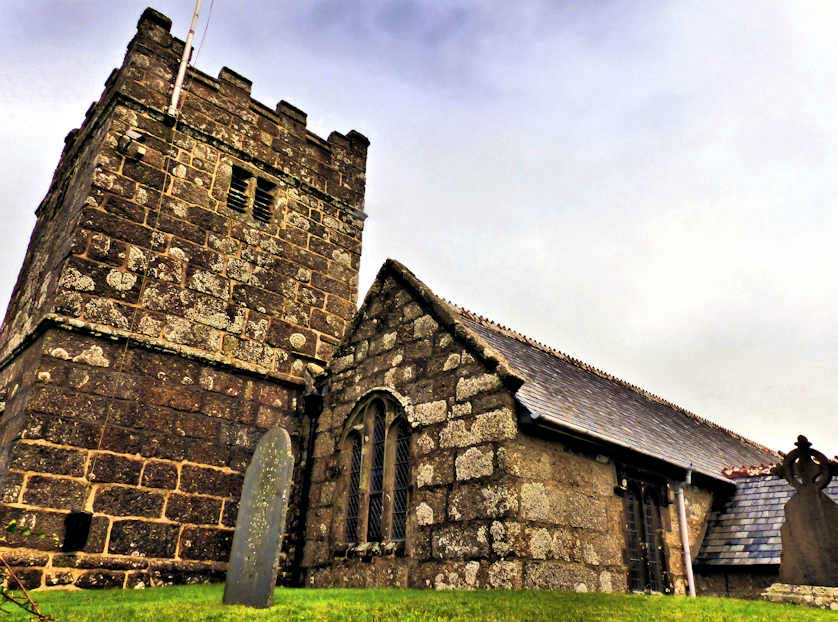
Towednack Parish Church
Towednack Parish Church is a low building built of large granite blocks. Like many buildings on the rugged and windswept north coast of the Penwith Peninsula in Cornwall it it seems to hunker down and hug the earth for safety. However, there is more to the story than that. The tower of the church is even lower than traditional Cornish churches, and is believed to be the work of the devil.
When the tower was being built around the year 1500, the masons would return to work each morning to discover that the work they had done the previous day on raising the tower and adding decoration had all been undone by the devil. So, they simply gave up and left it at its current height.
It is believed it was built on the site of an ancient monastic hermitage which explains why it is some distance from any settlement of size.
The church is dedicated to St. Winwaloe, a 6th century saint who founded the monastery of Landevennec in Brittany, an area with close connections and relations with Cornwall. Wednack and Walloe are forms of Winwaloe and other places in Cornwall with connections to St. Winwaloe are Landewednack and Gunwalloe.

St Mary Magdalene's Church
St Mary Magdalene's Church in Launceston is an amazing building. The granite exterior is almost entirely covered in detailed carvings. The church was built from 1511 to 1524 by Sir Henry Trecarrel in memory of his infant son. It is thought the stonework was originally meant to decorate Trecarrel's house but it was used to build the church after his family tragedy. One of the figures depicts a reclining Mary Magdalene. A local legend is that you can throw a pebble over your shoulder and have it rest on her back you will enjoy good fortune. The tower is much earlier and dates back to the 14th century. Edward, the Black Prince, had it constructed as a watchtower and it was later incorporated into the church. The interior contains a pre-Reformation pulpit and a Norman font.

St Mary's Church Penzance
St Mary's Church in Penzance dates from the 19th century but a church has existed here from much earlier. St Mary's is one of the largest churches in the town and a Grade II listed building. The church choir is of note and the church plays host to various musical events throughout the year. St John the Baptist Church in the east of the church near the station is another large church dating from the 19th century.
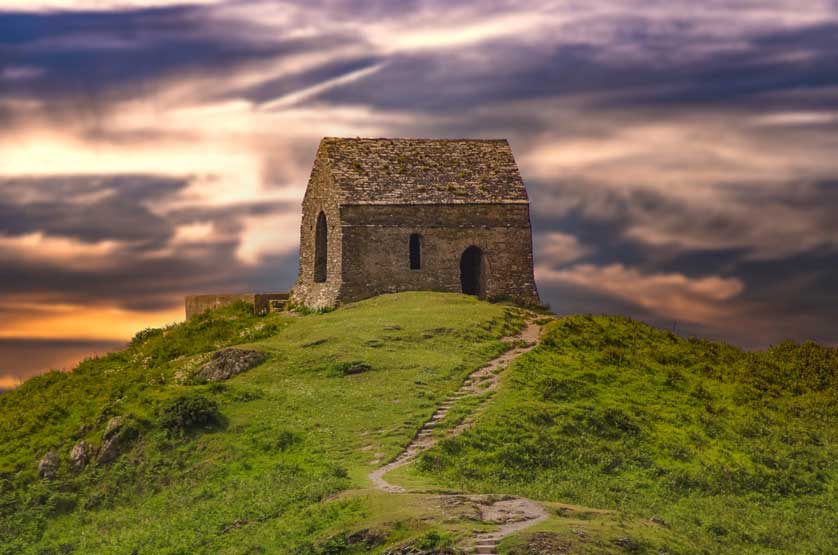
St Michael's Chapel, Rame Head
St Michael's Chapel is a ruined church on Rame Head, a strategic headland southwest of Plymouth. The small granite and slate chapel was dedicated to St Michael the Archangel and also served as a watchtower throughout its long history. The building lies on the South West Coast Path and there are beautiful views on fine days.

St Materiana's Church, Tintagel
St Materiana's Church in Tintagel on the cliffs close to Tintagel Castle. A church is believed to have stood here since the 6th century. Materiana is possibly Madryn, a 5th-century Princess of Gwent, who preached in the area. The existing church is thought to be Norman in origin with some Saxon elements. The tower is later. This ancient church holds within a Roman inscribed stone in the south transept and an original Norman font. The large churchyard has several historic memorials and a Bronze Age standing stone.
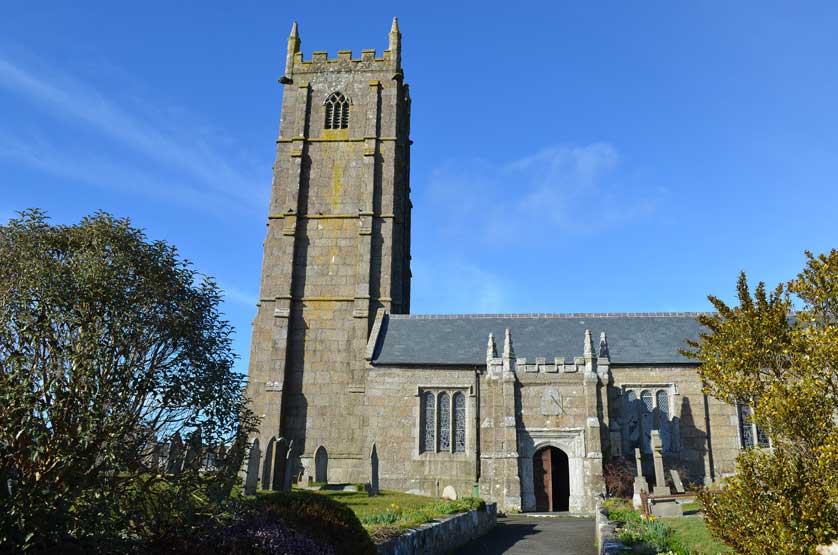
St Buryan Church
The St Buryan Church we see today dates from the late 15th century. Its antecedents are much older and relate to King Athelstan's military campaigns in Cornwall and the Isles of Scilly. The Saxon king vowed to erect a church if he was victorious. He duly was and he built a church in honour of Saint Buriana. The present church replaced the earlier one and has been restored several times since. The village of St Buryan is 8 km west of Penzance.

St Keverne
St Keverne (Church of St Akeveranus) is a large 15th century church in the village of the same name on The Lizard. The spire is an unusual feature for churches in Cornwall and may have been added as a landmark for ships. The treacherous Manacles Reef lies offshore and the churchyard has many of its shipwreck victims buried there. The SS Mohegan was wrecked on the reef in 1898 for example with the loss of over 100 lives. St Keverne was also the home of Michael Joseph (An Gof) - the village blacksmith who was one of the leaders of the ill-fated 1497 Cornish Rebellion.
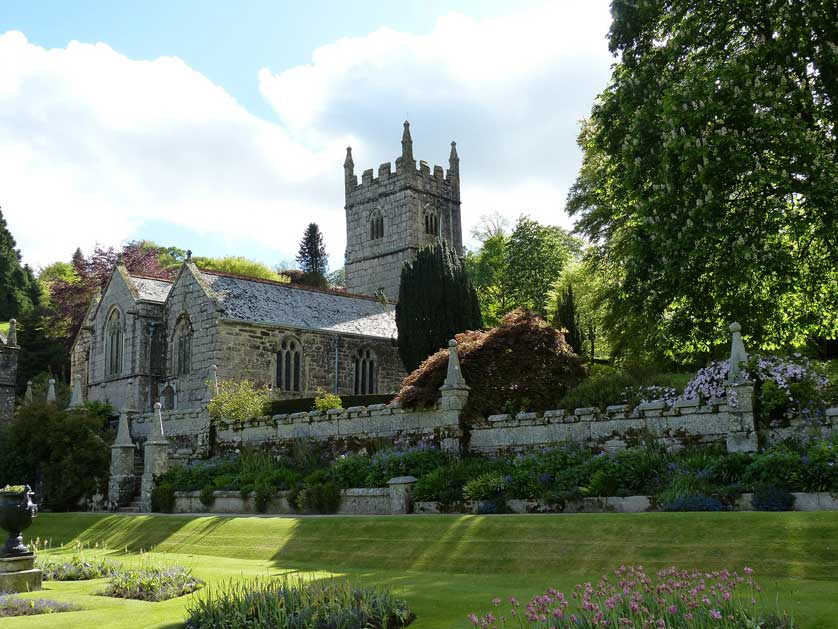
St Hydroc's Church, Lanhydrock
The Lanhydrock country house and estate also contains a church. 15th century in origin, it was restored in the late 19th century. The battlemented tower has nine bells. The estate, which is a short distance south of Bodmin, was an Augustinian priory until the Reformation. An old Cornish cross stands in the churchyard.
Map of Cornwall
Hotels in the UK
Book Hotels in England - Booking.com
Find Accommodation in London - Booking.com
Search Hotels in Scotland - Booking.com
Hotels in Northern Ireland - Booking.com