Wells Guide, Somerset
Wonderful Wells: England's second smallest city
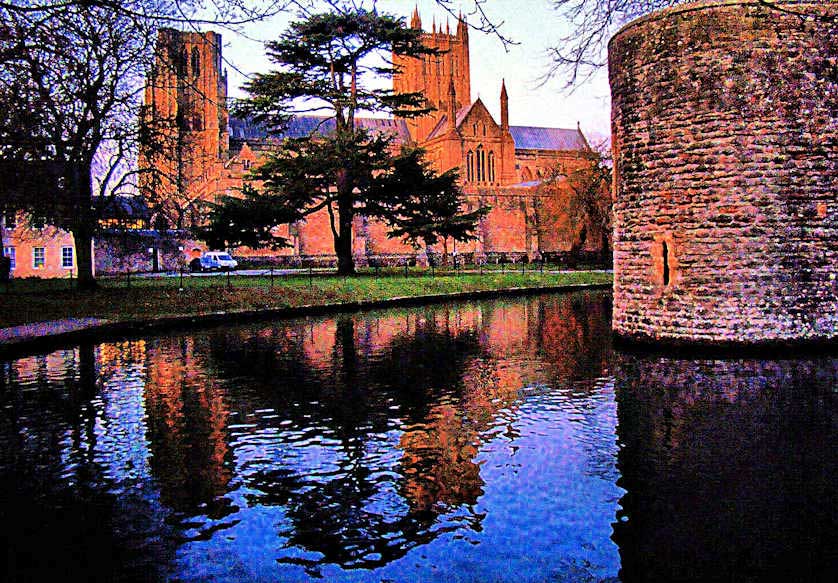
The magnificent Medieval cathedral qualifies tiny Wells in Somerset as a city, the second smallest in England, in fact, after the City of London.
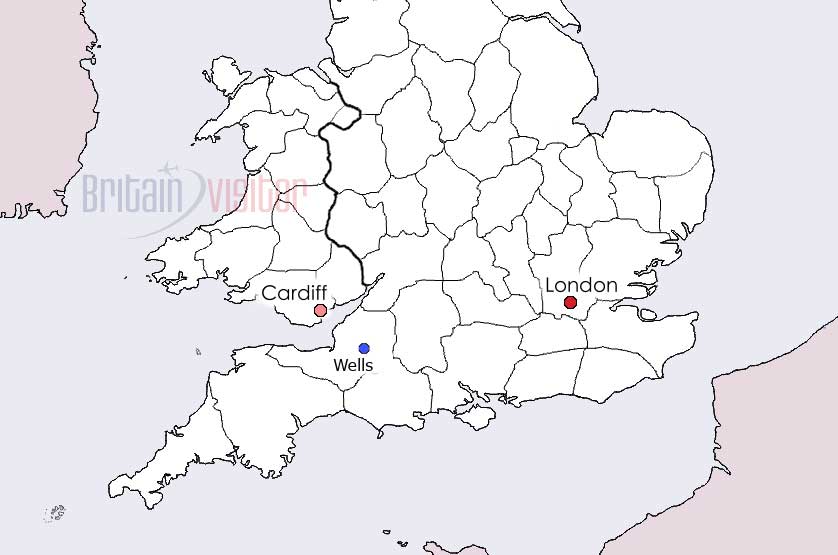
Located 21 miles southwest of Bath, and close to Glastonbury, Wells offers 900 years of history, a weekly market and some superb architecture.
Wells Cathedral
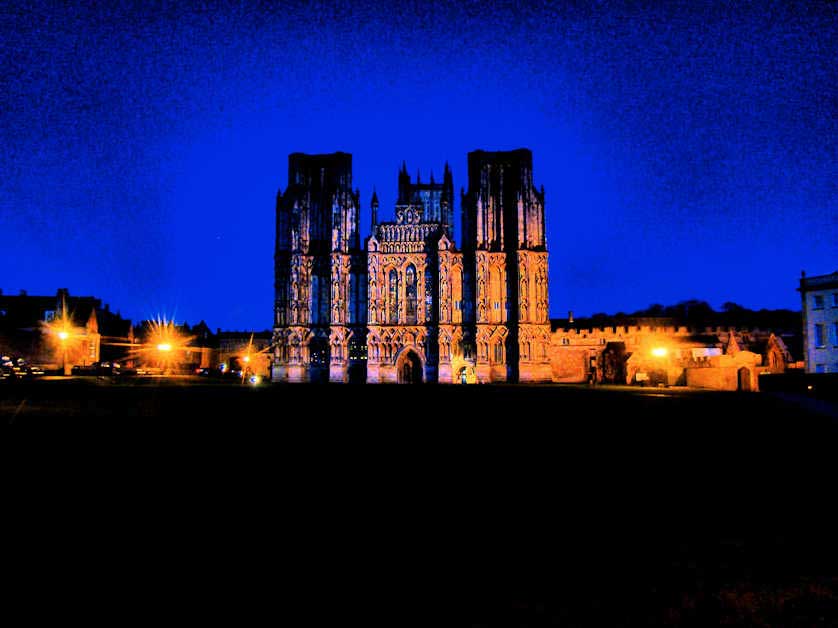
Wells Cathedral (Cathedral Church of St. Andrew) is rightly celebrated as one of the UK's most beautiful churches.
The cathedral was built between 1175 and 1490 and is the seat of the Bishop of Bath and Wells, who resides at the nearby Bishop's Palace. There is evidence that there has been a church at this site since the 8th century.
The magnificent West Front, which dates from around 1230, is one of the largest galleries of medieval sculpture in the world. From the bottom, biblical scenes are depicted rising to kings, bishops, and angels until the twelve apostles and Christ at the very top.
The superb Chapter House (1306) has a series of worn steps up to this most sumptuous meeting room. The octagonal-shaped room was used (and still is on occasion) to discuss the cathedral business. Before the stairs to the entrance to the Chapter House is the Wells Cathedral clock which is said to be the second oldest clock in England after the clock in Salisbury Cathedral and was probably built by the same clock-makers as the two clocks are very similar in style.
The spectacular Scissor Arches were a medieval solution to sinking tower foundations and were inserted in the 14th century to stabilize the structure. The Scissor Arches support the weight of the central tower. The church holds assembly for the nearby Wells Cathedral School, which was founded in the 10th century to educate choristers.

Bishop's Palace
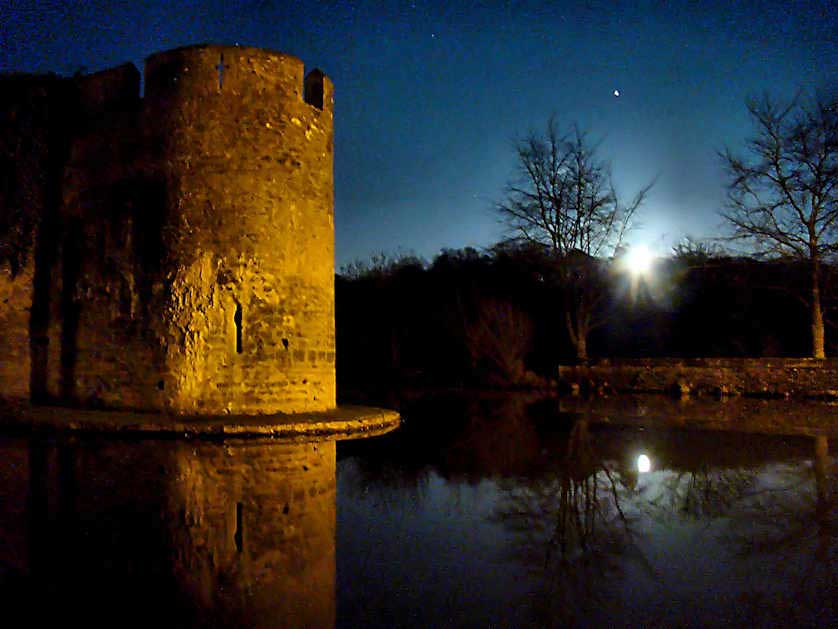
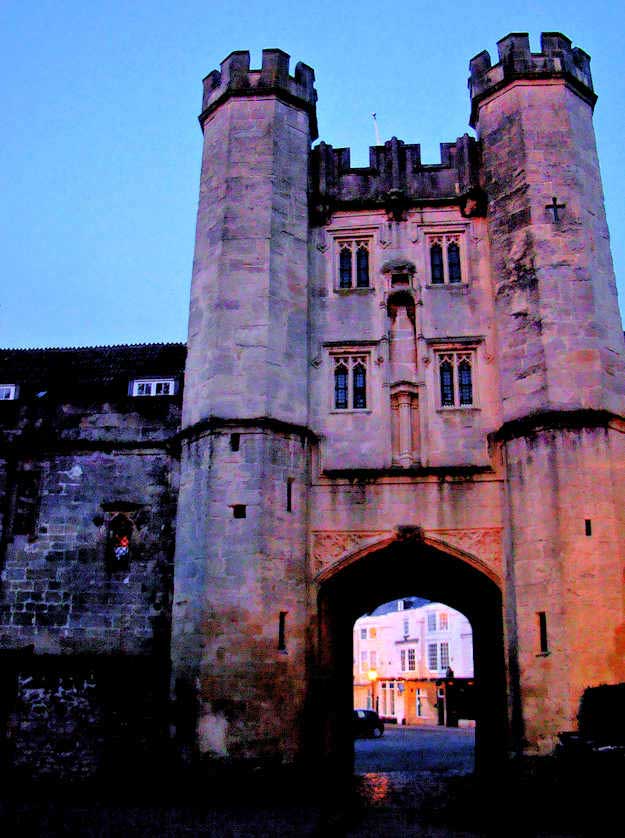
The fortress-like Bishop's Palace in Wells, just opposite Wells Cathedral, is the 800-year-old home of the Bishop of Wells. It is reputed to be the oldest inhabited building in England.
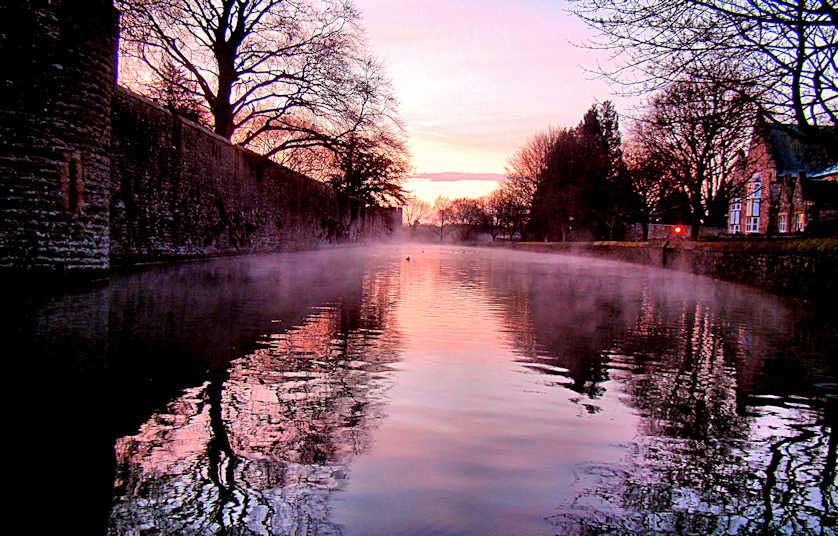
The palace has 14 acres of gardens both within and outside the palace including the springs which gives the city its name.
Bishop Jocelin Trotman began building the palace and deer park in 1206. Visitors enter the palace through the Gatehouse via a portcullis and drawbridge.
Within the palace, the ruined Great Hall acts as a decorative feature to the lovely gardens. The Bishop's private chapel dates from the late 13th century and is a gem.
In the Outer Gardens the spring pour out 100 litres per second into a well pool, from where the water flows into the moat and then into the River Sheppey. The flows from these springs also once powered the mills of the city of Wells.
Visitors to the Bishops Palace and Gardens can tour the impressive palace interior. The tour includes the First Floor Gallery, State Rooms, and the Bishop's Chapel. The First Floor Gallery and State Rooms are reached by way of a Jacobean staircase.
Cathedral Green
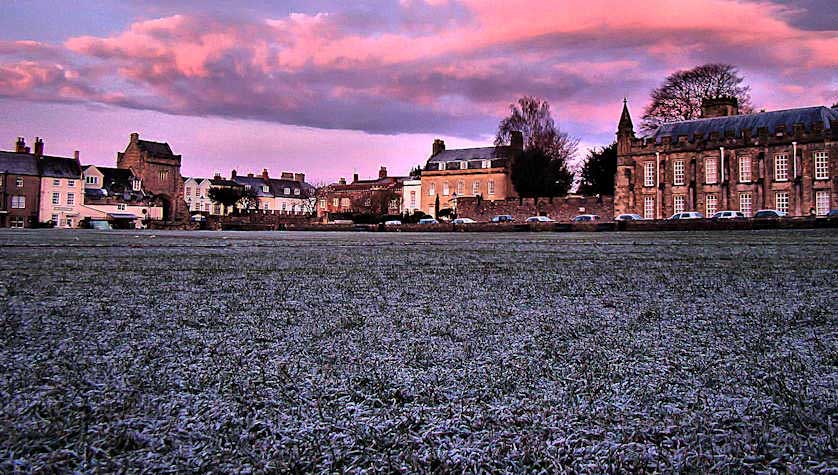
Other historic buildings in Cathedral Green include The Old Deanery and the Wells & Mendip Museum. The museum includes a walled garden and has exhibits on the natural history and geology of Wells and the surrounding Mendip Hills. The Old Deanery dates originally from the 12th century and was the former home of the dean. It includes the original gate and walls and now serves as offices and a Christian educational center for the Diocese of Bath and Wells.
Vicars' Close
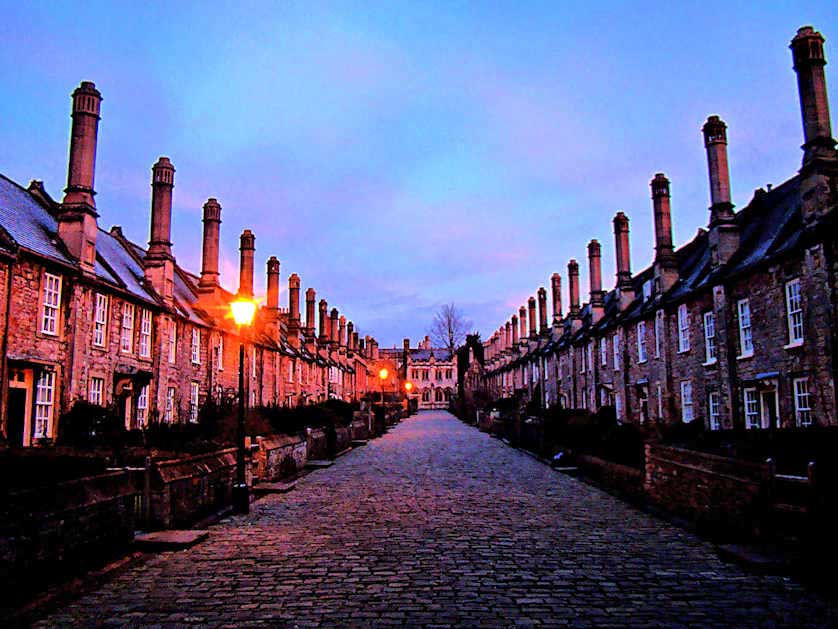
Just a short walk north is Vicars' Close. This is thought to be the oldest medieval street of purely residential structures in the country and indeed Europe as a whole.
Built in the 14th century as homes for the 42 Vicars Choral. The distinctive chimneys were added in the 15th century. Once priests were allowed to marry some of the dwellings were combined into larger homes. The road actually narrows by 10 feet to give the false perspective of it being longer.
Wookey Hole
Wookey Hole on the edge of the Mendip Hills near Wells in Somerset is home to the most spectacular set of caverns in the UK as well as numerous other attractions for the whole family.
The cave system was formed over eons by water percolating through the limestone. Humans have used the caves for at least 45,000 years as evidenced by Stone Age tools left behind, and evidence suggest during the Iron Age people lived in the caves.
The River Axe flows through the cavern system and a paper mill that was built near the caves in 1860 dammed the river to use the water.
This has led to the caves being more flooded than in earlier times. The paper mill closed down and is now used to house many of the site's attractions.
The caves opened to the public in 1927, and visitors today can explore the first nine chambers via a series of walkways and man-made tunnels.
The cave system extends for at least 1 kilometer and there are 25 separate chambers. The use of colored lights in the public chambers of the caves creates an even more other-worldly atmosphere.
Ebbor Gorge
Ebbor Gorge is a national nature reserve which encompasses a woodland on the southern escarpment of the Mendip Hills.
Most of the woodland trees are ash or planted oak but there are also whitebeam, wych elm, and field maple. The area is also interesting for its geological features which include small caves in which evidence of ice age mammals and stone and bronze age man have been found.
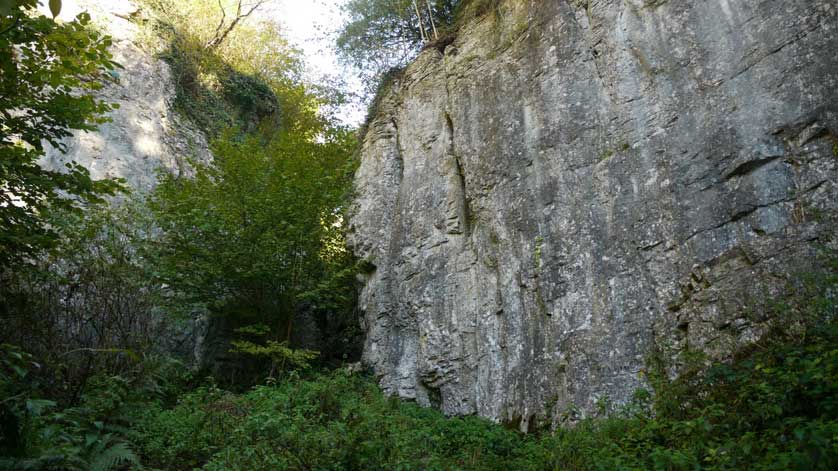
Visitors to Ebbor Gorge will find well-marked trails leading through and around the gorge which bring the visitor to impressive rock faces like the one below. The longest trail, 'The Gorge Scramble,' is about 2 kilometers long and takes around 1 hour to complete.
Glastonbury
Glastonbury, a small town of fewer than 9,000 people in Somerset, is now more famous for its annual music festival than the historic abbey that dominated the town's early history.
The town is associated with the legends of King Arthur, the Holy Grail and Avalon. The 12th & 13th-century French poems of Robert de Boron created the myth of Joseph of Arimathea bringing the Holy Grail containing Christ's blood from the cross to the kingdom of "Avalon" in the west.
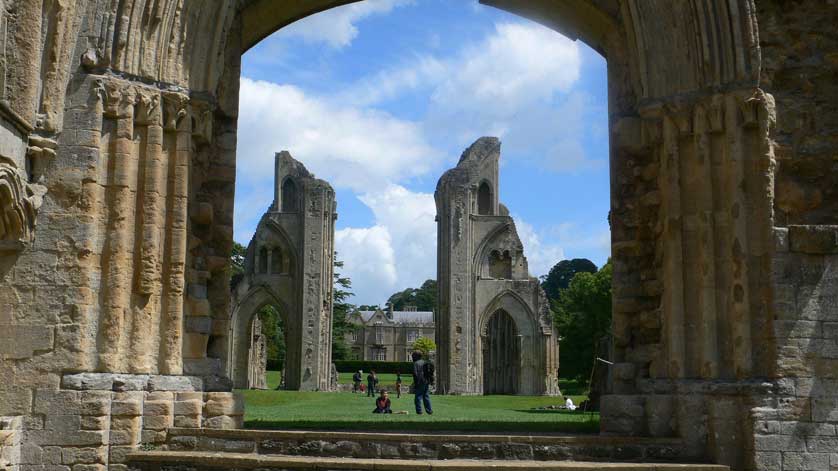
Glastonbury Abbey dates from around the 7th century and was an important and extremely wealthy monastery during the following centuries. Both King Edmund (d. 967) and Edmund Ironside (d. 1016) were buried here. The abbey, indeed, continued to flourish well after the Norman conquest.
The monastery is now in ruins following its Dissolution in the reign of Henry VIII as many of the stones were removed for local buildings.
Glastonbury Tor, which rises up from the Summerland Meadows plain, is another feature associated with the Arthurian legend. The roofless medieval St. Michael's Tower sits atop the hill.
Accommodation in Wells
The White Hart Hotel in Wells, just a short walk from Wells Cathedral, is a 15th-century coaching house. It is the perfect place to stay to fully appreciate this enticing town. There are 15 bedrooms in this historic AA two-star hotel. Brufani's Restaurant at the hotel is well known for its excellent food. (Book this hotel with Agoda)
Other places to stay include the Best Western Plus Swan Hotel, The Crossways, a short distance outside the city and in nearby Glastonbury, the George Hotel & Pilgrims' Inn.
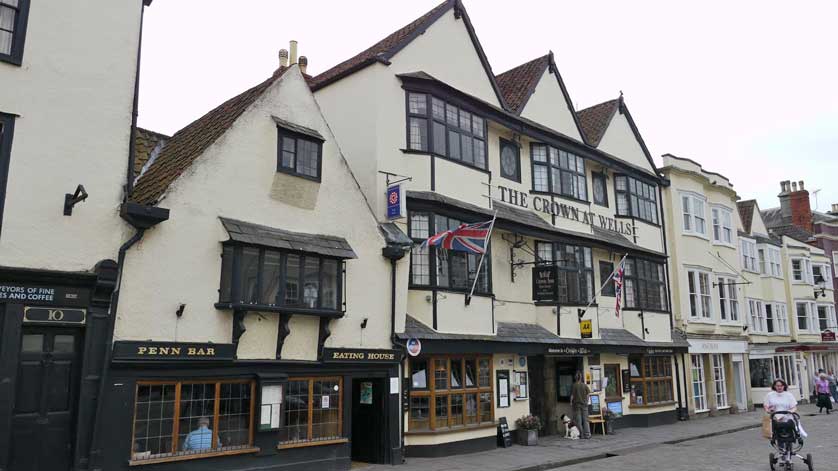
The Crown at Wells is a grade II listed coaching inn that dates to the 15th century. The Crown overlooks Wells Cathedral and The Bishop's Palace and Gardens. Accommodation is available and food and drink are served throughout the day. (Book Rooms at The Crown at Wells with Booking.com)
See here for a complete listing of accommodation in Wells.
Wells Access - Getting To Wells
Wells is located south of both Bath and Bristol. The city is also 17 miles west of Frome and 24 miles southwest of Bradford on Avon.
Though no longer on the rail network, Wells is easily reached by bus from either Bath or Bristol.
From the M5 motorway exit for Wells at junction 22.
London is around a two hour drive or a 90 minute train ride from Bath.


Maps
Hotels in the South West of England & Wales
Book Hotels in Bath - Agoda.com
Find Hotels in Bradford on Avon - Booking.com
Search Hotels in Cardiff - Booking.com
Recommended Hotels in Exeter - Agoda.com
Book Hotels in Salisbury - Agoda.com
Hotels in London - Booking.com
Hotels in England - Booking.com
Bath Hop-On Hop-Off Sightseeing Bus (Open Top)
The Hidden Cotswolds and The Making of England Day Tour from Bath