Medieval Coventry Guide
Medieval Coventry - A Journey into the Past
Jake Davies
Coventry is the 2021 City of Culture, and while known as a modern, dynamic city, was in the early twentieth century considered to be the best preserved medieval city in England.
In the subsequent decades, continued industrialization and then the devastating fire-bombings of the city in World War II took its toll on the city's medieval heritage. However, there are a surprising number of historical sites in the city centre that are worth looking out for.

Bayley Lane
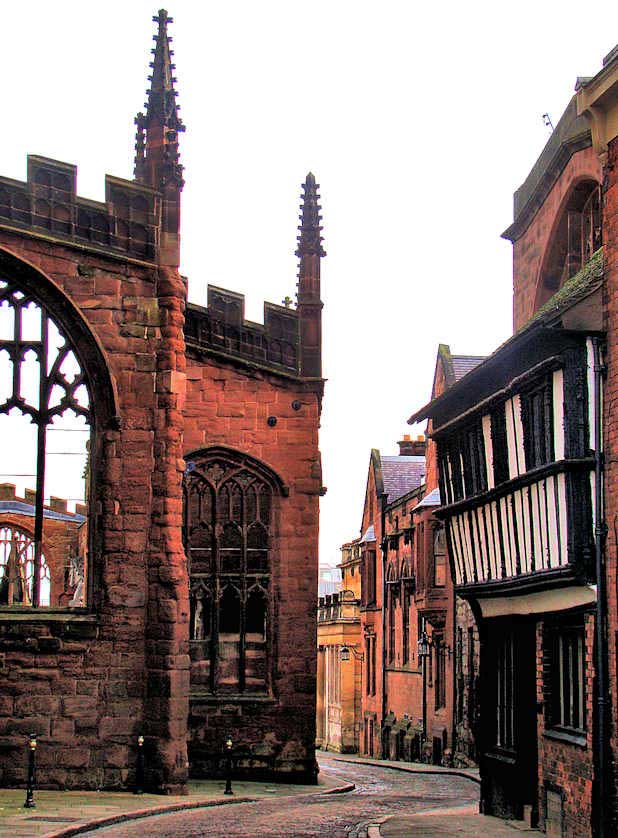
A good place to begin is the narrow, cobblestone lane that runs alongside the southern side of the old Cathedral of St. Michael's.
Named after the bailey that formed part of the old motte- and bailey castle that originally stood here, it is believed the first buildings were built here in the 14th century.
A 14th century cellar was uncovered when excavations took place for the new extension for the Herbert Art Gallery & Museum.
The oldest standing building on the lane is St. Mary's Guildhall. Built in the mid-14th century, and extensively modified in the 15th century.
Religious guilds were suppressed by Edward VI in the mid-16th century and the Guildhall then served as an armory as well as council meeting place.
Now open to the public, the Guildhall briefly held Mary Queen of Scots, and Queen Elizabeth I herself had lunch here on her visit to Coventry. Next door is Drapers' Hall, a 19th century structure.
Near the top of the lane is the last of the medieval timber-framed buildings to survive the bombings of World War II. 22 Bayley Lane, dating to the early 16th century, previously had a connection to the Guildhall. Near to 22 Bayley Lane, but not actually on the lane itself is the Golden Cross, the oldest pub in Coventry. Still serving drinks and food since being made into a pub in 1661, it was built in 1583.



Ford's Hospital & Almshouses
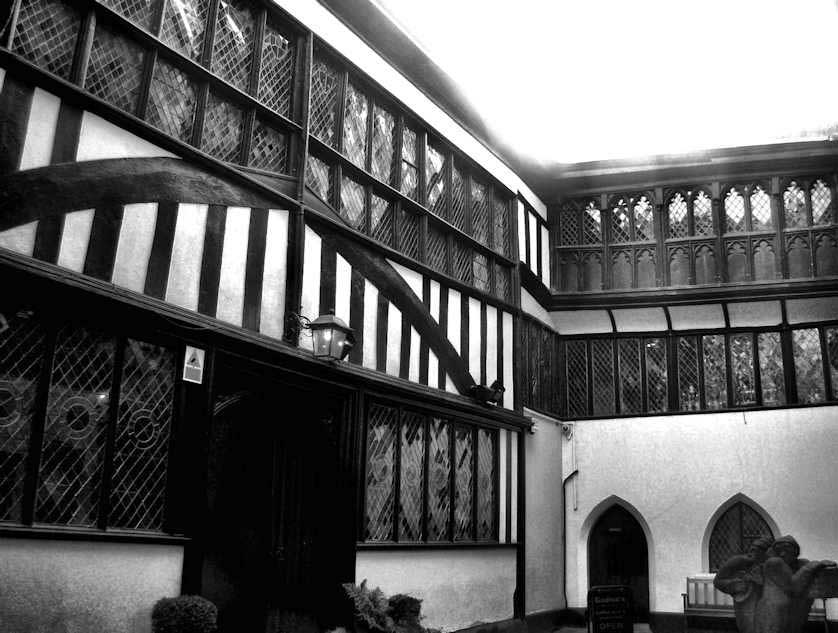
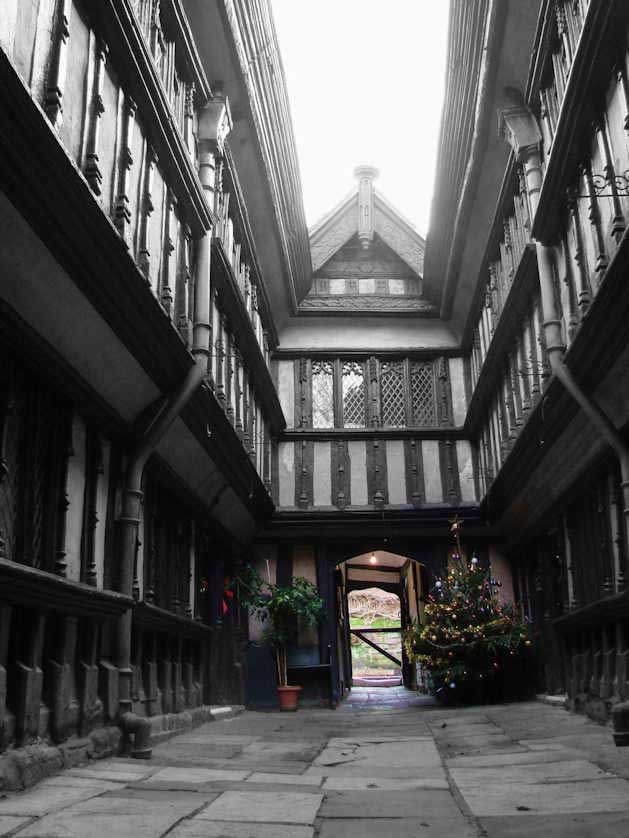
A short distance south of the centre of the city, on Greyfriars Lane, stands an early 16th century building considered one of the best examples of domestic architecture from the period.
Ford's Hospital was built in 1509 by wealthy merchant William Ford to provide housing for less well off elderly people. In 1517 and again in 1529 the building was extended to provide more accommodation and in 1846 a total of 40 women were living here.
It suffered bomb damage during the war but was repaired with original timbers. The doorways of the building were studied by historians involved in the modern reconstruction of Shakespeare's Globe Theatre in London. The building is still a residential property, but opens for a few days to the public in September.
Cheylesmore Manor House
Just a few minutes walk south from Ford's Hospital is the Registry Office for Coventry where all citizens must register new births, deaths, and marriages. Since 1965 it has been housed in the gatehouse of the former Cheylesmore Manor.
The oldest parts of the building date back to 1250 and the manor house was used as a hunting lodge by royalty, most notably the Black Prince, grandson of Queen Isabella who owned the manor. Several of the rooms are available for use during ceremonies.


Spon Street
Just to the west of the city centre is Medieval Spon Street or Historic Spon Street as it is commonly called.
Established as a settlement of dyers and tanners in the 12th and 13th centuries, outside of the city walls because of the smells of their processes, the road was one of the main routes between Coventry and Birmingham.
Most of the historical buildings in the street survived the war, but as post-war development took its toll on historical structures around Coventry it was decided to save some and have them reassembled on Spon Street.
Today there are a few specialist shops, but many of the timber-frame buildings now house restaurants, and the 16th century Old Windmill vies with the Golden Cross for the title of oldest pub in Coventry. Right next to Spon Street is the Coventry Watch Museum, dedicated to an industry which Coventry was known for in historical times.
Near the end of Spon Street is St. John the Baptist Church, founded in the mid-14th century as a guild chapel. The religious guilds were dissolved in 1548 but the church continued with services until about 1590.
The building was subsequently used as a prison, a stables, for producing cloth, and as a market. It was re-established as a parish church in 1734. Most of the internal decoration dates from the 19th and 20th centuries.

Grammar Schools
Adjacent to the church on Hill Street is another group of medieval buildings around a courtyard. Bablake School was founded in the mid-14th century but the current buildings date to 1560.
Around the courtyard are other buildings of the Bond's Hospital, almshouses established by Thomas Bond, a wealthy draper and former mayor, in 1507.
Bablake became one of two grammar schools in Coventry, and moved to new, larger premises on Coundon Road in 1890. The original grammar school that became Henry VII's Grammar School is located on the corner of Hales Street and Bishop Street.
Founded as a hospital in the mid-12th century, around the mid-16th century it closed and the building was sold by King Henry VIII with the proviso that it the new owner provide the town a free school.
The grammar school moved to its current site in 1885 and the building has been refurbished and is now used for events of various kinds.

City Walls
Not far from the Old Grammar School is the largest section remaining of the medieval city walls. Built in the 14th century, the walls once had 12 gates, but only two remain, and they were probably among the smallest.
The section of wall running between Swanswell Gate and Cook Street Gate is the best remaining section of the historic wall. The gatehouse at Swanswell Gate and also a small apartment above the Cook Street Gate can now be rented as rather pricey accommodation for visitors.

City of Culture
Though many of the factories and big industrial companies that fueled the growth of Coventry have now disappeared, the city has made somewhat of a comeback in the 21st century. There has been some light-industrial development, and a sizable increase in the service industries, but much of the resurgence seems to be down to the university.
After formerly being a Polytechnic, Coventry University achieved university status in 1992 and is the fastest growing university in Britain, and currently the 4th largest outside London. Combined with the smaller and older University of Warwick, the two universities provide a hefty chunk of Coventry's economy. The Arts Centre at the University of Warwick is also a thriving cultural centre serving the citizens s well as students.
The local football team, Coventry FC, known as the Sky Blues, moved into a new stadium built on the site of the former gasworks. Until recently known as Ricoh Arena, but since 2021 renamed Coventry Building Society Arena, the complex is also home to the local Wasps Rugby Union Club as well as housing an exhibition hall, casino, and hotel - the DoubleTree by Hilton Coventry Building Society Arena.
Coventry has been named City of Culture for 2021, and though the Covid pandemic put a crimp in the planned events and celebrations, there is a lot going on in 2021. For an up to date list please see the official website coventry2021.co.uk
Access - Getting to Coventry
Coventry is close to the following motorways: M1, M6, M40 and M42.
Coventry Station has connections to London Euston and Birmingham New Street.
There are local train services to Nuneaton, Northampton and Leamington Spa. The museum is a 15-minute walk from the station.
Long distance National Express buses run nationwide from Pool Meadow bus station, which is also the hub for local buses.
Map

Accommodation in the Midlands
There are places to stay to suit all budgets in both Birmingham and Coventry.
In Coventry the Ramada Hotel and Suites has four stars. The ibis Coventry Centre is a three-star property.
At the top end in Birmingham try the Clayton Hotel Birmingham or the Jurys Inn on Broad Street.
See a list of hotels in Coventry.
Midlands Related
Birmingham Museum & Art Gallery
Compare prices and rent a car in Birmingham
Hotels in the UK
Book Hotels in England - Booking.com
Find Accommodation in London - Booking.com
Search Hotels in Scotland - Booking.com
Hotels in Northern Ireland - Booking.com