UK Culture: Statues in Britain
Public Statues in the UK

The United Kingdom as a whole has over 800 public statues according to the charity the Public Monuments and Sculpture Association (PMSA).
Of the 10 best statues in Britain chosen by the Guardian newspaper in 2020, Damien Hirst's Verity (2012) in Ilfracombe, Devon was rated as the best. It depicts a bisected woman in stainless steel and bronze and stands at 20.25 meters. Other statues to make the list were Rodin's Burghers of Calais in London, the Marquess of Anglesey's Column in Anglesey, North Wales and the statue of the suffragette Millicent Fawcett in Parliament Square, also in London.
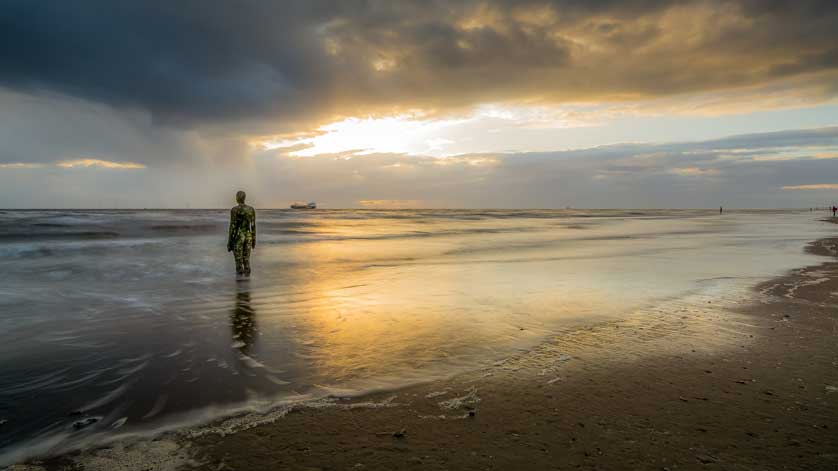
Also on the list are the River God, at The Grotto in Stourhead, in Wiltshire and the statues at Crosby Beach in Merseyside by Antony Gormley entitled Another Place.

Of the 828 statues listed by the PMSA in 2018, only 174 or a fifth were of women. Named women other than unnamed female figures such as nymphs and nudes brings that total down to just 80 with no statues of female politicians at all compared with 65 male politicians. In London, statues of animals presently outnumber those of named women. Statues of Queen Victoria, however, were the most common for both men and women with a total of 10 throughout the UK.
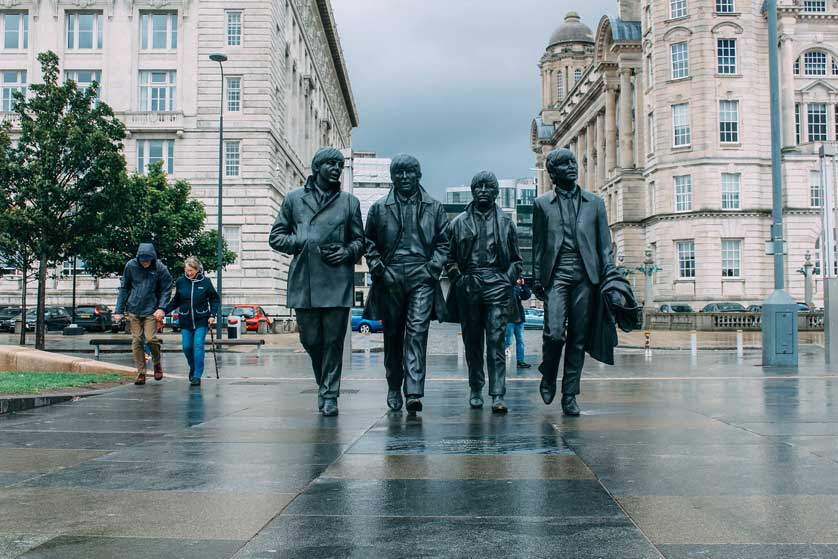
Besides Queen Victoria, other British monarchs and historical personages are common themes for public art in the UK. They often appear in the towns and cities that are most associated with them. Thus Robert the Bruce stands proud in Stirling Castle in Stirling, Scotland, Robin Hood in Nottingham, the Beatles and Billy Fury in Liverpool and William Shakespeare in Stratford-upon-Avon. The Black Prince in Leeds by sculptor Sir Thomas Brock (1847-1922) is an anomaly as the warrior prince has no connection with the city. He was born at Woodstock Palace in Oxfordshire and died in London.
London has the most statues with over 300.
Since the statue of slave-trader Edward Colston was pulled down in 2020 and dumped in Bristol Harbour during anti-racism protests several statues in the UK with links to the slave trade are under review. Colston's statue is now in the M Shed Museum in Bristol but will be put into storage in early 2022. In the City of London statues of William Beckford, a former London mayor, and John Cass, an MP are to be resited, for example. The statue of Sir Robert Geffrye (1613-1704) which stands above the entrance of The Museum of the Home (formerly the Geffrye Museum) may also be moved. Geffrye had links to the slave trade and part-ownership of a slave vessel. The museum, which has displays of domestic life from 1600 to the present, is housed in almshouses for widows established in Geffrye's will.
See a listing of public statues in Britain.


The Kelpies
The Kelpies are a pair of truly monumental-scale statues towering over the countryside near Falkirk in Scotland that have been visited by millions since their opening to the public in 2014.
Two gleaming horse heads, 100 ft (30 meters) tall are clad in stainless steel panels and sit astride a canal lock. The stainless steel panels are attached to structural steel frames and each statue weighs 300 tons. They were built in 2013 and designed by artist Andy Scott.
Scott, born in Scotland in 1964, graduated from Glasgow School of Art in 1986. Now based in the U.S., his work, mostly in steel and bronze, is primarily figurative though constructed using modern engineering techniques. The Kelpies are his best known work, though he has completed more than 80 public pieces around the world.
Kelpies are mythological water spirits that are said to inhabit lochs and pools throughout Scotland. Able to shapeshift into human form they mostly are described as resembling a horse and like similar spirits throughout the world are said to cause drownings.



Equus Altus
In the central atrium of Trinity Leeds shopping center in Leeds is another statue by Glasgow-born artist Andy Scott.
Standing 15 feet tall and weighing in at 2 tons, the statue depicts a pack horse laden down with rolls of cloth, remembering a time when horses were the primary transportation system.
Scott is most famous for The Kelpies (see above), the giant horse statues near Falkirk. Also at the entrance to Trinity Leeds is another Scott piece, the Briggate Minerva, Minerva being the Roman Goddess of commerce and weaving.

Golden Boys
Boulton, Watt, and Murdoch were three giants of the industrial revolution in The Midlands. Matthew Boulton (1728-1809) was an industrialist and entrepreneur who took advantage of the inventions of the time to make and sell a massive number of products.
James Watt (1736-1819) is known mostly for his improvements to the steam engine, and William Murdoch (1754-1839) is credited with inventing gas lighting.
All three are buried in St. Mary's Church in Handsworth. The statue, larger than life-size, is gilded bronze and was designed by William Bloye and Raymond Forbes-Kings. It was unveiled in 1956 and stands in Centenary Square, Birmingham. Known by locals as "the golden boys", and sometimes as "the carpet sellers", both nicknames seemingly obvious. The statue is one of several outstanding pieces of public art in the city.

Eric Morecambe Statue
The statue of comedian Eric Morecambe (1926-1984) stands on Morecambe Pier in Lancashire. It was unveiled by the Queen in 1999. It is a tribute to one of Britain's best-loved comedians. The sculptor of the larger-than-life statue was Graham Ibbeson.
Visitors pose for pictures copying Eric's signature "Give Me Sunshine" pose with views of Morecambe Bay and the Lake District beyond. The statue shows Eric with a pair of binoculars, a reference to his hobby of bird-watching.

Bobby Moore
A statue of Bobby Moore (1941-1993) stands outside Wembley Stadium in west London as a tribute to the only England football team captain to lift the World Cup to date.
Bobby Moore, then of West Ham United, was captain when England won the World Cup 4-2 against Germany in 1966 at the old Wembley Stadium.
Bobby Moore was a cultured centre back who was known for his sportsmanship and humility. As well as lifting the World Cup for England in 1966, Bobby Moore also captained West Ham to the FA Cup in 1964. Later on in his career, he went on to play for Fulham.
The statue of Moore was designed by Philip Jackson and commissioned by the Football Association (FA). The statue was unveiled when the new Wembley Stadium opened in 2007. The statue overlooks Wembley Way down to Wembley Park Station. The bronze statue is 6.1 meter tall set on a stone plinth.
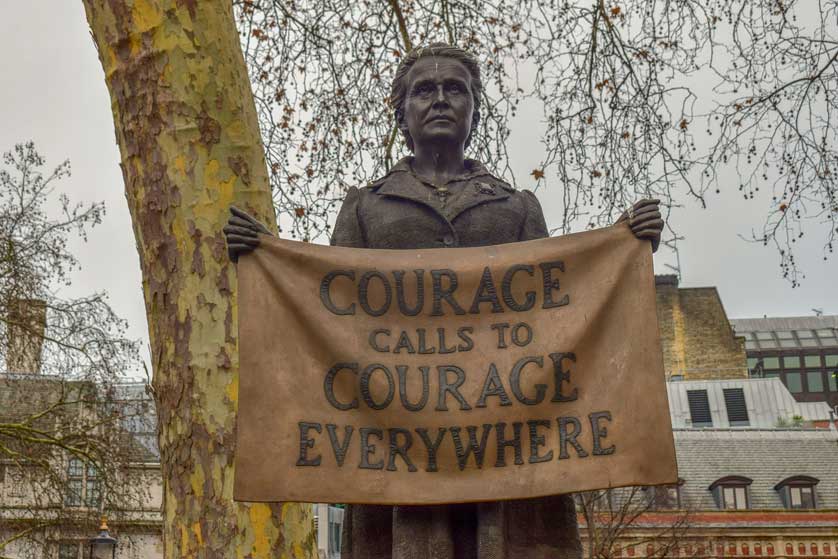
Millicent Fawcett
Feminist, politician and writer, Millicent Fawcett (1847-1929) headed the National Union of Women's Suffrage Societies. She also co-founded Newnham College, Cambridge in 1875, the second women's college founded at Cambridge after Girton College. She was the younger sister of Elizabeth Garrett Anderson. A statue of her stands in Parliament Square. A memorial to her in Westminster Abbey reads: "A wise constant and courageous Englishwoman. She won citizenship for women."
The bronze statue by Gillian Wearing was erected in Parliament Square following a campaign and petition by the activist Caroline Criado Perez. It was Parliament Square's first statue to a woman and also the square's first art work by a woman.
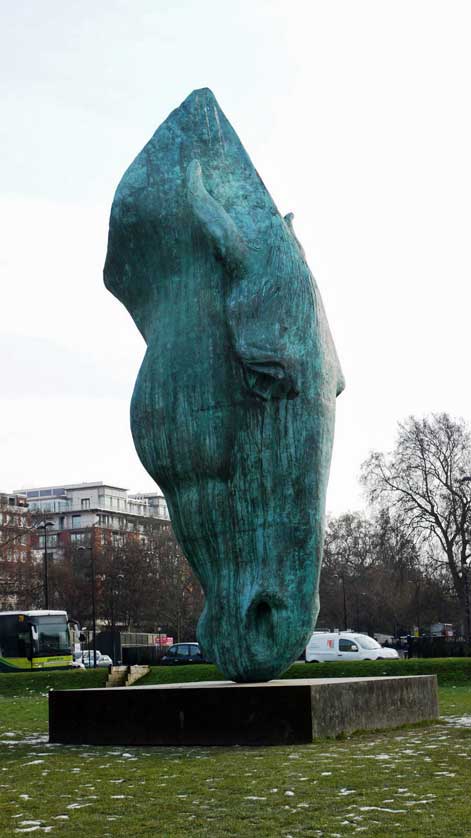
Horse Head Statue Marble Arch
The horse head sculpture (Still Water) in Marble Arch is by Nic Fiddian-Green.
The sculptor specializes in lifelike images of horses' heads inspired by a piece in the Elgin Marbles in the British Museum. His work can also be seen at Goodwood and Royal Ascot racecourses, Knowsley Hall near Liverpool and Glyndebourne near Lewes in East Sussex.

Women of World War II Monument
The Women of World War II Monument on Whitehall by sculptor John W. Willis was unveiled in 2005. The monument is located close to the Cenotaph and other war memorials and statues on Whitehall in central London. Money for the monument came from public fund-raising led by the politician Baroness Boothroyd along with Dame Vera Lynn and also HRH Princess Anne.
The bronze monument is 6.7 meters high, 4.9 meters long, and 1.8 meters wide. It depicts 17 sets of uniforms and clothing that women wore during their service for the country in World War II. The typeface of the lettering on the structure mirrors that of wartime ration books. Queen Elizabeth II unveiled the memorial in July 2005, just days after the 7/7 bombings in London. Dignitaries such as Margaret Thatcher and Dame Vera Lynn along with female veterans of World War II attended the official ceremony.

Wellington Statue, Glasgow
Erected in 1844 and standing in front of what is now the Glasgow Gallery of Modern Art (GoMA), the statue of Wellington astride a horse was sculpted by Carlo Marochetti. Sometimes in the 1980s an orange traffic cone started to appear on Wellington's head, and sometimes even the horse's head. There is a strong likelihood that the perpetrators of this evil deed were under the influence of alcohol.
The city council repeatedly removed the cones, and yet they kept reappearing. They made it a criminal offense with a hefty fine, installed security cameras, etc but all to no avail. Their final solution was to raise the plinth supporting the statue to such a height that it would be too difficult to climb, but the citizens of Glasgow responded with a petition and an online campaign that convinced the powers that be that they could not continue to fight against the will of the people to celebrate their sense of humour and irreverence.
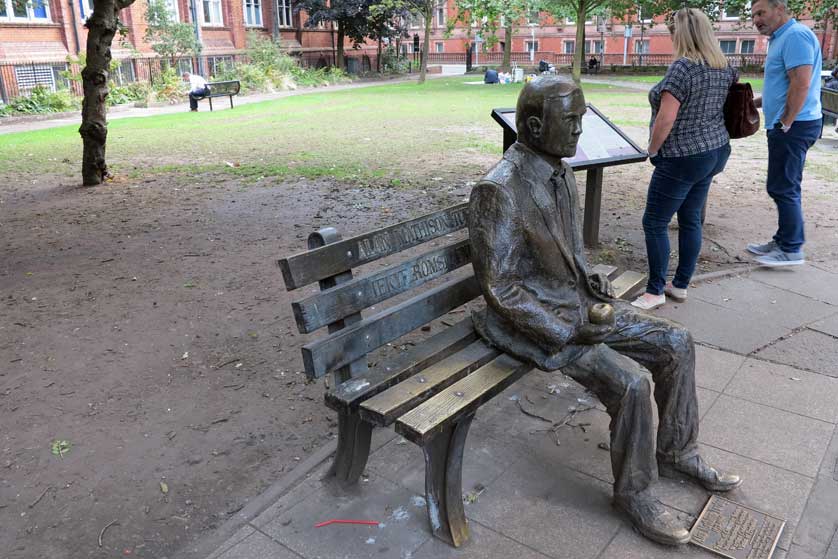
Alan Turing Statue
Alan Turing (1912-1954) was the mathematical genius who helped to crack the German Enigma codes in World War II. He is thought of as a progenitor of computer science and artificial intelligence. Turing is now honoured by a statue in Sackville Park in Manchester.
The statue of Alan Turing was unveiled in 2001 and its location in Sackville Park is close to Manchester University and symbolically the city's gay village. The idea and impetus for a memorial to Turing was Richard Humphry, a barrister from nearby Stockport. The work is by the industrial sculptor, Glyn Hughes.
The statue shows Turing seated holding an apple in his hand, the fruit of the Tree of Knowledge and also possibly the agent of his death. A plaque at his feet now reads: "Father of computer science, mathematician, logician, wartime code breaker, victim of prejudice."

Prince George Duke of Cambridge Statue
The Prince George Duke of Cambridge Statue on Whitehall by sculptor Adrian Jones and architect John Belcher was unveiled in 1907 by King Edward VII. The equestrian monument is located close to the Cenotaph and other statues and war memorials on Whitehall in central London. If ever a man did not really deserve a colossal bronze statue in his honor, it is probably Prince George, Duke of Cambridge (George William Frederick Charles; 1819-1904). The bronze equestrian monument is 7.6 meters high including the 45-ton granite plinth. The figure is holding a baton in one hand and the reins of his horse in the other. George is wearing the full uniform of a Field Marshal of the British army including his medals.

Statue of Eros, Piccadilly Circus
The Statue of Eros in Piccadilly Circus in the West End of London, is another icon of the capital city.
A popular meeting place, the statue stands atop the Shaftesbury Memorial Fountain. The fountain and statue commemorate the 7th Earl of Shaftesbury and his philanthropic work to replace child labor with education in his day.
First erected in 1893, the statue and fountain have been moved slightly a couple of times since then.
Piccadilly Circus tube station is right here where the circus connects Regent Street, Piccadilly, Shaftesbury Avenue (also named after the Earl), Haymarket, Coventry Street and Glasshouse Street.
The nude (controversial at the time) statue is by sculptor Alfred Gilbert and is actually of Anteros, Eros' brother, not Eros himself. It was the first statue cast in aluminium in the world and stands on top of the bronze fountain. Eros is the Greek god of sensual love, probably appropriate as it stands in London's theatre district close to Soho.

Boudicca Statue
The statue of Boadicea (aka Boudicca in modern spelling) and Her Daughters stands near Big Ben and the Houses of Parliament in Westminster. The statue, close to the Thames, is the work of sculptor Thomas Thornycroft and is loosely based on Queen Victoria, the ruling monarch at the time the sculpture was being made. However, the work was not erected until 1902 after the deaths of both Thornycroft and Victoria. Boudicca was the Queen of the Iceni tribe that rebelled against Roman rule in AD 60 destroying the Roman city of Colchester and attacking Londinium. The statue, on a granite plinth, shows Boudicca (a British folk hero) riding a scythe-wheeled chariot holding aloft a spear.
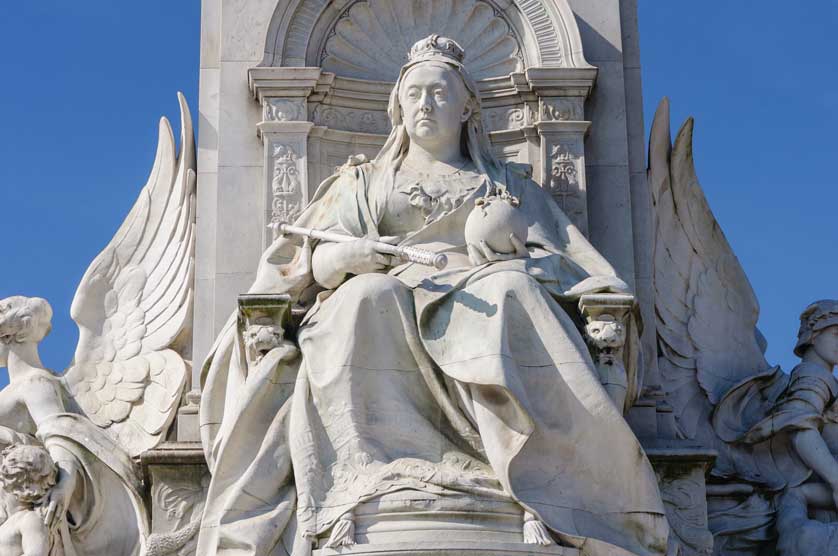
Queen Victoria Memorial
The Queen Victoria Memorial stands on The Mall outside Buckingham Palace. The work is by Thomas Brock and was unveiled in 1911 though not fully completed until 1924. The hugely expensive and grandiose structure was funded by subscriptions and donations throughout the British Empire of the day. A gilded bronze statue of Winged Victory stands on top of the memorial with marble statues of Queen Victoria (looking down The Mall), Motherhood (facing Buckingham Palace), Justice and Truth. At a height of 25 meters it is the tallest monument to a monarch in England.
Another Place, Crosby Beach, Merseyside
Crosby Beach on Merseyside, north of Liverpool, is probably most famous for its Another Place statues by sculptor Antony Gormley. Altogether 100 cast iron figures are placed facing towards the sea. The figures depict the artist's own naked body and stand 6 foot, 2 inches tall. The sculptures stand on the beach between Waterloo and Blundellsands. Gormley's most famous work in the UK is probably the huge Angel of the North in Gateshead. Completed in 1998, the Angel of the North is one of the largest sculptures in Britain at 20 meters in height, with its wings spreading 54 meters. Like the Another Place figures, the statue is based on a cast of the artist's body.

Desperate Dan High Street, Dundee, Scotland
Dundee in Scotland has a connection with comics as the publishers D. C. Thomson & Co are based in the city. The company published such former classic comics as The Dandy and The Beano. A statue of Desperate Dan and other characters from the comics, such as Minnie the Minx and Dawg the Dog can be seen in Dundee city center. The 2.5 meter tall, bronze statue is by Scottish artists Tony and Suzie Morrow. Dundee and other cities in Scotland also have statues of Oor Wullie, another D. C. Thomson creation that appears in the Sunday Post newspaper. In 2004, Oor Wullie was voted "Scotland's Favourite Son", ahead of even William Wallace and Sean Connery.

Wellington Statue, Royal Exchange, City of London
An equestrian statue of the Duke of Wellington stands outside the Royal Exchange in the City of London. The work of sculptor Francis Leggatt Chantrey, the statue was erected as thanks for Wellington's help in ensuring that a bill was passed to allow the reconstruction of London Bridge. The unveiling took place on 18 June 1844 with Wellington in attendance. The date is significant as it was on 18 June 1815 that Wellington achieved his greatest victory at the Battle of Waterloo. Part of the text on the plinth reads: "The government donated the metal, which is bronze from captured enemy cannon melted down after the Battle of Waterloo."


Sir Harold Wilson Statue, Huddersfield
A statue of locally-born former Prime Minister Harold Wilson stands in front of the Grade I Huddersfield Station in Huddersfield, Yorkshire. Unveiled by Tony Blair in 1999, the larger than life 2.5 meter bronze statue is by sculptor, Ian Walters. The work shows Wilson without his trademark pipe, at the request of his wife, Mary, who believed it would make the statue a caricature. Based on photographs taken in 1964, the statue is a major landmark in the square outside the station.

The Meeting Place
Within St Pancras Station in London near the Eurostar platforms is a 9 meter-tall bronze statue by Paul Day. It was unveiled in 2007 and has received some unkind words from other artists and art critics, though the work is popular with the public in general. The statue cost in the region of £1 million and is modeled on the artist and his wife, who is French. Day's other work in the capital include The Battle of Britain Monument (2005) and the Iraq and Afghanistan Memorial (2017) both on Victoria Embankment.

Gracie Fields
Outside the magnificent town hall in Rochdale in Greater Manchester is a statue of local heroine Gracie Fields (1898-1979) unveiled in 2016. She was once the world's highest-paid female entertainer in the 1930s. Born above a chip shop in Rochdale she went on to achieve global fame as a star of both music hall and cinema.

World Cup Heroes
The bronze World Cup Heroes Statue by sculptor Andy Edwards stands outside Tameside Stadium in Ashton-under-Lyne in Greater Manchester, northwest England. The work in bronze was unveiled in 2010. It depicts three locally-born football players who all won the World Cup. They are Sir Geoff Hurst MBE England 1966 (b Ashton 1941), Jimmy Armfield OBE England 1966 (b Denton 1935) and Simone Perrotta Italy 2006 (b Ashton 1977).
Victory Over Blindness
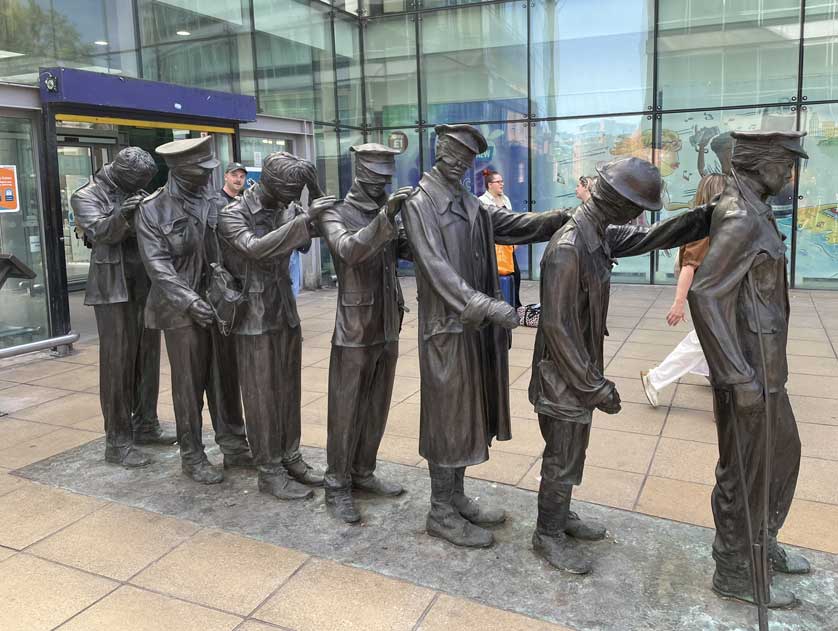
Victory Over Blindness is a bronze statue outside the main entrance to Piccadilly Station in Manchester. The evocative work by Johanna Domke-Guyot shows seven blind soldiers from World War I with their hands on the soldier in front guiding each other from the battlefield. They are led by one soldier on crutches who appears to have lost one eye. The sculpture was unveiled in 2018 by The Countess of Wessex and commemorates the centenary of the end of the First World War in 1918. The Blind Veterans UK commissioned the piece which is based on an actual photograph from the time (shown below). The charity, which was set up in 1915 to help and rehabilitate soldiers blinded in the conflict, believes it is the only memorial in Britain to show disabled war veterans. Two plaques, one in braille, accompany the statue.

Other UK Statues
The Bela Bartok statue in Onslow Square in London commemorates the Hungarian composer Bela Bartok (1881-1945). The bronze statue on a granite base is the work of Hungarian sculptor, Imre Varga. Bartok is shown in the statue wearing a trilby and overcoat. There are other statues of Bartok by the same sculptor in Brussels, Budapest and Paris.
The Billy Fury statue celebrates his life in his hometown of Liverpool. Funded primarily from fans, a bronze statue of Billy Fury was unveiled in 2003 and is now located on the waterfront in front of the Piermaster's House, behind the Tate Liverpool, and across from the Liverpool Museum. There are several other sculptures on display at the same place.
The Isis Statue (aka Serenity) in Hyde Park, London, near to the Princess Diana Memorial Fountain, was erected in 2009. The work by Simon Gudgeon, represents Isis, the Egyptian goddess of motherhood and more widely nature and magic, in the form of a bird.
Originally located in Platt Fields Park, the bronze statue of Abraham Lincoln by George Grey Barnard was moved to Lincoln Square, Brazenose Street, Manchester in 1986. The statue was presented to the city in 1919 to thank the citizens of Manchester for their support of Lincoln's fight against slavery.
The Physical Energy Statue in Kensington Gardens/Hyde Park in central London is in the artist's words a symbol of "that restless physical impulse to seek the still unachieved in the domain of material things." The statue may have reference to Cecil Rhodes the diamond magnate and imperialist active in southern Africa, as well as other empire builders such as Attila the Hun, Mohammed, and Genghis Khan.
The racehorse Red Rum is an icon of the town of Southport on the north west coast of England. A Red Rum statue stands proudly in the town. Born in Ireland, Red Rum won the Grand National at nearby Aintree a record three times and also came in second twice in a stellar career as a steeplechaser.
A statue of Robert Clive or "Clive of India" stands in King Charles Street off Whitehall near the Cabinet War Rooms in London. Clive (1725-1774) is credited with establishing British rule in India for the East India Company (EIC) through his campaigns against the French and Indian native rulers. Following the global anti-racism protests of 2020, Clive's statue will be considered in a review of London's public monuments ordered by the Mayor of London, Sadiq Khan. Another statue of Clive is in the Shropshire town of Shrewsbury, where he was once an MP and mayor.
Wellington's Column in Liverpool near Lime Street Station, the Empire Theatre, Walker Art Gallery, and St George's Hall dates from the 1860s and was completely finished in 1865. A Grade II listed building, it stands at just over 40 meters and is made from sandstone with a granite pedestal. The column is the work of the Scottish architect Andrew Lawson and the statue of Wellington by his brother George Anderson Lawson. The statue is made from melted-down bronze from mainly French cannons captured at the Battle of Waterloo as well as other old guns donated by the government.
Related
Statues at British Football Grounds

Hotels in the UK
Book Hotels in England - Booking.com
Find Accommodation in London - Booking.com
Search Hotels in Scotland - Booking.com
Hotels in Northern Ireland - Booking.com