Keble College Oxford
Keble College Oxford
Jake Davies

Keble College is one of the newest of the colleges at Oxford University, being founded in 1870. It is, however, one of the larger with about 800 students, undergraduate and postgraduate.
Keble was founded as a theological college with roots in the Oxford Movement, a campaign attempting to reintroduce Catholic elements into the Anglican Church, sometimes referred to as Tractarians.
A major member of the movement was John Keble and following his death in 1866 it was decided to found a college as a memorial to him.


Architecture
The design was by architect William Butterfield (1814-1900), also a member of the Oxford Movement. Whereas the college buildings of Oxford had been built primarily of stone, he went with brick and built in Victorian Gothic style.
Sometimes called Neo-Gothic, sometimes Gothic Revival, the style was popular among the Anglo-Catholic-High Church movements. It is one of the few secular building built by him.

Gothic Revival
The use of different coloured bricks enable a high degree of ornamentation without having to "add" anything extra to the building - one of the tenets of the Gothic revival.
The use of brick also made it less expensive, and led to the college being able to offer cheaper courses. For most of its history Keble College architecture was controversial and heavily criticized, and students at the nearby St. John's College started a Destroy Keble Society, membership of which entailed taking a brick from Keble College in the hope of completely dismantling it. Sir Kenneth Clark went so far as to call Keble College the "ugliest building in the world".
In recent decades the architecture of Keble has come to be more positively appreciated as a fine example of Victorian Gothic. The college is usually open to the public in the afternoons, and the chapel is obviously a highlight.
Somewhat grand and with an interior featuring plenty of colourful mosaics and stained glass, it is cathedral-like. The Light of the World, by William Holman Hunt was donated to the college by the painter and it is on view in the side chapel.
Also noteworthy is the dining hall at Keble, believed to be the longest in the whole university, and part of the college's mission to provide affordable education to the less aristocratic who could not afford to dine in their rooms as at the other colleges.
The student accommodations at Keble are considered some of the finest at Oxford University, and during the Easter and Summer vacations the college rents them out to the public as a B & B.

Access
Parks Rd, Oxford OX1 3PG
Tel: 01865 272727
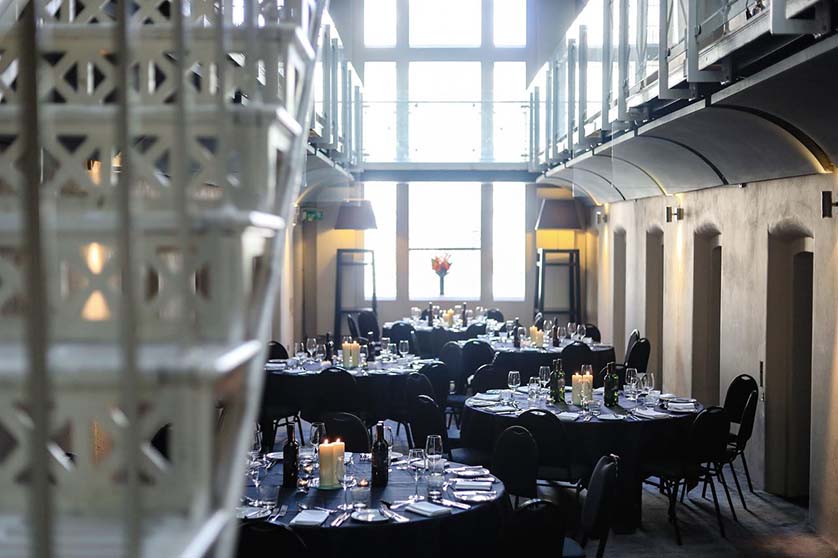
The luxury four-star, boutique hotel, Malmaison Oxford is a recommended place to stay in Oxford.
Other places of interest in the city include Carfax Tower, the Ashmolean Museum and the Pitt Rivers Museum & Oxford University Natural History Museum.



Access - Getting to Oxford
Oxford is served by London Oxford Airport, in nearby Kidlington, though it has very few flights to other destinations at present.
Oxford has 5 park and ride sites with bus links to the city centre: Pear Tree (bus 300), Redbridge (bus 300), Seacourt (bus 400), Thornhill (bus 400) and Water Eaton (bus 500).
There is frequent coach service between Oxford and London, including the X90, which is operated by the Oxford Bus Company. The Oxford Bus Company also runs services to Heathrow and Gatwick airports. The bus station at Gloucester Green is used mainly by the London and airport buses. National Express coaches and other long-distance buses including route X5 to Milton Keynes and Cambridge also use the station.
Oxford railway station is about 1 km west of the city centre. The station is served by many routes, including CrossCountry services to places as far away as Manchester and Edinburgh. First Great Western operates the station and offers services to London Paddington as well as other destinations such as Worcester.
The Oxford Ring Road surrounds the city centre and close suburbs. The main roads to and from Oxford are the A34 - which connects the North and Midlands to the port of Southampton, the A40, the A44 – which begins in Oxford and extends past Evesham to Worcester, Hereford and Aberystwyth, the A420 – which also begins in Oxford and leads to Bristol by way of Swindon and Chippenham. Oxford is also served by the M40 motorway, which connects London to Birmingham. The M40 comes no closer than 16 km away from the city centre, but it meets the A34 to the north of Oxford.
Blenheim Palace is located just off the A44 in Woodstock, Oxfordshire.
Accommodation
Oxford is close enough to London to make a day trip easy enough, especially if your hotel is close to Paddington Station. However, if you do stay in Oxford, the city has a range of accommodation to suit all budgets.
See a list of hotels in Oxford.
Oxford Related
Hotels in the UK
Book Hotels in England - Booking.com
Find Accommodation in London - Booking.com
Search Hotels in Scotland - Booking.com
Hotels in Northern Ireland - Booking.com