Cirencester Guide
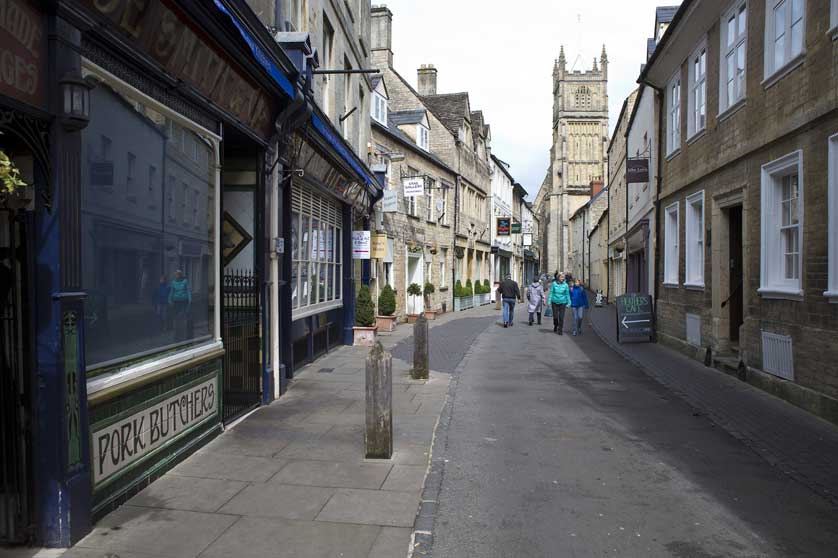
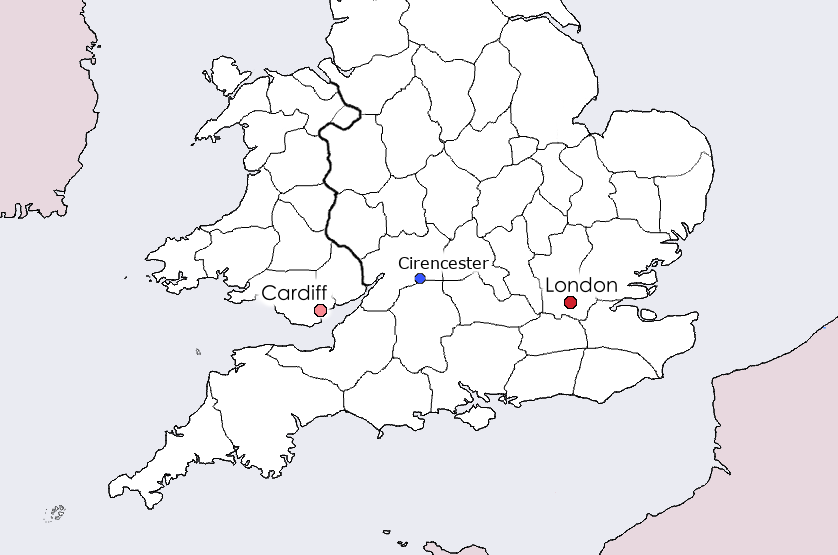
Cirencester (pronounced siren-sester) is the largest town in the Cotswolds.
This well-to-do market town has a population of around 20,000 people while the wider borough has around 116,000 inhabitants.
Cirencester History
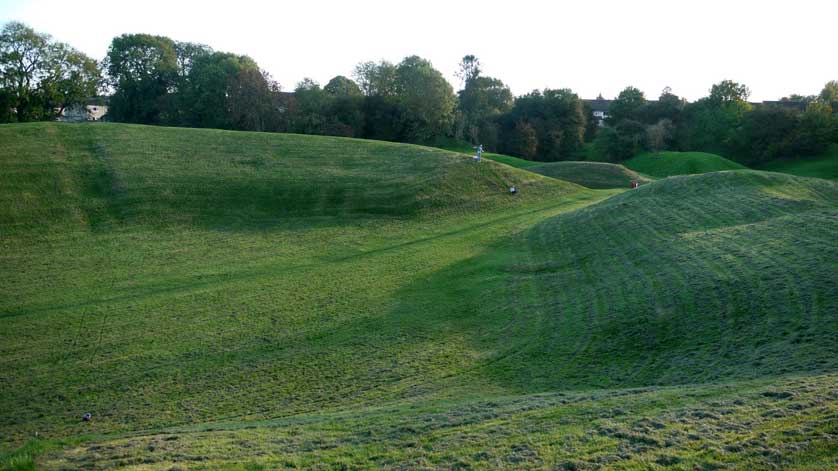
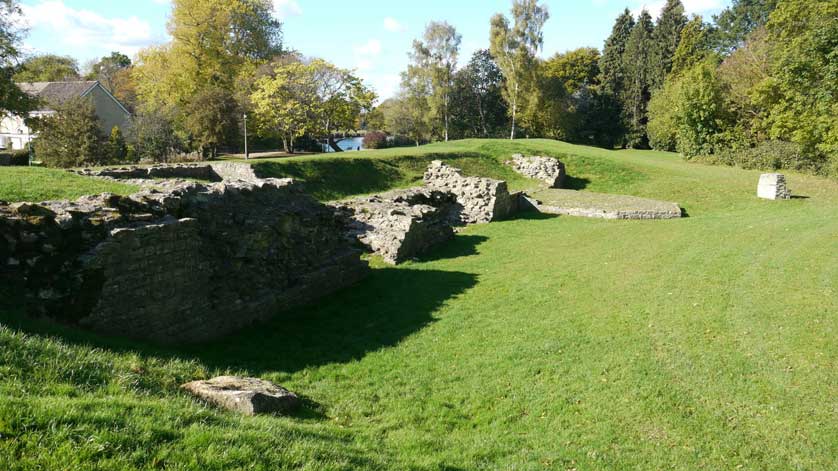
In Roman times Cirencester (Corinium Dobunnorum) was second in importance only to Londinium (present day London). The settlement was protected by stone walls added to its ramparts in the 3rd century AD. Parts of the Roman wall and the amphitheatre still exist.
During the Middle Ages, Cirencester, like the Cotswolds as a whole, grew wealthy from the wool trade with continental Europe. Grain production was also an important source of revenue and the town prospered as a market town in the 18th and early 19th centuries with good trade links along the Thames and Severn Canal to the River Thames.
Cirencester Attractions
The town's Roman history can be appreciated at several sites. These include the Roman Wall, in the grounds of the former Augustinian Abbey of St Mary, and the impressive Roman Amphitheatre.
The Roman Amphitheatre at Cirencester dates from the early second century AD. It was constructed on the site of an existing Roman quarry. The amphitheatre once offered seating for more than 8,000 people which was more than the number of inhabitants of nearby Corinium.
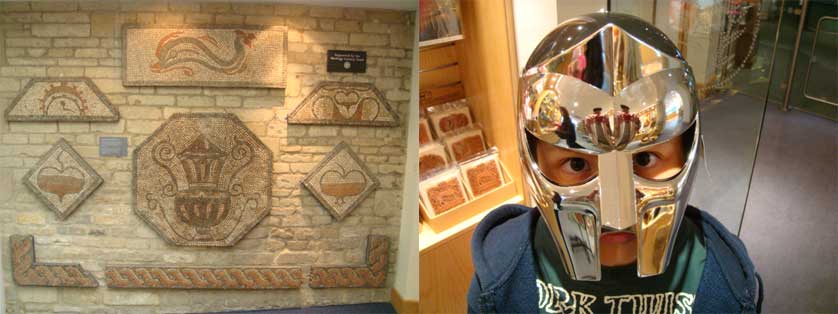
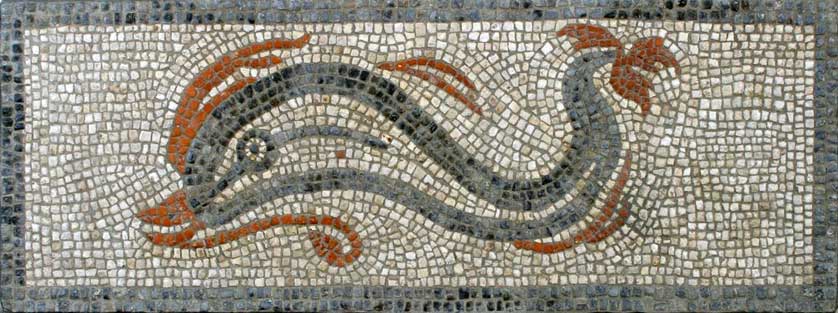
The imaginative Corinium Museum displays a large collection of Roman and Saxon remains and has a number of fine mosaic pavements. Highlights include Roman stone columns, jewellery and grave stones.
The Saxon gallery holds the reconstructed body of 6th century Anglo-Saxon princess and some of the many treasures buried with her.
Also on display are several inscribed tombstones including that of Bodicacia, a woman of 27, that was excavated in 2015.
The medieval gallery in the Corinium Museum reveals the economic impact that the local wool trade had on the town of Cirencester and its Abbey.
Totally refurbished in 2004 and again in 2014-2015, this impressive museum has hands-on exhibits, audio-visual, interactive displays, an interesting shop and can be of particular interest to children and school groups.
The Corinium Museum also has temporary exhibitions featuring arts and crafts, often by local artists.
The Bathurst Estate & Cirencester Park is a short walk from the centre of Cirencester. The land now occupied by the estate and park was purchased in 1695 by Sir Benjamin Bathurst. Benjamin's son, the first Earl, Allen Bathurst, with the assistance of the poet Alexander Pope, laid out much of the grounds in the early eighteenth century including the so-called Pope's Seat. Jonathan Swift, author of Gulliver's Travels, was another of the first Earl's literary circle.
Cirencester House, the present Earl of Bathurst's family home, contains portraits by such artists Thomas Gainsborough, John Hoppner and Joshua Reynolds and antiques collected by the family over the years. The house is not open to the public and is surrounded by a huge hedge.
Churches
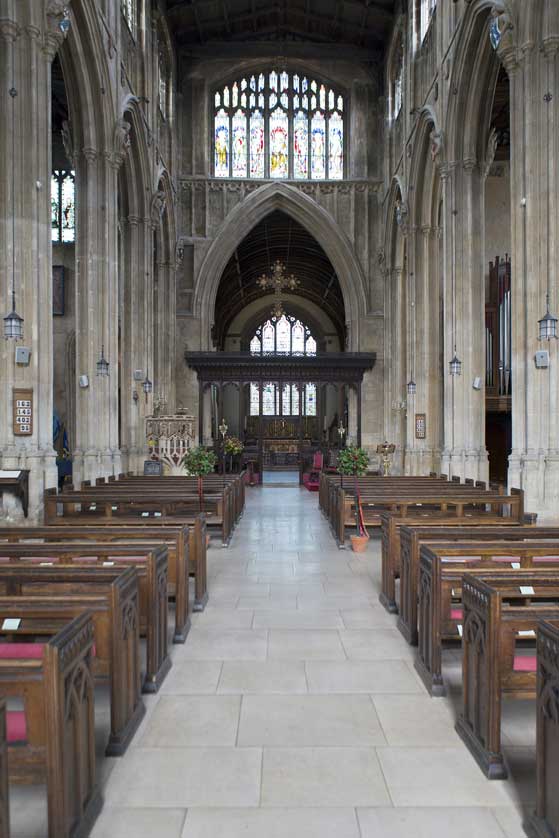
The 15th century Parish Church of St John the Baptist (the so-called "Cathedral of the Cotswolds") dominates the picturesque Market Place in the heart of Cirencester. The wine glass shaped pulpit is one of the few to have survived the Reformation.
The Anne Boleyn Cup, a silver goblet is on display inside the church. It was given by Queen Anne Boleyn (the second wife of King Henry VIII) to the physician Dr. Richard Masters, in gratitude for his care of Anne Boleyn's daughter, the future Elizabeth I.
The construction costs of the church were financed by affluent wool merchants of the day.
Shopping
Cirencester and its charming streets of golden stone are a haven for independent shops. Tiny Black Jack Street is a great place to start. The visitor will find the Stableyard there, home to appealing boutiques, and Cowley House with its assortment of accessories. Over by Castle Street, the New Brewery Arts Centre features contemporary crafts and visual arts. The town also hosts weekly Monday and Friday markets.
Pubs
Two good pubs in town include The Crown and The Golden Cross Inn. The Crown is a large, friendly pub with a mixed clientele of all ages.
The Golden Cross Inn has been completely revamped and now offers bed and breakfast accommodation in two en-suite rooms. Originally an 18th century coaching inn, the pub provides daily lunches and a fine selection of beers, wines and spirits.
Around Cirencester
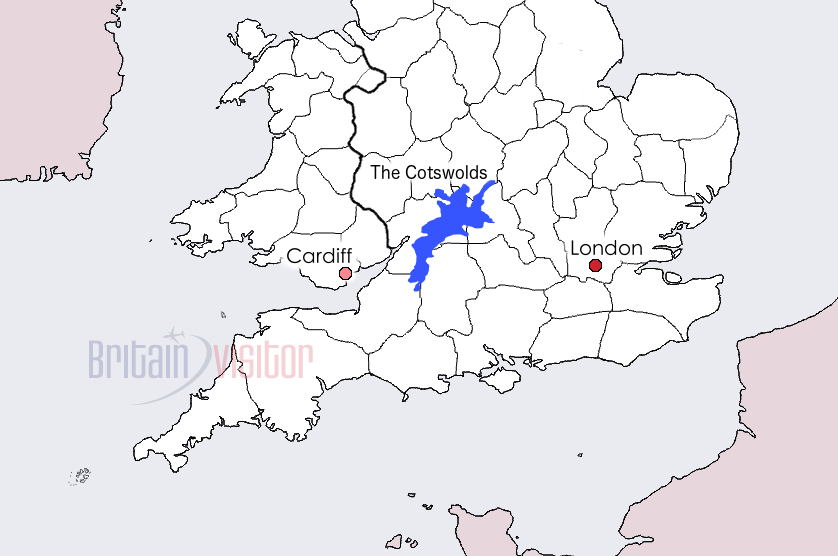
The Cotswolds is around 40 km across and 145 km long. The Cotswolds stretches from Stratford-upon-Avon to Bath.
Located eight miles north of Cheltenham, Sudeley Castle is a honey-colored stone edifice complete with banqueting hall. It was once owned by Katherine Parr, the last wife of Henry VIII.
Typical Cotswold towns include Burford, Chipping Norton, Moreton-in-Marsh and Stow-on-the-Wold. One Cotswold town, Chipping Campden, is well-known for being the home of the Arts and Crafts movement, founded by William Morris at the end of the 19th century.
Four miles from Chipping Campden lies Hidcote Manor. It features one of the most inventive gardens of the 20th century.
The Slaughters are another Cotswold treat. The visitor should take the easy, mile-long stroll between the twin villages of Upper and Lower Slaughter. The path runs beside the River Eye past scenic cottages and around an old flour mill, now converted into a tea and craft shop and a museum. By the way, the name "Slaughter" has nothing to do with meat production but rather derives from the Anglo Saxon word for mud.
Lacock has featured atmospherically in numerous films, from Harry Potter to Cranford and Pride and Prejudice. Visitors shouldn't miss Lacock Abbey, a medieval dwelling turned country house that also celebrates the work of its former resident, Henry Fox Talbot, who invented the photographic negative.
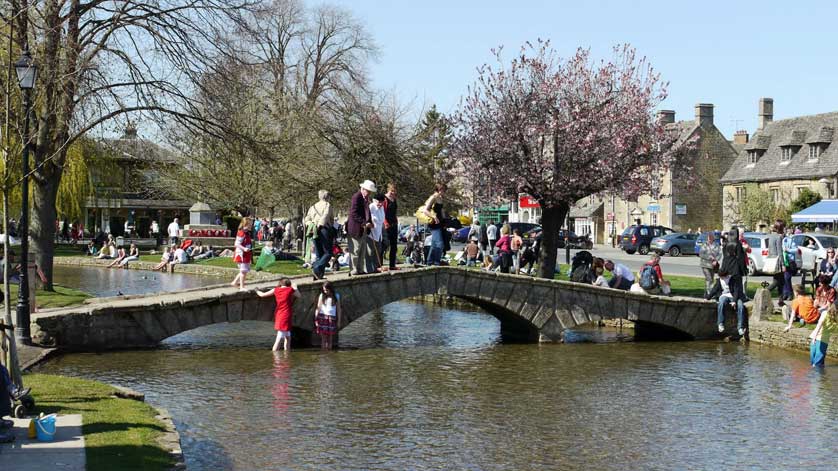
Bourton-on-the-Water is a very popular town in the Cotswolds and draws hordes of visitors to its beautifully crafted Model Village, the Bourton Model Railway, and the Dragonfly Maze.
Cheltenham abounds in elegant architecture with Regency terraces and swirling wrought-iron flourishes along Suffolk Square and Queen's Parade on Parabola Road.
Cheltenham also offers an absorbing art gallery and museum called The Wilson, named after Edward Wilson, who was born in the town and who died in 1912 on Scott's Antarctic expedition. The permanent collection includes a renowned exhibition on the Arts and Crafts movement.
The Cheltenham Festival in March is a highlight of the National Hunt horse racing calendar and brings visitors from all over the country.
Cirencester Hotels
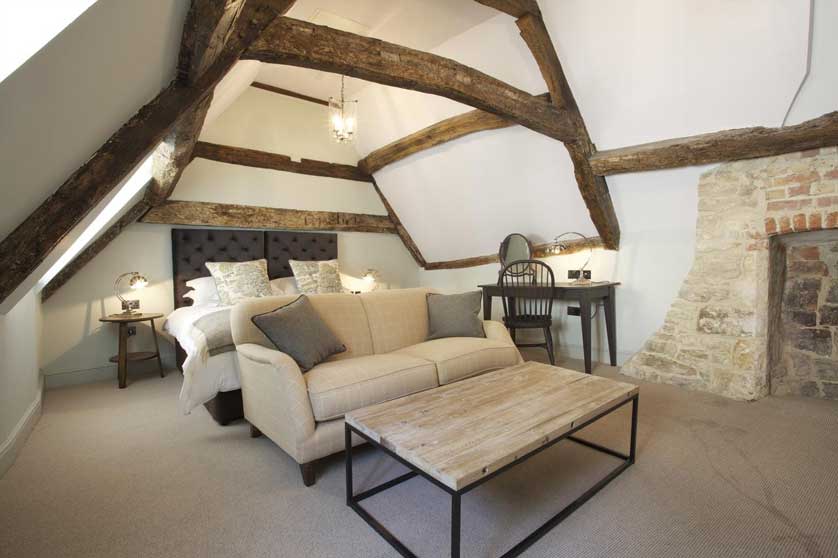
There are several good places to stay in the town. Choose from the four-star Kings Head Hotel on Market Place, the Corinium Hotel & Restaurant on Gloucester Street, three stars, or the Eliot Arms.
See here for a listing of places to stay in Cirencester.
Cotswolds Access - Getting To The Cotswolds
Cirencester is on the A417, A419 and A429. It is roughly equidistant from both Swindon to the southeast and Cheltenham to the northwest. No longer connected by rail, the nearest station is at Kemble, 30 minutes away on the 93 bus.
Bus 51 runs to Cheltenham (40 minutes), the 852 to Gloucester (75 minutes), the 54 and 54A to Stroud (40 minutes) and the 881 to Tetbury (30 minutes).
By Rail: All rail service from London to the Cotswolds departs from Paddington Station, which has its own London Underground station.
To travel to the Cotswolds from London by train takes about 1 ½ hours and trains run every hour, 7 days a week. Although rail services do not cover the whole of the Cotswolds, it is possible to travel to and from Bath, Cheltenham, Stratford, Chippenham, Gloucester, Kemble, Moreton-in-Marsh Station, Kingham and Oxford.
By Car: Driving from London to the Cotswolds takes about 2 hours and utilizes well sign-posted major roads. The M4 motorway provides easy access to Bath, Castle Combe and the South Cotswolds. The M40 motorway provides access to Oxford and Stratford and the North Cotswolds.
By Coach: National Express offers coach service to the Cotswolds. The main route to the Cotswolds from London starts at Victoria Coach Station and takes about 3 - 4 hours. Coaches run regularly from London to the Cotswolds, although there is no service on Sundays. The main coach stops in and around the Cotswolds are at Bath, Bourton-on-the-Water, Cheltenham, Chippenham, Gloucester, Moreton-in-Marsh, Northleach, Oxford, Stow-on-the-Wold, Stratford-upon-Avon, Stroud.
Cotswolds Maps
Hotels in the UK
Book Hotels in England - Booking.com
Find Accommodation in London - Booking.com
Search Hotels in Scotland - Booking.com
Hotels in Northern Ireland - Booking.com