Corsham Guide

Corsham in Wiltshire, on the southeastern edge of the Cotswolds close to Bath, is an historic and picturesque market town with much to see and do.
Pretty Corsham was the inspiration for The Pickwick Papers, the novel by Charles Dickens. Once separate, Pickwick now forms the northeast part of the town.
Corsham History
The settlement of Corsham was mentioned in the Domesday Book of the Norman period, when it was known as Cosseham.
Like nearby Lacock, Corsham was a prosperous wool town in the medieval period of English history known for its sheep and weaving. When that trade waned with the advent of cheap cotton imports from the United States in the 19th century, Corsham continued to prosper from the quarrying of Bath stone. This warm, honey-colored stone was used extensively to construct many of the grand buildings in Bath, Bradford-on-Avon and nearby Prior Park.
The London to Bristol Turnpike also passed through Corsham and had a beneficial effect on the local economy as often wealthy travelers, such as Dickens' character Samuel Pickwick would stay in the town and make merry overnight.
Since World War I, the Ministry of Defence has had a presence in the town and is now a major employer. Some of the facilities are underground in former Bath Stone quarries. Part of the UK's cyber security services are based here.
Nowadays, the town has a population of just over 14,000 inhabitants.

Corsham Attractions
The present house at Corsham Court was built in 1582 by Thomas Smythe. Prior to that, Corsham had been a royal manor since Saxon times, supposedly a seat of Ethelred the Unready (968-1016 AD).
Later, Corsham became part of the queen's dower going to two of Henry VIII's wives, Catherine of Aragon and Katherine Parr. The house and park are now privately owned. Visitors can still enjoy the house's significant art collection, however.
Between 1761 and 1764, Lancelot 'Capability' Brown was commissioned to redesign the house and landscape the park (see below). The commission was for Brown second in importance only to that he received for Blenheim Palace.
The Almshouses in Corsham were built by Dame Margaret Hungerford, wife of Sir Edward Hungerford, Commander of Cromwell’s Forces in Wiltshire, in 1668.
At the time, the Hungerfords were living at nearby Corsham Court. The Almshouses also include a schoolroom, the Warden’s House and stables. The schoolroom has its original 17th Century furnishings. The Almshouses are amongst the finest in England and are a grade I listed building.
Famous previous residents of Corsham include Camilla Parker Bowles and her first husband, Andrew Parker Bowles. The couple lived at Middlewick House from 1986 to 1995. It was rather mischievously said of Andrew Parker Bowles that "he laid down his wife for his country" as Camilla became first the mistress and then the wife of Prince Charles, the future king. The house was purchased by Nick Mason, the drummer of Pink Floyd.

Churches
Saint Bartholomew's Church in Corsham dates from 1132 but parts of it are from earlier Saxon times. It is now a grade I listed building. Many interesting graves surround the church including that of Sarah Jarvis who died in 1753 at the age of 107 having grown a third set of teeth!
Inside the church are various chapels. The Lady Chapel contains the tomb of Thomas Tropenell of Great Chalfield fame and his son, Christopher. Tropenell had made his money as a cloth merchant and became an avid purchaser of lands and estates as well as a local MP in the 15th century. Tropenell's tomb is somewhat grander than that of his son and was once brightly painted.
The Methuen Chapel is Victorian and has memorials to members of the Methuen family including Lady Methuen. The chancel has superb stained glass by the Victorian artist Charles Eamer Kempe (1837-1907) and serves as a memorial to an earlier Lady Methuen. The font dates from the 15th century and is decorated with Tudor roses.
Shopping
The main shopping centre in Corsham is the Martingate Centre with over 20 stores plus a cafe and restaurant.
Pubs
The Royal Oak in Corsham has been a pub since at least 1899. The name "Royal Oak" refers to the oak tree within which King Charles II hid to escape the Roundheads following the Battle of Worcester in 1651. Today the establishment is both pub serving traditional British food and a bed and breakfast.
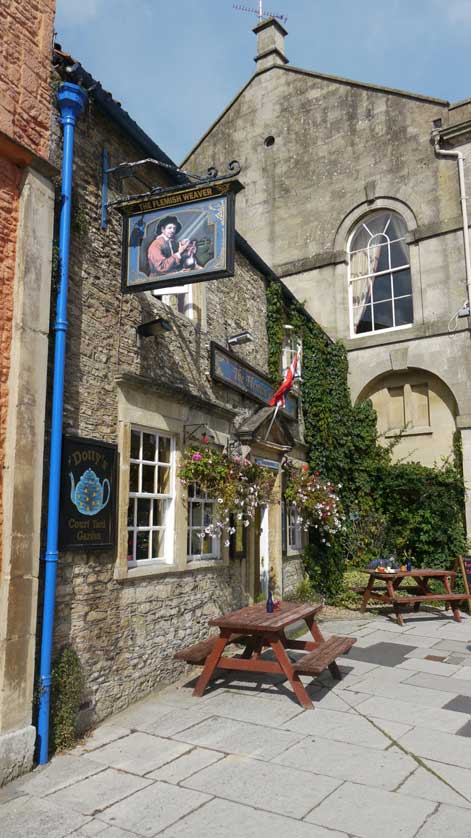
The Flemish Weaver features real ales and a menu that changes daily. In good weather, the rear garden is a popular place to relax and unwind. The pub is located next to the town hall on Corsham High Street.

Around Corsham
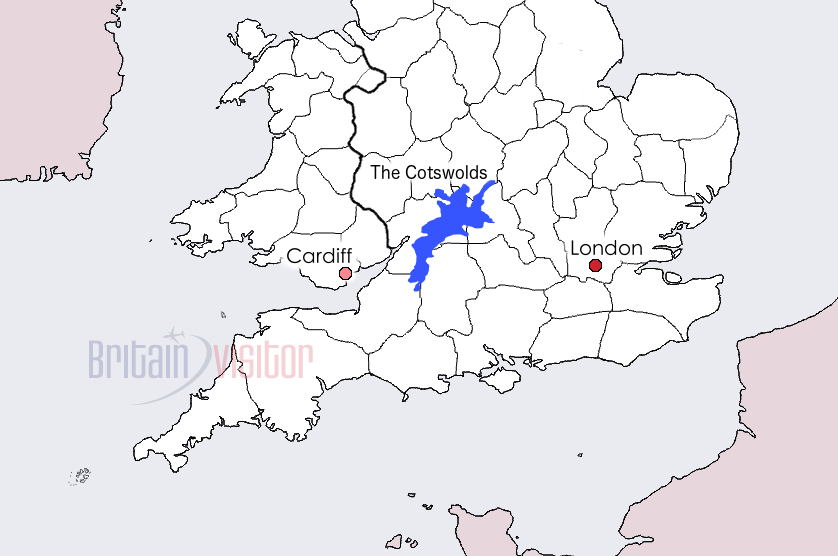
The Cotswolds is around 40 km across and 145 km long. The Cotswolds stretches from Stratford-upon-Avon to Bath. Within this large area there are many, many things to enjoy whatever the weather.
The market cross in nearby Castle Combe was erected in the 14th century when the privilege to hold a weekly market in Castle Combe was granted. The roofed structure is located where the town’s three principal streets converge.
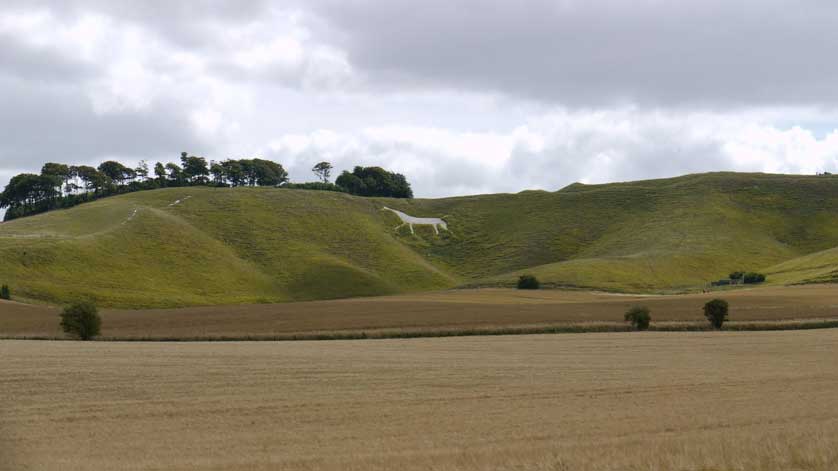
Cherhill White Horse, not far from the Avebury Stone Circle, was cut into the hillside in 1780 under the direction of one Dr. Christopher Allsup. The chalk horse is 40 meters long and 43 meters high.
The Atwell-Wilson Motor Museum displays over 100 exhibits mostly vehicles (cars, trucks, motorbikes etc) from the 1920s onwards. Also on show are manuals and other motor memorabilia.
Typical Cotswold towns are Chipping Norton, Moreton-in-Marsh and Stow-on-the-Wold. One Cotswold town, Chipping Campden, is well-known for being the home of the Arts and Crafts movement, founded by William Morris at the end of the 19th century.
Four miles from Chipping Campden lies Hidcote Manor. It features one of the most inventive gardens of the 20th century.
The Slaughters are another Cotswold treat. The visitor should take the easy, mile-long stroll between the twin villages of Upper and Lower Slaughter. The path runs beside the River Eye past scenic cottages and around an old flour mill, now converted into a tea and craft shop and a museum. By the way, the name "Slaughter" has nothing to do with meat production but rather derives from the Anglo Saxon word for mud.
Lacock has featured atmospherically in numerous films, from Harry Potter to Cranford and Pride and Prejudice. It is one of the most picturesque villages in the Cotswolds if not the most picturesque. Things to see include Lacock Abbey and St Cyriac's Parish Church. The George Inn and the Red Lion are historic inns in the village.

Bourton-on-the-Water is a very popular town in the Cotswolds and draws hordes of visitors to its beautifully crafted Model Village, the Bourton Model Railway, and the Dragonfly Maze.
Cheltenham abounds in elegant architecture with Regency terraces and swirling wrought-iron flourishes along Suffolk Square and Queen's Parade on Parabola Road.
Cheltenham also offers an absorbing art gallery and museum called The Wilson, named after Edward Wilson, who was born in the town and who died in 1912 on Scott's Antarctic expedition. The permanent collection includes a renowned exhibition on the Arts and Crafts movement.
The Cheltenham Festival in March is a highlight of the National Hunt horse racing calendar and brings visitors from all over the country.

Corsham Hotels
Places to stay in and around Corsham include Guyers House and The Methuen Arms, a former Georgian coaching inn.
Celebrity chef Marco Pierre White runs the The Rudloe Arms, housed in a Victorian building. Highlights are the food, of course, plus an eclectic and quirky collection of the chef's antiques, furniture and art.
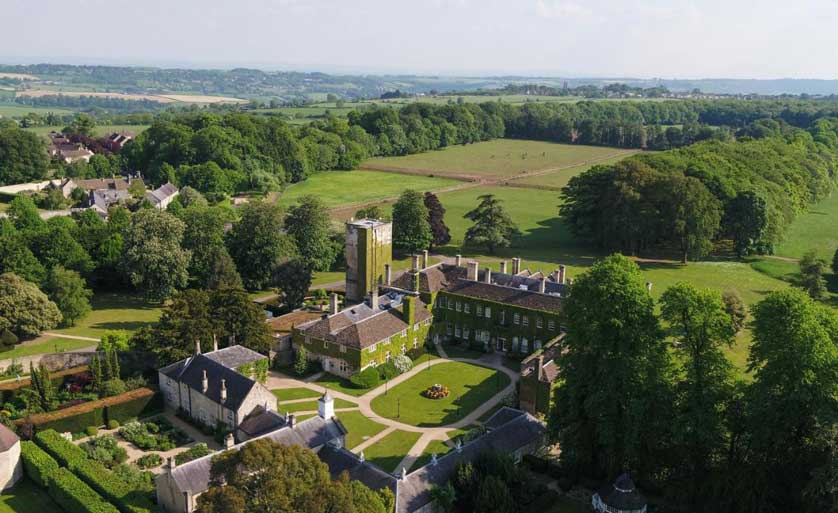
The Lucknam Park Hotel offers luxury accommodation with Michelin Star dining set within a private 500-acre estate with a walled garden.
See here for a complete listing of places to stay in Corsham.
Cotswolds Access - Getting To The Cotswolds
Corsham is located off the A350 on the Bath Road 5 miles (8.5 km) south of Chippenham in Wiltshire. Exit the M4 south at junction 17. From Bristol the A420 is one route.
Chippenham, Melksham and Bath have the nearest railway stations, though the station in Corsham may reopen at some time in the future. A revue is underway.
The village is 27 miles (43 km) south of Cirencester on the A429 and about 18 miles (28.5 km) west of Avebury on the A4.
Bath is just 15 km to the southwest on the A4 (Bath Road) and Swindon 39 km away on the A350 and M4. Lacock is only 5 km away on the Corsham and Lacock roads.
Frome in Somerset is 28 km south on the B3109.
By Rail: All rail service from London to the Cotswolds departs from Paddington Station, which has its own London Underground station.
To travel to the Cotswolds from London by train takes about 1 ½ hours and trains run every hour, 7 days a week. Although rail services do not cover the whole of the Cotswolds, it is possible to travel to and from Bath, Cheltenham, Stratford, Chippenham, Gloucester, Kemble, Moreton-in-Marsh Station, Kingham and Oxford.
By Car: Driving from London to the Cotswolds takes about 2 hours and utilizes well sign-posted major roads. The M4 motorway provides easy access to Bath, Castle Combe and the South Cotswolds. The M40 motorway provides access to Oxford and Stratford and the North Cotswolds.
By Coach: National Express offers coach service to the Cotswolds. The main route to the Cotswolds from London starts at Victoria Coach Station and takes about 3 - 4 hours. Coaches run regularly from London to the Cotswolds, although there is no service on Sundays. The main coach stops in and around the Cotswolds are at Bath, Bourton-on-the-Water, Cheltenham, Chippenham, Gloucester, Moreton-in-Marsh, Northleach, Oxford, Stow-on-the-Wold, Stratford-upon-Avon, Stroud.
Cotswolds Maps
Hotels in the UK
Book Hotels in England - Booking.com
Find Accommodation in London - Booking.com
Search Hotels in Scotland - Booking.com
Hotels in Northern Ireland - Booking.com